Getting a flu with heavy cough just as I was preparing to travel from Italy to Spain, I bought a pot of delicious “linden honey from the tuscan hills” to sooth my throat, but it was confiscated at the Amerigo Vespucci airport on Uncle Sam’s orders.
Apparently, even solid-type honey counts as a “liquid” and cannot be transported. I offered to taste it in front of the agents to prove that it was not any kind of explosive device, but it was useless. Rules are rules, even when they are completely nonsensical.
The “no liquids” rule on flights was created in 2006, following the discovery by British authorities of a supposed “Al Qaeda” plot to blow up planes using hydrogen peroxide (which reminds me, I also had pharmaceutical hydrogen peroxide in my bag, which was also confiscated, perhaps with more reason) and other flammable liquids hidden in soft drink bottles.
Of course, now we know that “Al Qaeda” was mostly an invented boogeyman, Bin Laden was a CIA agent who was not responsible for 9/11 and who was not killed and “buried at the sea” by U.S. Navy Seals, and that a lot of of those “terrorist plots” were actually created or at least promoted by the same authorities that were supposed to combat them. Besides, in any case today there’s already a technology that allows for scanning and identifying all kinds of liquids, but no matter. The nonsensical rule continues to be enforced in most airports. (I wonder if it’s just something pushed to make passengers only buy stuff at the more expensive Duty Free shops).
At least they mercifully stopped with the masks and vaccine passes. The “war on terror”, just as the “war on viruses”, which are really both ways of “war on normal life”, must go on.
In the meantime, Uncle Sam spent last year one million dollars in a study trying to turn monkeys transgender. Apparently, it’s not enough for the U.S. to turn every child in the world into a transsexual, they have to do it to the long-suffering Rhesus monkeys too. Of course, that’s just pocket change compared to the billions sent to the Ukraine or to Israel to help them bomb Palestinian children and shoot Christians.
If America contained its madness into itself it would be already bad enough, but they want to export it worldwide, and spare no effort or newly printed money in the process. Critical Race Theory, George Floyd Riots, school shootings, transgender-mania, mass migration, radical feminism, “woke casting”, every bad idea seems to start in America and then is pushed to everyone everywhere, from Egypt to Uganda. No one is safe.
Sure, we cannot just blame America. The whole West, lulled by its relative prosperity, is willing participant in the madness. People in the West are so apathetic they even forget to reproduce themselves, and many countries are having negative population growth (no matter, they can be replaced by hordes of Asians and Africans, we’re just numbers). In Canada, however, population replacement by migration is now considered too slow a genocide, so they are pushing euthanasia too, for anyone over the age of 18 suffering from depression, anorexia or drug addiction.
What cannot go on forever, probably won’t. At some point the madness will end, but who knows how many people will have been killed, hurt or psychologically damaged before it happens.
But hey, it’s Christmas. It’s a time for hope and joy, so let’s celebrate what we can. (I’m a bit grumpy because of my flu, but I love Christmas).
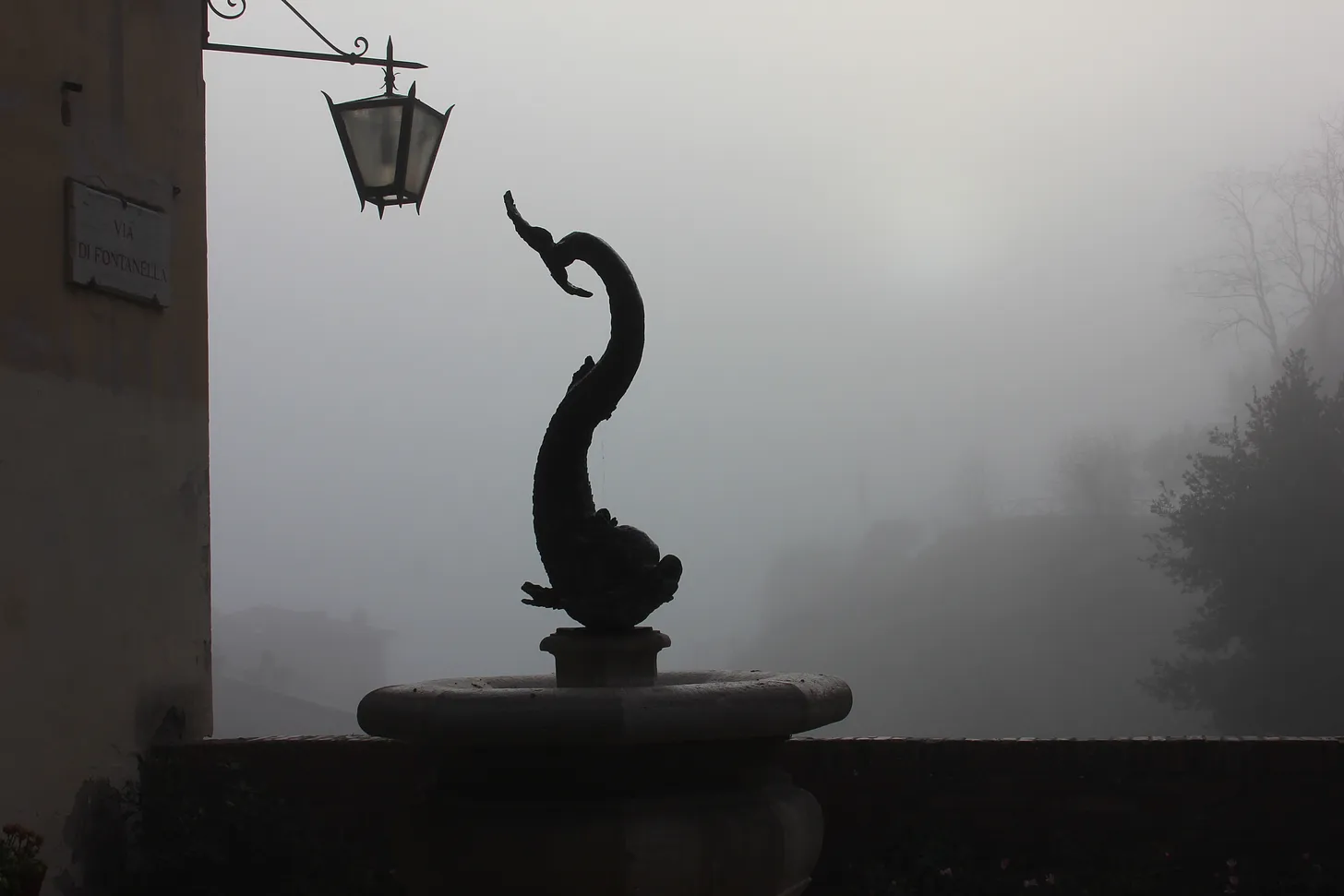
As I left Siena early in the morning, it was so foggy you could barely see ten steps ahead, which reminded me of the beautiful animated short movie by Yuri Norstein, “Hedgehog in the Fog“. It is a deceptively simple story about a hedgehog who, on the way to visit his bear friend, gets lost in the thick fog of the forest. As he tries to find his way through the unknown, like all of us, he wavers between fear, surprise and occasional wonder. (Spoiler: in the end, he finds his way. We will find it too.)
Merry Christmas to all.
Foggy Siena
Il Campo in Siena.
Young Italian student reading “1984” on the train.
Saint Gemma Galgani was born in 1878 into a poor family in a small village near Lucca, but they soon moved to Lucca as her father, a pharmacist, found work there. She was the fifth of eight siblings, only two females, the rest males. As it happened to other poor people at the time, death was an early companion. Two of her siblings died still in their early childhood. Then her mother died when Gemma was only 7 years old. Her father died when she was 19, and she herself was frail and plagued by many different health problems all her life, and died at just 25 of tuberculosis.
And yet, looking at her photographs, you see a face that seems calm and serene.
Most famous saints were born and died before the invention of photography, but we have wonderful paintings of them by famous artists. With Gemma, it’s the opposite. When Saint Gemma was canonized, in 1940, modern art was already in full swing, so there are no great paintings of her, but there are two or three beautiful photographs — and only because she was ordered to by her confessor, as she didn’t like to be photographed.
I visited the Sanctuary of Saint Gemma in Lucca — which is also, by the way, the hometown of opera composer Giacomo Puccini, but I only found that out because there was a giant statue of him right in front of the place I was staying — and also Casa Giannini, which is the house of the Giannini family that basically adopted her after she became an orphan. A nun gave me a guided tour as she enthusiastically talked about Gemma’s life.
There is another house where Gemma lived, which belonged to her father, the so-called “casa delle stigmata”, which is where she supposedly received the stigmata signs of Christ. I wanted to visit it too, but that required an appointment and unfortunately I didn’t have much time. Not having a car, my mobility was reduced, and I had to get to San Gimignano that same afternoon. It took me almost five hours to reach it by a combination of delayed buses and trains.
Two other things impressed me in Lucca: that a lot of people moved around in bicycles, including some very elegantly dressed women checking their iPhone at the same time (this is not as common in Italy as it is in, say, the Netherlands), and the young students in the street selling, or trying to sell, the “Lotta Communista” newspaper. (I thought Italy’s love affair with the Communist Party was a thing of the past, but apparently not.)
Fina
San Gimignano is a wonderful little medieval town with nothing much going on except well, amazing churches and afrescos and towers, but during summer it is usually full of annoying British, American and German tourists. Thousands of them. (The American ones are particularly obnoxious. I remember once an American middle-aged woman saying about a similar medieval town: “it is beautiful, but everything looks the same”. “Let’s get a gelato”, his husband replied).
Italy would be a wonderful place to visit if it wasn’t for the tourists.
Now, I know, it’s not nice to complain about tourists when I am a stupid tourist myself. But the nice thing about visiting Tuscany in winter is that almost everything is empty and quiet. No lines, no crowds. The town, usually filled to maximum capacity in summer, right now has mostly deserted streets. I bumped with a few locals and a couple of Japanese tourists — there are always Japanese tourists, but they are quiet and polite and don’t bother me — but that was it.
In San Gimignano, the most famous local saint is Santa Fina. Her life, if anything, was even more tragic than that of poor Gemma. Born in 1238 into a noble family that had, however, fallen into rough times, at just ten years of age she developed an illness that left her basically paralyzed. Refusing a bed with a mattress, which she thought too comfortable for a poor sinner like herself, she slept in a wooden pallet. During her five years of illness, her father died from some disease or other, then her mother fell down the stairs and died too. Fina got worse and worse and died at just 15 years of age, but with the same serenity as Gemma. There are no photographs of her, of course, and not even paintings made when she was still alive, but several paintings and afrescos in the local church and museum tell her story. Fina’s house also still exists, but unfortunately it is now a private residency and it not possible to visit it.
For some reason, Saint Fina was never officially canonized, but don’t tell that to the people in San Gimignano. They hold not just one, but two processions in homage to her every year, one in March, and one in August. Unfortunately, none in December.
Catarina
Siena is another wonderful medieval town, certainly bigger than San Gimignano and even Lucca, although not as big as Florence. Dante visited it a few times and mentions it in his Comedy. Catarina di Siena — Saint Catherine — was born there just a few years after Dante’s death.
She didn’t live to old age either, but at least managed to reached a slightly more respectable age of 33 years old — the same as Christ — when she died. While like Gemma and Fina she also lived a personally humble and austere life, contrary to them she was not from a poor family and eventually she also became heavily involved in theology and politics. In fact, she’s famous for having managed to help solve a schism and convince the then Pope to return to Rome from Avignon — were it not for her, perhaps the Papal seat would today be located in France.
There are many paintings of her, at least one of them contemporary, and her real head can be seen in the Basilica of San Domenico in Siena. It is an impressive sight. Her head is supposedly “uncorrupted”, that is, the skull was never mummified by artificial means, but somehow remained with skin around it — for over 600 years.
When I visited it, Siena was also relatively quiet in the morning and early afternoon, but then, at around 4 PM in that lazy Sunday, the streets suddenly became filled with people. Where did all those pedestrians just come from? It seemed as if everyone and their mother had decided to come out of their home at exactly the same time. Perhaps it’s just because “lunch time” in Italy is from 1PM – 4PM and most shops are closed during that period, but it was odd.
I don’t know about my two or three remaining readers, but I am fascinated by the lives of martyrs and saints. They usually have lead such rough, difficult, even tragic lives, full of suffering and pain, and yet they withstand everything with the utmost serenity. “Well, that’s why they are saints”, you’ll say, while we’re just stupid sinners, but having just a diminutive crumb of that serenity and internal peace would certainly help in this day and age.
And by coincidence — but, some say, there are no coincidences — as I had finished writing this text at around 9 PM, I went out to see “what was going on” at night in San Gimignano in winter. As you can imagine, not much. The streets were deserted and all shops were closed. But there seemed to be light inside the main Church. The door was opened and I entered. Inside, there were a few people, mostly older men and women between the ages of 60 and 80, which I suppose is the average age of the local inhabitants. (This is not a joke, as the recent local obituaries posted in the street showed ages between 97 and 102.) Most young people who work in the local bars or shops don’t really live in San Gimignano, but in other nearby towns.
Turns out they were all waiting for the “Novena di Natale”, or Christmas Novena. And, in his homily, the priest spoke about “sanctity”. But he emphasized that he was talking, not about the sanctity that we associate with the most famous Saints, but the everyday “sanctity” that even we can achieve, in little ways, or, at least, in some ways. The Novena ended with the beautiful Christmas song “Tu Scendi delle Stelle” (you can hear it here in a version in a more polished version by Andrea Bocelli).
Merry Christmas to all.
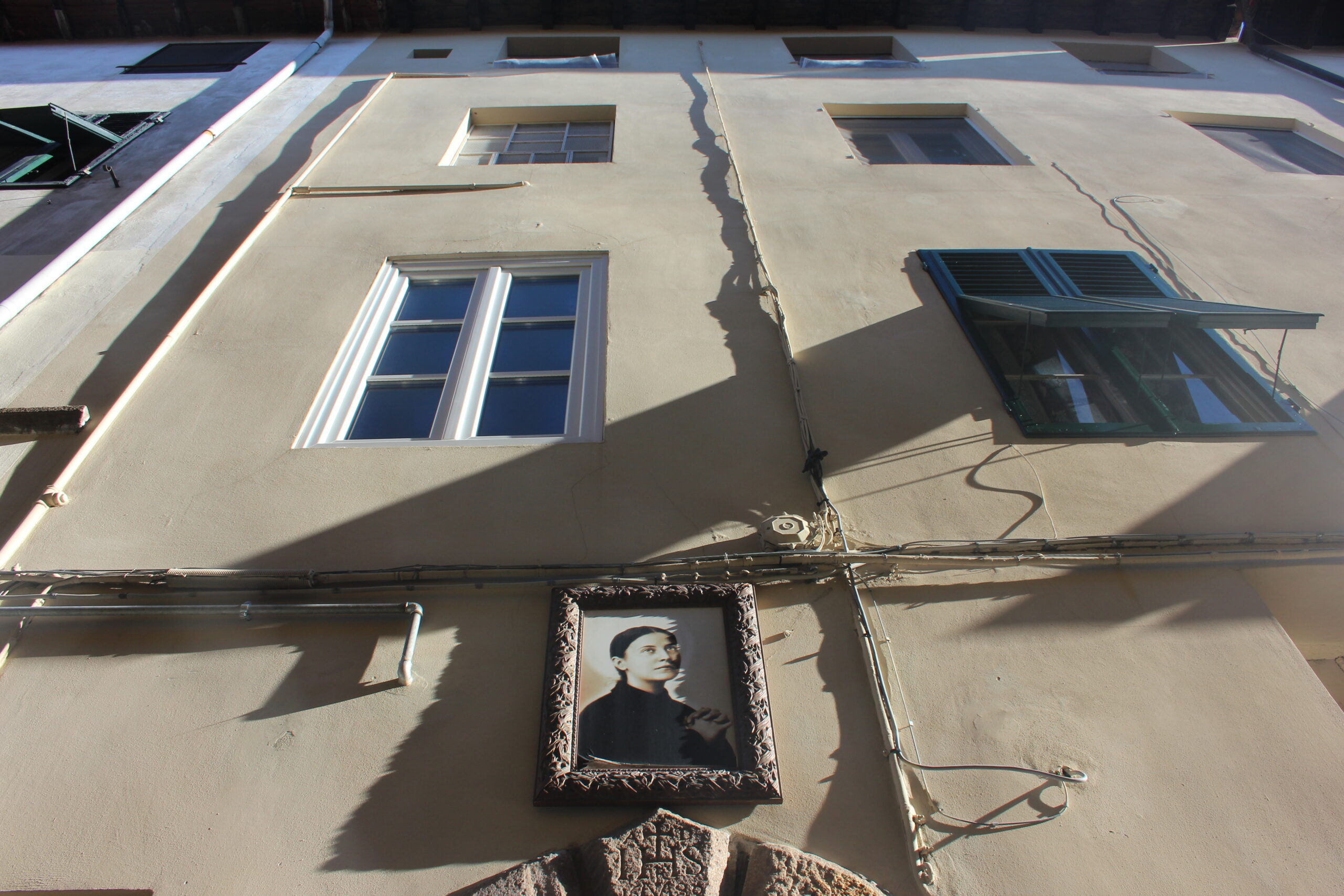
Saint Gemma’s house (“Casa delle stigmata”) in Lucca.
Santa Fina in her wooden bed fighting demons.
The amazing Chiesa della Santissima Anunziata in Siena.
My only dinner companion in San Gimignano.
San Gimignano at night in December. Merry Christmas.
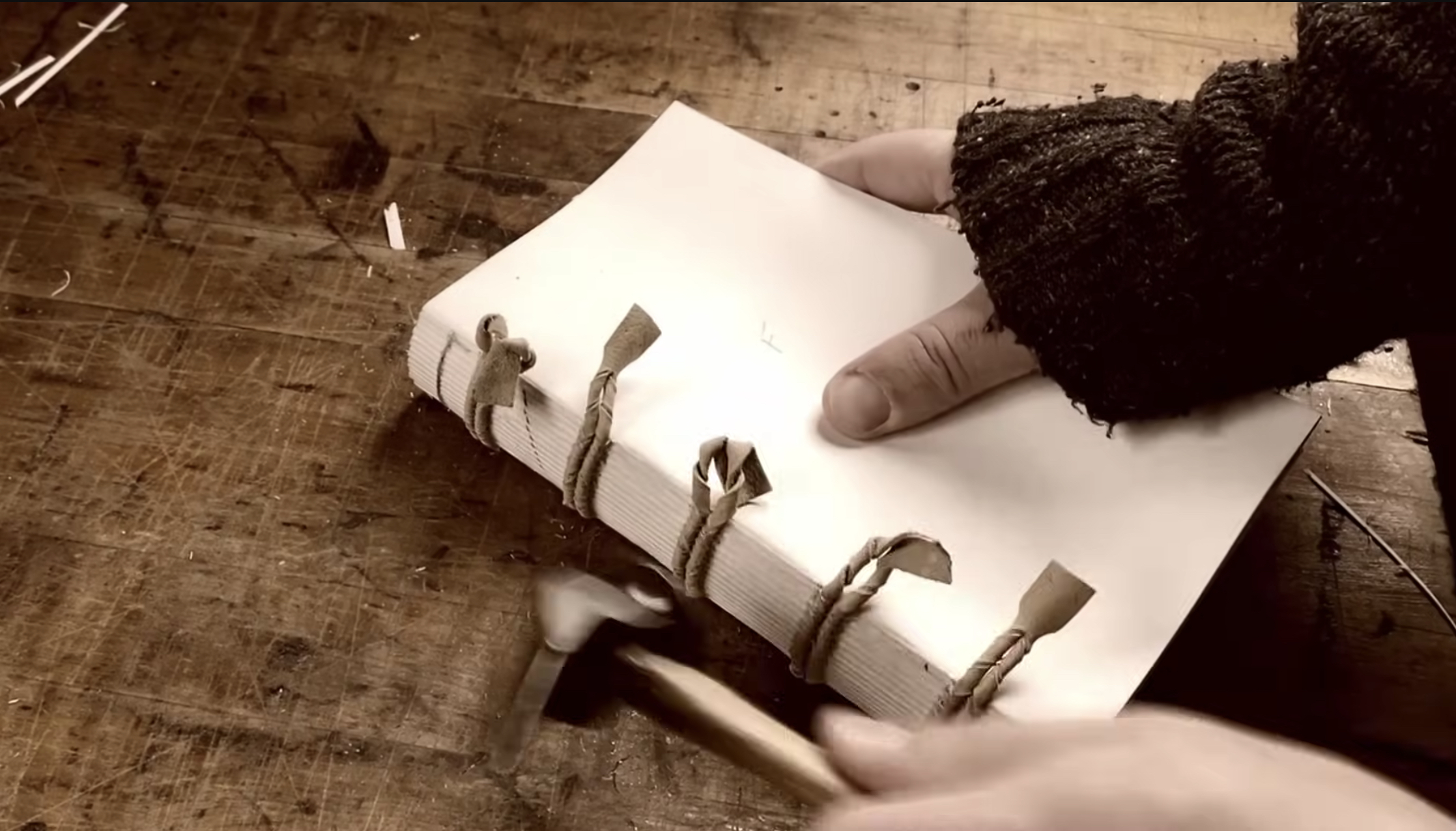
If you’re into complicated hobbies, perhaps this video about “how to make a medieval book” will interest you. I thought it was nice; perhaps it might also interest the three or four readers of this website. The video has no voice-over narration, just a written commentary in the subtitles, and no music either, just the sound of the tools, which is strangely relaxing and a nice change from the usual YouTube videos. It also avoid the typical jump cuts and simply slowly fades from one shot to the next, which is adequate to the level of patience needed for this type of thing.
In one of the stories by Frank O’Connor, “The Ugly Duckling” — the title is of course a reference to Hans Christian Andersen’s famous fairy tale, but this story about a tomboy girl is as Irish as it gets — there is a wonderful observation about certain types of people who, because of certain inadequacy or perceived inadequacy in their early life (poverty, ugliness, shyness, family problems etc), they escape their outside circumstances by creating for themselves a “rich interior world.”
I suppose this is common enough. A child or teenager withdraws into himself and, if he’s at least a little bit creative, he will put his feelings into writing or drawing or singing. Some of these unhappy children or teenagers will later on grow up to become poets or artists or drunkards or saints, but not all.
It has nothing to do with talent, necessarily, but with forging a sort of barrier against the perceived rejection by the world. As Paul Simon described the feeling in his classic song “I am a rock“:
I am a rock
I am an island
I’ve built walls
A fortress, steep and mighty
That none may penetrate
I have no need of friendship
Friendship causes pain
Its laughter and its loving I disdain
This phenomenon is related to, but also not exactly the same, as the contrast between introversion and extroversion. Introversion and extroversion are more related to our abilities to socialize, but not to our creative impulse, although perhaps there is a relation there too. Introverted people will probably tend to go more towards solitary arts like writing and painting, while extroverted people will probably prefer more social arts such as acting or singing or dancing.
But I have noticed — and it was almost a shock at the beginning — that there’s many people who have no creative or even meditative impulse whatsoever. All their energy is purely directed to the outside world, to action, to the material: to consuming and moving and talking and watching. People who can’t stay five seconds with their own thoughts, or they’d go mad. I’ve seen them, I even talked to them. Take away their smartphone for ten seconds and they start to panic: “And you see behind every face the mental emptiness deepen / Leaving only the growing terror of nothing to think about.” (T. S. Eliot, “Four Quartets”) Or, as Pascal said, “all of humanity’s problems stem from man’s inability to stay quietly in a room alone.”
Introspection does not necessarily mean being alone. In fact, there is probably more loneliness among young people today than at any other period in history, and lots of people, perhaps even a third of all adults, live alone. It doesn’t mean they are introspective — they will be chatting online or watching pornography or playing video games or doing any para-social activity that will occupy their time, but mostly in negative ways.
As our society creates more and more noisy distractions to avoid the horrors of inner gazing, people become less interested, not only in creating, but even in reading or watching more meditative, introspective forms of art. Instead of retreating into an interior world, they desire, on the contrary, to escape it at all costs.
There was a time when film directors such as Ozu, Tarkovsky or Bresson could create slow, atmospheric films without “plot points” or special effects, and still be relatively successful, or at least find their niche audience. I watched Bresson’s “Mouchette” for the first time recently and it is such a masterpiece — the George Bernanos’ novel in which it is based is very good too.
(Here’s a short clip about the filming that includes a brief interview with Bresson).
Sure, it’s not a film for everyone. Reading the comments on a trailer of the movie, I saw a comment of someone who showed the film to a group of teenagers. All of them walked out in the first fifteen minutes, but one kid remained, and then when the film ended he asked: “can I watch it again?”
I have similar experiences teaching film or literature in college. I would show a movie or talk about a book and most students would be bored out of their minds, but there would be that one kid or that one girl who loved the book or the movie because it touched deeply into his or her soul.
Bresson and Tarkovsky and Ozu kept making movies until the end of their lives. But, as they say, those were different times. Is there anyone who even tries to do such kind of films today? Would he find someone to finance him? Or someone who creates actual poetry, or actual painting? Very few. Even when many people still have talent — and there’s always talented people in every generation — modern culture seem to lack the depth and spirituality to generate great transcending art. Almost everything these days seems to be done either just for money or to promote some kind of political message.
But things will change, surely. I think that the last decades of the Western world, or this period of accelerated social change that we’ve seen from, say, the mid-1960s until today, is in the end an anomaly. Already we see cracks on the façade, and the yearning of many young people for something different. The New World Order will break apart, and I don’t think it will take that long.
In the meantime, we can cultivate our interior world.
It has snowed for the first time just a few days ago and the city is still all covered in white. There is something magical about the first snow of the year. And even if, months later, you get absolutely tired of all that white and cold and yearn for spring and flowers and warmth, this initial magic never leaves you. It feels too much like a fairy tale.
I grew up reading lots of books. My mom says I learned to read at age four. It’s possible. I don’t remember much of the early readings. But I do remember, a bit later on, fairy tales and comic books as the usual things I read. Tintin, Asterix, Mortadelo y Filemón in the comics department, and all kinds of fairy tales. There was a particular collection I liked, divided by country or region of origin — Russian Fairy Tales, Chinese Fairy Tales, European Fairy Tales, etc.
One of my favourite fairy tales, still today, is Hans Christian Andersen’s “The Snow Queen”. Today’s children are probably much more familiar with Disney’s “Frozen” — the animation may have a few qualities and nice songs, but it has almost nothing to do with Andersen’s tale. There is a good animated version from the Soviet Union from 1957 which is pretty faithful to the original story and is not bad at all. It has even inspired the great Japanese director Hayao Miyazaki. I showed it to children a few years ago who grew up with Youtube Kids and Tik Tok and they enjoyed it.
There may be other good animated versions, I don’t know. But the best thing is to read the full story in Andersen’s original. It is available in different public domain versions on Gutenberg or Wikimedia Sources. Of course, you can also purchase the illustrated book here.
“The Snow Queen” makes no direct references to Christmas, although it takes place in Winter and has some Christian allusions, including a biblical reference at the very end. But, with all that snow, it does feel like a Christmas story.
We barely started the Advent, and I am already in a Christmas mood.
Having grown up in South America, and then having lived for a while for different periods in warm places such as Sicily, Spain and California, I am definitely not a “winter person”. I lived in Canada for a few years, and one of the reasons I left was that I could not stand 6 months of extremely cold winter every year. Now, at least for the moment (we never know about the future) I am in Germany, which is almost as bad, but not quite — perhaps it’s five months of winter instead of six, and the temperatures do not usually get as low as in Canada, so it’s survivable. Plus, they have wonderful Christmas markets. Christmas season is really nice here.
And I like snow, and, in particular, snow during the Christmas period. If anything, it’s the lack of light that is the most depressing aspect of winter to me, and the bright whiteness of snow helps with that. And of course, you can play with snow in a way that you cannot with rain. All children love snow. It started snowing just a few days ago and already you see children throwing snowballs at each other, building snowmen or sledding down the little hill next to the church.
I love the Scandinavian countries and cultures, but, probably, I could not live there for a long period of time. The opposites of almost permanent night in winter and almost permanent day in summer are too much to bear. I survive better in lower latitudes. But there’s a lot to like about it, even in winter.
As the world seems to descend more and more into chaos and hate and war and murder and panic and anxiety, it is nice to be able to just sit next to a stove watching the snow falling outside, and to put up Christmas decorations, and to hear the voice of children playing in the snow, and to feel that life sometimes — at least sometimes, and usually around Christmas — can also be like a little fairy tale.
It seems that there have just been some riots in Dublin. The details are not very clear, but apparently a few schoolchildren were stabbed by an Algerian migrant, right on Parnell Square, which led to fighting and then to a more generalized anti-government riots, with cars being burned and clashes with the police which are only now clearing up.
It’s funny, but I was just thinking about the Irish. I was just reading some stories by Frank O’Connor, which are really great, by the way.
And, you know, I really like the Irish. I don’t really know why. I’m not Irish and I’ve never been to Ireland. Maybe it’s because they’re Catholic. Or maybe it’s because they used to be poor and drunk and rebellious. Maybe it’s because they fought so much as underdogs against the English. Or maybe it’s just because they have so many great singers and poets and writers.
I can’t relate to the Anglos, to the so-called WASPs, at all. Nothing personal against them, I just don’t really understand them. Their mentality is basically very different from mine. But I do get the Irish.
And it’s sad what’s happening to that nation, which seems to have gained its independence only to sell it right away.
The current Irish PM, Leo Varadkar, said that the riots “brought shame to Ireland, and that the violence was not reflective of the Irish people.”
“This is not who we are”, he said. The cliche of cliches of the modern world. “This is not who we are”. But what are we, then?
And I ask myself, why is a half-Indian, gay man talking about and representing “the Irish people”, the traditionally Catholic Irish? It’s just bizarre.
Bear in mind that this is the same PM that, just a few days ago, was saying that foreign asylum seekers should be hosted even in small towns, and even against the wishes of the locals, and that “nobody has a right of veto to say who lives near them, beside them, or in their town or village.”
I think it’s slowly dawning now on most people in the West that our supposed representatives are not really our representatives at all.
And it doesn’t even matter if they call themselves, or are called by the media, “left-wing”, “right-wing”, or “far-right” or “far-left”. No matter what label they are given, they are all part of some Global Uniparty.
They do not represent the native people, and not even the migrants, but a new form of of global government bent on creating some kind of technocratic society where nations and cultures will not exist anymore, and everyone will be just a number, or not even a number, but a package of Big Data to be analyzed and controlled by facial recognition and vaccine passes and AI.
“Imagine there’s no countries, and no religion too. Imagine all the people sharing all the world”, sang John Lennon. (Who was partly Irish too, I think.)
Not Lennon’s best song, by far, but it became a boomer hymn, and I guess it seemed like a nice dream at the time, when it was just a utopia. But now that it’s becoming real, it’s revealing its ugly and dark side.
Turns out that having no countries and no religion doesn’t lead to “a brotherhood of men”, but to chaos and to the fighting of all against all.
These riots will not last. But it’s likely that in the near future there will be more violence, and then other riots.
Perhaps the Troubles are coming up again, but now in the form of a conflict, not of the Irish against the English, but of the people against the government. Perhaps the rebellion starts in Ireland.
In Latin America, it is customary for governments to alternate between “right-wing” pro-American populists and “left-wing” anti-American populists. Last year, Bolsonaro was replaced by Lula in Brazil; now Argentina, with the pendulum swinging in the opposite direction, ousted the left-wing peronista government and elected right-wing populist Javier Milei.
The conventional wisdom is that the rightists tend to do better in the economy and leftists better on social issues, but it doesn’t always work like that. The right-wing sometimes pushes for too extreme neoliberal policies that benefits bankers at the expense of workers, while, on social issues, the left pushes for all current negative fads such as transgenders, radical feminism, abortion, etc.
On social issues, I prefer the right. On the economy, I’m more mixed. Sometimes the right promotes good policies, but sometimes it doesn’t. I am not sure at all about Milei’s dollarization plans, but the peronistas have completely wrecked Argentina’s economy, creating an inflation of 140% and causing more than a third of Argentines to live now beyond the poverty line. I’ve heard tales from Argentina’s growing poverty, and it’s unsettling. I still have relatives there.
But the main problem of the “right” in Latin America is their foreign policy. They always align with the United States (and Israel), with all the pressure that that entails. Leftists are sometimes too extreme in the other direction, but it is usually healthier to be, or at least try to be, more independent. The shadow of the U.S. looms large.
While Bolsonaro had the Brazilian evangelicals firmly on his side, Milei’s religious views are unclear. Supposedly he’s Catholic, but I am not sure if he practices it. Some time ago he called Pope Francis “an envoy of Satan”, but I think it has to do less with the fake Pope’s heretical policies than with his sympathy and support for Milei’s rival peronistas, in particular for Cristina Kirchner.
Milei is supposedly a libertarian, so he’s not exactly a social conservative. His views on social issues are mixed. One one way, he says he’s against abortion. On the other hand, he seems to favour gay marriage, drug use liberalization, and he mentioned new policies such as “legalizing the free sale and purchase of organs for transplants.” I don’t know, but this seems like a very bad idea.
Abused childhood
Milei appears in many campaign pictures next to a blonde woman whom I thought was his wife, but turns out it’s actually his sister. It seems they had a difficult childhood, with parents that abused them — not sexual, but violent and psychological abuse.
Violent abuse in childhood is something that is not much talked about — we hear more about sex tales — and yet it causes terrible repercussions for those involved, perhaps being as bad as sexual abuse. I’ve read terrible tales of people who had a childhood like that, and they never forget it. John Darnielle, the singer of The Mountain Goats, was constantly beaten by his stepfather since he was six years old. It led him to drug addiction, attempted suicide and other problems. Only becoming a musician and writing lyrics about that period seems to have helped him.
The sad thing is that it’s so easy to be happy as a child. I had a very happy childhood — incidentally, in Argentina — and yet it was nothing out of the ordinary. “All you need is love” is a tired cliché, and I do not think that it is completely true for adults, but it’s true for children. All you need to be happy as a child is love from your parents. That is all.
Note that this has nothing to do with currents prohibition of spanking and other attempts by modern government to interfere in the rearing of children. I think I and my siblings were lightly spanked on occasions when we deserved it, and it didn’t affect any of us at all. No, I’m talking about being violently kicked and punched all across the kitchen floor by a drunk father, as Milei apparently was.
I don’t know if it’s because of the abuse, but Milei has had a curious, atypical personal history that earned him the nickname “El Loco”. Then again, that may be part of his appeal.
He never married although he’s supposedly dating an Argentine model now. He has no children but had a dog that he considered a son; when the dog died in 2017, he fell into a deep depression. He had it cloned and now lives with the three cloned dogs that he also treats as children. He says he talks to his dead dog through a medium. The medium also helps him to communicate with the libertarian economist Murray Rothbard, who may have been the one who suggested to him the dollarization policy…
We will see how it goes. I’m no fan of peronistas, so in that sense the change is welcome, but this could go either way.
Is the Pope Catholic? For a long time, this was a rhetorical question, similar to the question about where do bears relieve themselves. But as of late, it has become an actual question, with no clear answer, or maybe a negative answer.
Something very strange is happening in the heart of the Catholic Church. I suppose most of my few readers are not Catholic and don’t care, but I was raised Catholic and know many Catholics. And most of them are very confused about what is going on.
Pope Francis has done so many heretical statements and so many attacks on traditionalists — most recently with the direct firing of Bishop Strickland — that is unclear if he even understands Catholic doctrine, much less practice it.
The best explanation, so far, is the one by Ann Barnhardt, saying that previous Pope Benedict didn’t validly resign, so Francis’ election was invalid, and he’s not the real Pope, and he needs to be ejected from the seat.
But in truth, it’s not just Francis. The problem goes much farther and many years back in time.
The tragedy of the Catholic Church is that it is its own top hierarchy who seems to be bent on destroying Catholicism forever.
In the 1960s, among many other changes, the Vatican II council completely changed the way Mass was performed, basically eliminating the traditional rituals. They persecuted priests who still followed the old system, and now there are only a few parishes who follow the traditional Latin Mass. But even the few remaining ones are being persecuted.
Now, think about it. What also has happened since the 1960s? People abandoned the Catholic Church in droves. In Latin America, they fled to evangelical denominations, while in Europe and North America they simply became atheists. The Church itself was marred by several sexual scandals, some real, some not, but all this certainly tarnished its image. Also, in part thanks to birth control but also to the loss of Catholic traditional morality, marriage and birth rates collapsed. It was normal for Catholic families to have 5, 6, even 10 children in the early 1960s. Now it is lucky if they have 1 or 2.
The Mass has become less strict in a way that was supposed to be more appealing to the modern public, but, in fact, it has not appealed to the public at all. In some cases, it has just become a clown show. One of the last times I went to a “Novus Ordo” mass, years ago, they were playing Leonard Cohen’s Hallelujah during the Eucharist. I mean, I like Leonard Cohen as much as anyone, but there’s a time and a place for it, and it’s completely out of place in a Mass. You have to have organs and a choir singing, not pop songs.
As a result of all that, most churches are empty or frequented only by a few octogenarians. Many churches are even destroyed or repurposed. The only churches where I still saw young people going to mass were those who still performed the traditional ritual.
So, if the idea of the Vatican was to “modernize the Church” and thus bring more people into the fold, it failed miserably. Anyone seeing such results would think, “hey, it didn’t work at all, it’s time to reverse gears and go back to what it was”.
But what is happening is exactly the opposite. Pope Francis and his gang are doubling down with the destruction. They are now planning to marry homosexual couples and declare women priests.
Recently Pope Francis declared that “being a Freemason is still a sin and that you can’t be a Freemason and a Catholic.” But it seems to be misdirection. The Church was infiltrated and taken over long ago. I wouldn’t be surprised if Francis is a secret Freemason himself.
The way it is going, it is very possible that the Catholic Church will not even exist in 100 years. Just as Europe or America may not exist anymore in any traditional sense.
There was a construction going on for months near my place, and every morning at 7 AM they would start this annoying BEEP-BEEP sound that pierces your ears and can be heard from a block away. Even after construction ended, I could still hear the sound in my mind. I think it permanently damaged by eardrums.
Now, I never understood the point of that. You can see and even hear the machine. And all paths are blocked anyway. There is no need to add that annoying sound. I suppose it is could be useful for blind or drunk people but even they can hear the motor of the machine. If you need to add some extra sound for some reason, you could at least put a more agreeable sound, like some soft humming. Why does it need to be heard from a mile away, where it’s obviously not a danger?
It just seems a very bad solution to a mostly imaginary problem.
Well, almost everything in modernity is like that.
The solutions proposed for “climate change”, which is mostly a non-existing problem, as carbon dioxide constitutes only 0.04% of the atmosphere, do not solve anything and may even cause more environmental damage in the long run. Batteries for electric cars are very difficult to dispose of, and the same is true of wind turbines, which have toxic elements in their blades.
The “transgender” issue is another example of a completely imaginary problem, with proposed solutions that only cause even more chaos.
One of the worst cases of this phenomenon is probably feminism. It started with the false problem of women being oppressed in the West. If anything, women were always protected. Most of them didn’t need to work — although the few that wanted to, could, and there were even a few women artists, writers and scientists. Sure, most women had to stay at home being provided for and taking care of children. It doesn’t seem to be a bad deal to me, but apparently many women considered that a form of oppression.
Well, fast forward a few decades and look at modern women today. They do not seem to be any happier with their so-called “freedom” and with exchanging child-rearing for a walk-on part in the rat race. If anything, it’s exactly the opposite. Women are unhappy, and making men unhappy too. The ones who married are divorcing, the ones who remained single and childless in their thirties are miserable, and both males and females seem to be feeling increasingly in despair. Most teenagers today report not having relationships at all, except for the phenomenon of female teachers having sex with students, which seems to have exploded recently for some reason, perhaps another effect of feminism gone wrong.
Almost 30% of young people worldwide, between the ages of 15 and 29, report feeling increasingly lonely — while for people older than 65, that number is only 17%.
All in all, it’s an unmitigated disaster.
As a consequence of all that, birth rates have collapsed in the Western world, and again, the bad solution proposed against that is massive migration by people of all kinds of different countries, which is just causing new forms of conflicts.
And yet, even as the imagined liberal utopia crumbles before our very eyes, the proposed solutions are simply to promote more of the same demented policies that took us to this dead-end.
But, at some point, I guess reality will set in. What can’t go on forever, usually won’t.
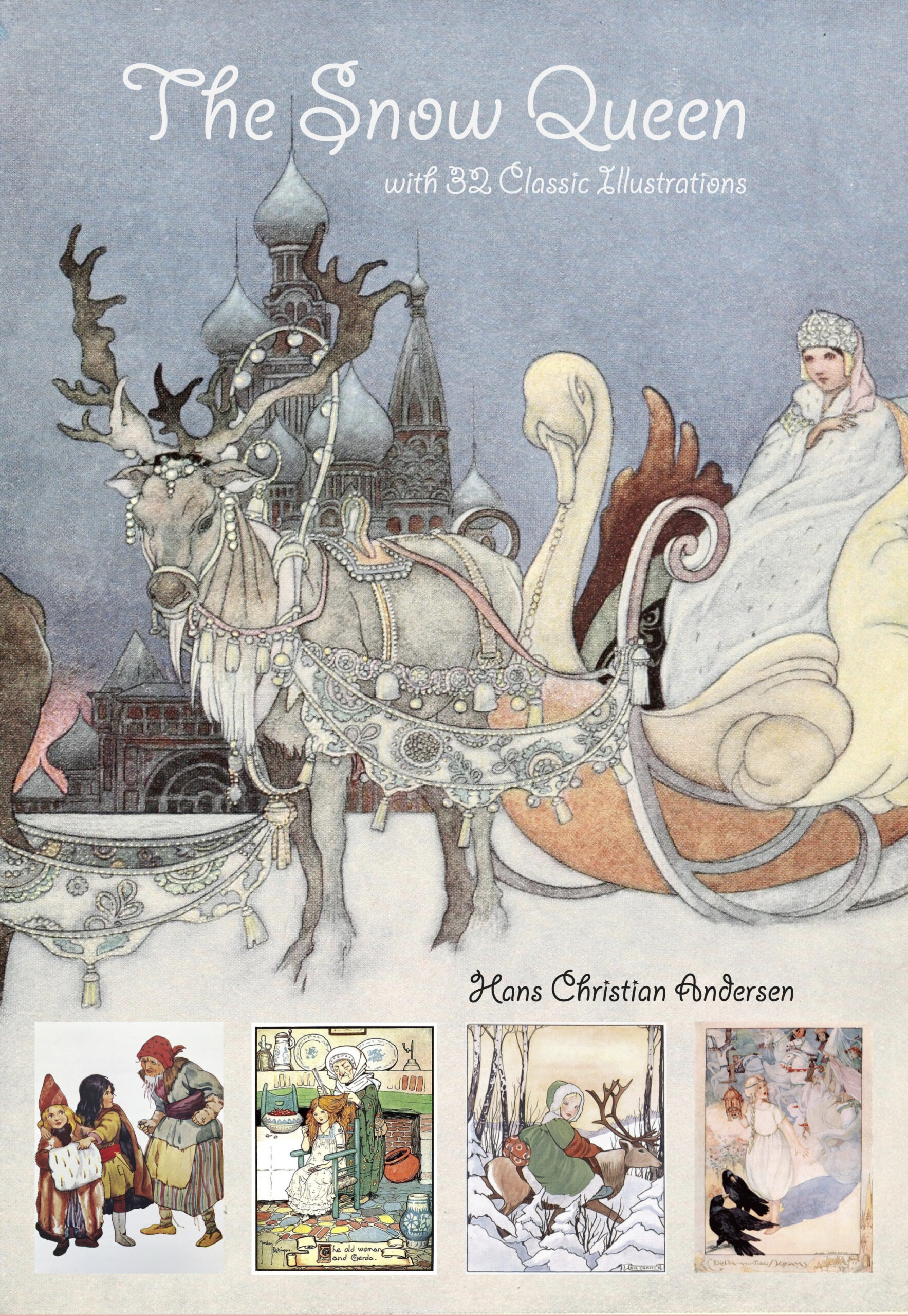
Just in time for Christmas, we have created a new version of Hans Andersen’s Story “The Snow Queen”. Yes, you read it right, it’s not “The Drag Queen”, to keep up with modern times, it’s the original “The Snow Queen”, Andersen’s immortal beloved classic.
You can buy it now at a cheaper price in our shop! Or at the regular price at Amazon.
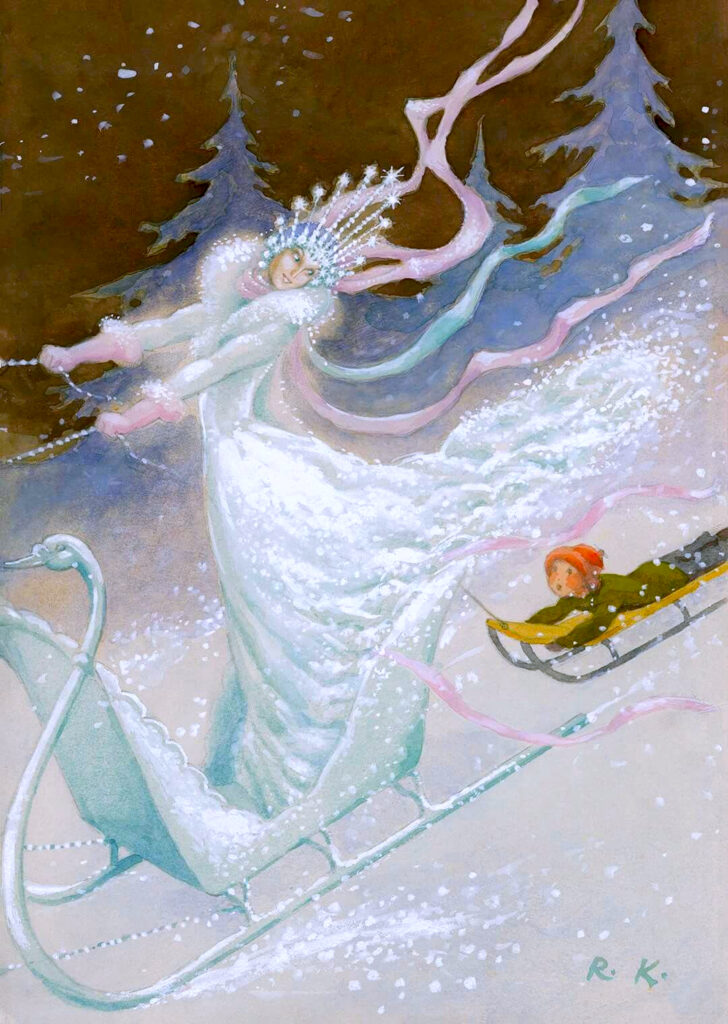
The story is the same everyone knows and loves, but we revised and updated the English translation and, most importantly, we added 32 classic illustrations by 13 different illustrators, from Anne Anderson to Charles Robinson (there are in fact three different Robinsons illustrating here, including two who are brothers) to Edmund Dulac, Margaret Tarrant and Rudolf Koivu.
Tarrant and Koivu are the ones who have more illustrations featured, in part to promote their work a bit more. Tarrant was an English illustrator from the early 20th century. But Rudolf Koivu was interesting to us because he was a Finnish illustrator, and while he’s relatively famous in Finland and has become the name of a prize for children’s books, he’s not so well-known abroad. So we thought it would be nice to use his illustrations in this version. Of course all the others are nice too.
Anne Anderson, a Scottish illustrator, was interesting too: she lived in Argentina until she was a teenager, as her parents had some business there, and it appears that it was in Argentina where she became interested in illustration. She moved back to Britain as a teenager.
I don’t know about you, but I’m a sucker for old-style illustrations, and for illustrated books in general. As Lewis Carrol’s Alice would say, “what’s the use of a book it it has no pictures in it?” Well, we wouldn’t go that far, but we do think that illustrations usually add to the enjoyment of reading. The book is available in paperback, hardcover and ebook, and is a nice Christmas gift for all.