
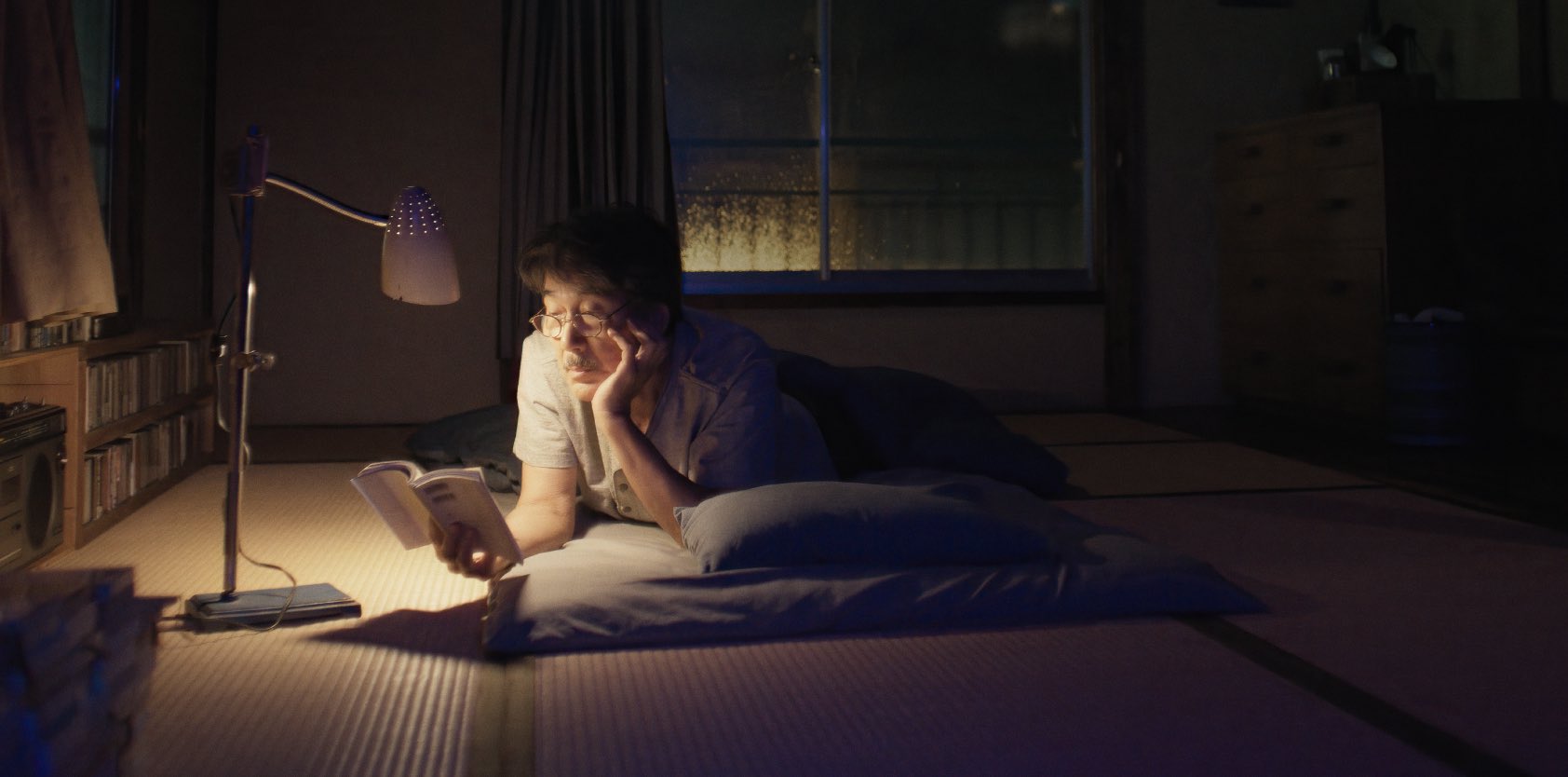
Perfect Days
“Perfect Days”, Wim Wenders’ latest movie set in Tokyo, is a very poetic, minimalistic film about finding joy in the simple things of life. (I am usually not a great fan of Wenders, but this is a good one).
In the film, the main character works as a public toilet cleaner, although his education level seems to be relatively high. He’s an avid reader (Faulkner, Highsmith), an amateur photographer, and he enjoys listening to alternative American music from the 1960s and 1970s (Nina Simone, Lou Reed and The Kinks are the main hits of the soundtrack that he plays from cassette tapes in his car while driving to work). Excepting one Japanese song and at least one Japanese book, most books and songs shown in the film are by Americans, so this looks like a demonstration of how Americanized Japan has become, although that might be a generational thing: it represents the Japanese who came of age in the 1960s/1970s, of which writer Haruki Murakami might be another example. (Today, it’s in large part the American youth who watches Japanese animes and gets “Japanized”.)
The main character is a single man in his 50s living alone in Tokyo. He has no children and apparently has never married, although the film implies he had some form of relationship with a woman years ago. His only family connections seem to be a sister and a niece he rarely sees.
The film is not really about the appalling birth rates in Japan, nor about the increasing loneliness in modern Japanese cities. But characters like the one in the movie, once an exception, must be very common now. A recent survey informs us that “More than one-third of unmarried Japanese adults in their 20s to 40s have never been in a relationship and one-fourth have no intention of ever getting married.”
It’s no wonder that Japan has one of the lowest fertility rates in the world.
Why don’t Japanese people want to marry? For men, the alleged main cause was “the financial strain of married life”. For women, “they do not want to compromise their freedom and independence.”
Freedom and independence, eh? How’s that working out for women, though? Most women appear to be increasingly unhappier than they were decades ago. In the following article from a left-leaning site, they call it a “paradox” and say that it is “strange”:
Something strange is going on in women’s happiness research. Because despite having more freedom and employment opportunities than ever before, women have higher levels of anxiety and more mental health challenges, such as depression, anger, loneliness and more restless sleep. And these results are seen across many countries and different age groups.
But who says it is a paradox? Isn’t it more likely that “freedom and employment” don’t lead to happiness, and that marriage and babies, while no guarantee of “happiness” either, at least give a more concrete sense of long-term satisfaction?
As a fan of Ozu movies, I make a case that Japan should just go back to arranged or semi-arranged marriages. (By the way, in Ozu’s “Late Spring” there’s a good speech by the father about marriage.)
Not just the Japs
Japan may be an extreme case, with its young men “marrying” holograms or anime characters. But neighbouring South Korea has an even lower birth rate — and Asia is far from alone in that trend. In fact, most of the world, excepting perhaps Africa and India, is on a downward population trend. All Western countries right now, and many non-Western too, have below-replacement birth rates. Some, such as Germany or Italy, are dangerously close to the levels of Japan and South Korea.
And recently even France, which for years used to be an exception with more robust birth rates — although that might have been caused by the influx of foreign migrants that the French government doesn’t like to count in its statistics — now had a “baby bust” with the lowest number of births since World War II.

But why?
There are lots of reasons, of course. Some are biological — micro-plastics, whatever they put in our food and water, vaccines. Some are economic — higher living costs and uncertainty about the future. Some are social — feminism, urbanization, loss of religion.
The biological and economic causes warrant some investigation, but I’d say that the social causes are the most important ones.
The loss of religion by itself seems to he a huge part of it. The groups with higher birth rates tend to be the most religious ones: the Amish, traditional Catholics, practising Muslims, Orthodox Jews. Having and taking care of several children is not easy. The idea of having a higher purpose in life beyond personal happiness certainly helps, as this memorable dialog from Tarkovsky’s “Nostalghia” reminds us: “I know, you want to be happy. But there are more important things.”
Several years ago, I did a short documentary that no-one watched about exactly that issue. It was called “Childless in Europe” and you can watch it below.
And Feminism?
Feminism didn’t help either. Women, in the end, are the ones who decide if they will have children or not. And most are deciding not to, either because they prefer to focus on their career and marry later, or because they decide that having children interfere with their search for happiness, or because they consider marriage a form of prison, or… Who knows? Fact is, wherever feminism flourishes, the birth rate goes down.
On top of that, there is a growing dissatisfaction between the sexes. Men and women no longer seem to understand each other. Many Western women, in particular, seem to have become totally unaware of what men want, and even of what they themselves want. A viral video recently showed a typical modern young Western woman saying that she “doesn’t cook, doesn’t clean, and doesn’t bring anything to the table in a relationship except her looks and personality”. Many such cases. Sad.
Of course the men’s reaction is not much better, divided into either virgin MGTOWs or chad PUAs — both awful lifestyles that do not lead to higher birth rates, but rather increase even more the problem. Sexual liberation ends up being bad for both sexes.
(This is not even new, as J. D. Unwin’s “Sex and Culture”, published in 1934, observed that sexual liberation and the end of strict monogamy always led to cultural decay).
The role of digital technology
Technology, and in particular digital technology in the form of social media and smartphones in general, might also be a factor.
I don’t know the exact mechanism, but it seems that the more we live in the digital world, the less we want to interact with real people in real life. Some people even prefer to have “AI girlfriends” and pay for them.
Autism is growing (although that could also be an effect of vaccines). Many young people no longer know how to communicate face to face.
We have evolved into a society that talks a lot about sex, and inflicts graphic images of sex even on teenagers and children, but more and more it seems to be just images and talking. Narcissistic posturing. The more people talk or fantasize about sex and about their “sexual identity”, the less they seem to actually have sex, much less procreative sex.


Many young people seem to make themselves ugly on purpose, consciously or subconsciously, with tattoos, blue hair, pink hair, piercings, nose rings. It might be a subtle, or perhaps not so subtle, way of avoiding sexual interest from others and further social interaction. Safer to interact just from behind a screen.
Even prostitution has receded mostly to cams, nudes and other interactions at a distance. OnlyFans is the new brothel. Phones are the new bed. Everything is virtual.
If it goes on like that, a few European ethnicities could disappear in the not too distant future, either by mixing into the general globalized gene pool or simply by failing to reproduce in enough numbers.

Is there hope?
If there is, it lies in the young Catholic converts I saw singing in the Latin Mass in Finland. In the young woman in Spain kneeling in front of the crucifix during a Corpus Christi procession. In the young woman in Leipzig playing the piano at church. They are the future, whether they know it or not.
And not necessarily because they are better or more moral than their blue-haired brethren, but simply because the blue-haired, tattooed, pierced folks will likely have zero or few children — if they even marry at all, I mean someone of their own sex — while those Catholic young men and women are more likely to form large families one day.
But, more importantly, even if they don’t have any children themselves, they are establishing the foundations of a more stable society based on stable, time-tested values. Blue-haired, pierced, socially atomized individuals who marry holograms or anime characters don’t lead to any kind of society that can last.