• Articles - Featured - Memories

    Love is the answer, but I forgot the question: Loneliness in the modern world

    The algorithm works in mysterious ways.

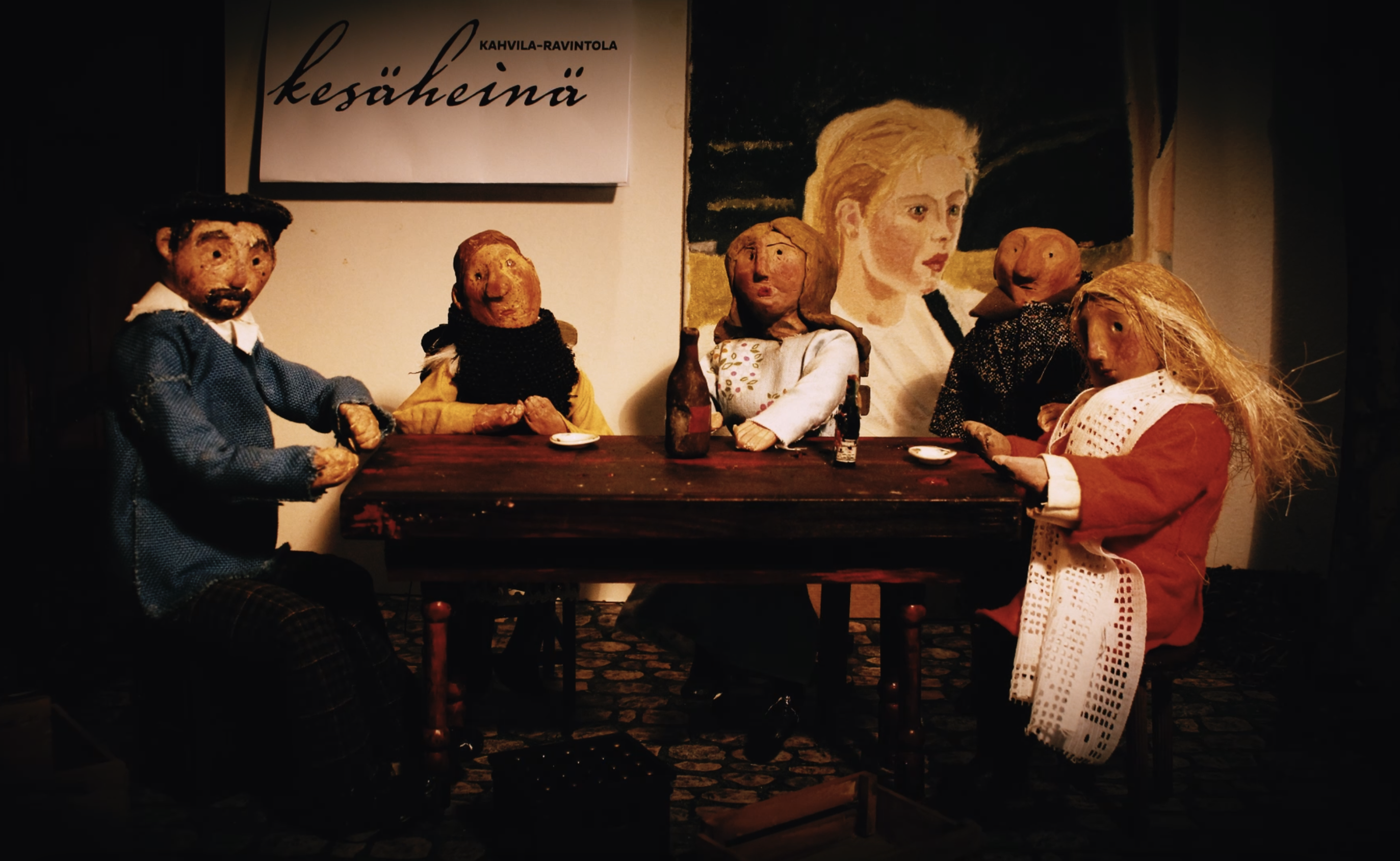
    I spent almost a full year working in a documentary film about Finland, taking the trouble to create complicated stop-motion scenes to represent dreams, and hardly anyone watched it. I think not even the people who appear in the film watched it. Maybe it was too long and too boring. Too artsy-fartsy. I don’t know.

    Then I published a quickly made video about my nostalgia for old technologies, and it had 3,000 views in a day. Weird.

    But today I want to talk about something else. About love and friendship. About our relationships with others, and about how they are being affected by the strange world in which we live.

    • (Note: You can also watch this in video version, above. Some people prefer it)

    I think it was the pessimist philosopher Schopenhauer who said it, but it could have been somebody else. He said that people are like hedgehogs. If they get too far apart, they feel lonely, but if they get too close, they prickle each other with their thorns.

    It’s true, but it’s also true that we cannot live without human connections. And while we may have thorns, we also learn to love each other despite them. We accommodate to each others’ thorns.

    Hedgehogs are very cute, though. Cuter than most humans.

    But the world were we live is against all kinds of human connections.

    Forming a family has become increasingly hard for young men and young women. Birth rates are collapsing in most of the world.

    Even friendships are becoming more difficult, sometimes for reasons no one can understand. It’s hard.

    Weird programs of social engineering have been created to set people increasingly apart, or to make them suspicious of each other. In no other age as in the modern world have there been so many people living alone.

    It’s not just families. All kinds of social relations are being affected. People are increasingly hesitant to engage with others.

    In Bowling Alone, written 20 years ago, Robert Putnam talked about how people were reducing their social interactions with their fellow citizens. There were less and less people joining clubs, joining the church choir, playing sports, organizing charity events.

    Now, it’s much worse. Connections are mostly virtual. Even dating has become a completely online phenomenon, and everybody hates it.

    And increasingly they want us living alone in pods, or locked inside a virtual world.

    Is it just me, or this image feels extremely creepy?

    Covid was the worst. They forced families to be apart, made nonsensical rules about social distancing, and in some countries they even forbade people to go out and socialize with friends if they didn’t have a vaccine pass.

    Now the Covid operation has been forgotten, as if it had never existed, and while the extremism of the policies has passed, the bad feeling caused by them remains.

    And they continue with other policies to separate people, maybe not as extreme, but no less insidious.

    It’s hard to live like this. But we must fight against this order that wants to destroy not just the family but any form of human relationship. They want atomized consumers, not humans. And so, even if it’s hard, we must rebel.

    We must form communities again. We must form families again. We must form churches and clubs again. Even if it has to be outside the system.

    We must learn to love one another again.

    And we must not feel anxious if things don’t always work.

    It’s going to be a slow process.

    Remember, there is a reason for everything, even if we don’t always know it.

    And old-style gathering in Italy in 1935.
  • Art - Featured - Memories

    “AI” killed the Internet star

    You know what, I miss the 1990s. All the way up to the early 2000s. And not just because I was young in that period. It’s not just nostalgia. Those years were objectively better. There were great movies (too many to list), great music (many great bands from the 1980s still active and many good new ones), even great sitcoms — I’ve recently re-watched “Spaced”, a classic British sitcom from 1999-2000, and I still found it funny and endearing, although in that case it could be just nostalgia: I did live in London in those years, after all).

    But, more importantly, in those times the so-called Internet was just beginning to show its vast potential.

    We called it the “world wide web” back then. I think no one uses this expression anymore. (I know the “web” and “Internet” technically refer to different things, but anyway, the point is that no one says “world wide web” or even “www” anymore.)

    Up until 2010 or so, the main form of publishing was blogging. You set up a blog with Blogger or WordPress, and voilà. You could get thousands of readers. Sometimes friendships were formed. And you could find a lot of free, interesting and uncensored information.

    No one uses Blogger or WordPress anymore. Now there’s mostly social media: Facebook, Instagram. Even Twitter became “X”, one of the worst rebrands ever.

    It’s not the same thing at all. Now everything is controlled, spied, branded, censored.

    For former bloggers, there is Substack, but it’s also not really the same thing. For one, it is really an email newsletter, not a blog. And two, perhaps because of the competition with the other companies that monopolize searching, most Substack sites are really hard to find.

    Speaking of Google: it became much worse. It is really hard to find anything useful sometimes. I’m not sure if it’s because their search engine got worse or simply because there is a lot more material online these days.

    Youtube got much worse too, especially since they started to censor people heavily during the Covid era. The most interesting creators migrated to other platforms. A lot of the videos now are very commercial. Gone are the days when any Youtuber could become a star just doing random videos without any major corporate support.

    AI killed the Internet star

    But all that was before “AI”, of course. The new type of software that some misname “intelligence” was the killing shot.

    If “video killed the radio star“, then AI killed the Internet.

    I am not sure of the exact percentages, but a lot of texts you find online today, probably the majority, are written by bots. Just google any article about anything. Everything seems written by ChatGPT or a similar software. And as such, everything reads exactly the same. More than once I located two articles in different sites but with an identical text. I guess both authors used the same bot. Lots of commenters are bots, too.

    Image search was also contaminated by the so-called “AI art”. Google “baby peacock“, for instance, and at least half of the resulting images will be ugly, unrealistic digital images created by one of those bots.

    (The other day I watched “Beetlejuice Beetlejuice”, the sequel to Tim Burton’s 1988’s classic, and one of the good things about it was that most of the effects were, like in the 1980s/90s, practical effects, make-up or stop-motion. Little CGI, and certainly no random “AI art”.)

    Alas, “AI” is going to be ever more present in our lives. It is going to “curate” all of our online experience (and not only), so that you don’t risk running into some dangerous “conspiracy theory” blogger, or, God forbid, a text or an image created by a real person from scratch, and not merely recycled from data fed to a “software language model”. You’ll have to get used to use facial recognition to get into a self-driving car that you will pay with a scan of your retina, the whole shebang. It is sold as a utopia, but those of us who grew up in the 1980s and 1990s know better. We watched all those old sci-fi movies. We know how they end.


    While I decide what to do with my own personal creations in a new Internet that has little space for them, I leave you with two little gifts.

    One is my recent documentary about Finland, “Dreaming of Finland”, linked below. The few people who have followed this blog — or well, newsletter — know that I visited Finland last year and wrote about it. Well, now there’s a film about it too. It even has some 90s style stop-motion.

    The other is Geist magazine, an independent (very independent!) magazine of literature and art that I occasionally publish. There is a new issue, number 6, Fall 2024, that just came out this past Halloween. You can read a preview here or just order an old-fashioned print copy in full colour and quality paper at our online shop here.

    Thank you.

  • Art - Featured - Italy - Memories

    Why can’t we make beautiful art anymore?

    Some people say I am too harsh on the modern world. That we have wonderful technology and people live in comfort and we have so many ways of amusing ourselves and we can find any ethnic restaurant we want in any town on Earth.

    Fair enough, I guess.

    But why is so difficult to make beautiful art and architecture in this world?

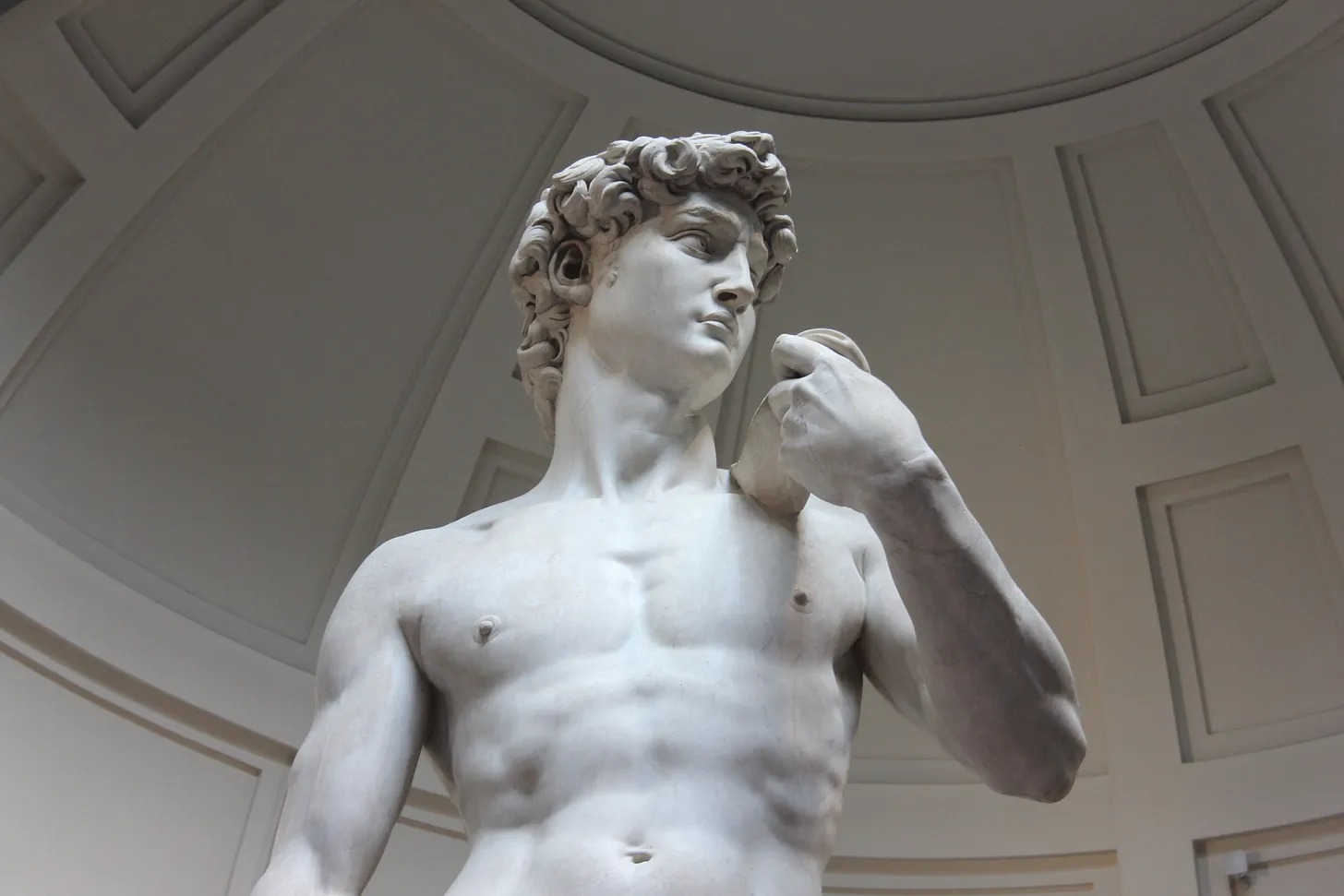
    In my third visit to Tuscany, I finally had time to see Michelangelo’s “David”. It is one of those works that is actually more impressive in real life than in pictures.

    I say this because the “Mona Lisa”, for instance, is a bit underwhelming. (Then again, I never understood why critics singled out Leonardo’s “Mona Lisa” as his “masterpiece” out of his hundreds of much more impressive works. Perhaps they chose a simple portrait as a way to distract from his much more beautiful religious paintings?)

    Of course, in Tuscany, beautiful art is everywhere.

    Visiting San Gimignano, which is basically a medieval town frozen in time, there are so many churches with wonderful paintings, and this is a very small town — if you go to Florence, you will find a thousand others.

    Of course beauty didn’t start in the Renaissance. This is a painting from 1317, in the Church and Monastery of Saint Augustine in San Gimignano.

    And this is a detail of another one, no date indicated but from about a hundred years later.

    This one below, in a museum, with a similar theme (Saint Magdalene by the cross) is also from the 1400s.

    In the same church, however, you can (regrettably) see this sculpture from 1995.

    And then there is this fountain built in 2014, sitting nearby, just outside the walls of the old town. Compare it to the Fontana di Trevi in Rome, or, really, anything built before the 20th century.

    Ugly stuff! Even the most mediocre medieval sculptor could certainly do better than that. And that’s not even the ugliest stuff. If you want really ugly modern stuff, just check this page with sculptures in some American university campus. It’s so horrifying, it cannot not be on purpose.

    If you are one of the two or three people who have read my article about how much money the Renaissance and Baroque painters made, you may have found that the Catholic Church at the time invested a lot of money in creating beautiful churches and paintings and sculptures. They had an almost limitless budget for that stuff. They spent what would be millions today.

    Today we have even more money — we can print all the money we want, it’s all digital anyway! — but it all goes to create mostly… the worst kind of trash they can find?

    I mean, we can’t even make beautiful churches anymore. This is a Catholic church in Los Angeles.


    But there are similar examples even in Italy. Any church built after, say, 1960, is usually ugly or bland.

    Why is that? What the Hell is going on?

    It’s not that people no longer care for beauty. I mean, if people didn’t care for beauty, there wouldn’t be millions of tourists visiting Florence and San Gimignano and Siena and Paris and Barcelona every year. They want to see the old, beautiful stuff. Not the ugly modern stuff.

    And in private, people also like beautiful things. Inside many apartments and in a few shops you can find that many places are still arranged with relative good taste (although usually tending more towards the clean/functional look than to the decorative.)

    It’s also not that there are no talented people anymore. There are still a few good book illustrators and designers, for instance. I suppose a few good filmmakers, although even those are rare these days.

    But in visual arts and public sculpture, the money seems to go to the worst things you can find. So there seems to be a deliberate attempt to promote ugly stuff. I mean, all those ugly sculptures cost money, and someone is paying for them.

    But that’s not all. Even when there are talented artists, they create mostly meaningless things. Most classic art was about religious or mythological themes. There is a reason for that. Art is about transcendence. About a connection with the world beyond our senses and our daily experience.

    Even the good portrait painters (when portrait painting was basically just catering to the vanity of rich people to have their “portrait taken”) understood that, and that’s why their paintings are still valuable and interesting even when the person portrayed has been dead and forgotten for hundreds of years.

    But now… “Art” is not just ugly (it doesn’t even try to be beautiful), it’s usually about some random political or social theme that will be forgotten in a few years. Or about some trivial, mundane event. Or even pornography. There is just no effort to connect the individual to the universal and the material to the spiritual.

    Why are Western people so apathetic?

    But it goes beyond art and beauty, which in the end are just a reflex of our world. If our art is ugly it’s probably because our society is, in many ways, ugly. It is a symptom of disease.

    Most Western people seem to be very apathetic in the face of extinction. Extinction? Well, not only birth rates are plummeting in all the Western world, there is an ongoing demographic replacement by foreigners, and while things seem relatively fine on the surface, everyone knows or at least fears that the possibility of war and economic doom is just around the corner.

    Or am I exaggerating? Sometimes I don’t know. It is true that level of prosperity in the West is still quite high. People on average are able to live in comfort and without too many worries.

    Then again, none of that matters if people are not having children and the economy crashes and there’s war.

    But most Western people are just… I don’t know. They don’t seem to care about the future, or anything, really. Or they care about fake, obviously manufactured problems such as “global warming” or “Covid” or “Trump” or whatever the media will bring next week, but not about the very real problem of the survival of their own culture and their own people into the future.

    I don’t know what to make of it, but I suppose my opinion is also irrelevant, bound to flutter for a few seconds in the air like a fallen leave and then disappear forever.

    In the meantime, I take a few pictures and write a few words to register a few beautiful moments in time, before I’m gone, too.

    Church of Saint Augustine, San Gimignano.


  • Articles - Memories

    Merry Christmas!

    Recently, I received many corporate emails from different companies wishing “Happy Holidays”, “Happy Season”, but curiously enough not one of them was wishing “Merry Christmas”. One of them had the outline of a Christmas tree, but it only wished “Happy New Year”, even though it was sent on Christmas’ Eve.

    And yet, it is Christmas. No one can stop it.

    I always loved Christmas. I always liked the imagery, both Christian and pagan, and I enjoyed the festivities, the music, the food, and of course, most of all reuniting with the family. Once more, due to the current surreal regulations, it is not possible for me to be together with my extended family, but I am having a great time nevertheless.

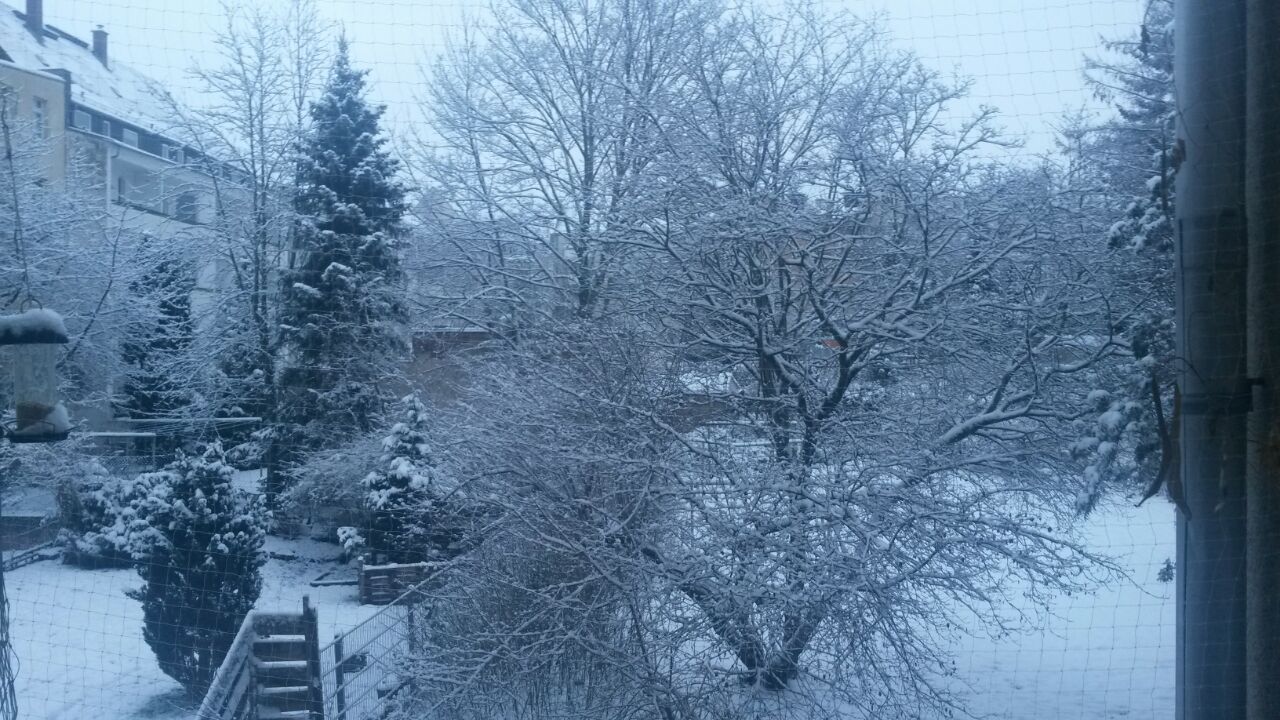
    It snowed during the night and now we have a wonderful white landscape outside.

    Merry Christmas to everyone!

  • Articles - Cinema - Memories

    Fellini, Scorsese and the end of cinema

    Martin Scorsese has just published an article about Fellini at Harper’s magazine, but which also discusses a bit the current sad state of cinema. Today, he says, everything has become merely indistinct “content”, and the magic of cinema and its artistic auteurs has been lost.


    I tend to agree. When I was a teenager, I used to go to the now defunct street cinemas, or to specialized art cinemas, to watch films by Fellini, Truffaut, Renoir. Granted, in the 80s and 90s this was already a culture in extinction, much farther from the golden age of the 1960s and 1970s that Scorsese mentions, but there were still a few remains of that era.
    Then the local cinemas were replaced by the multiplexes, which would show mostly super-hero movies or other blockbusters. Auteur or art cinema became an even smaller niche. And then cinema was replaced by television and streaming.

    Going to the cinema is a social experience, closer to going to the theatre or to church; watching a film on television or VCR reduced this experience to a smaller screen and the familiar unit. People no longer paid so much attention to what was on the screen, it became a sort of mere background for other activities. Fellini was already very critical of television; he mentioned it in several interviews, and his “Ginger and Fred”, one of his last works, from the 80s, is a satirical view of the medium.

    Today, of course, it’s even worse in some ways. Television was replaced by streaming, and the familiar unit was further reduced to an individual, watching it most likely on a cell phone screen. The reduction of the screen size and of the viewing public reflects the growing social atomization that took place in the last decades, culminating in the current “corona” lockdown where people are “social distancing” and locked in their own homes.

    It was the final nail in the coffin of cinema as a social spectacle, and who knows if it will return? Even if the lockdown is lifted and people start going again to the cinemas, it is unlikely that the auteur era will return. This doesn’t mean that cinema as an art is dead, but its golden age seems long past.

  • Articles - Memories

    Memories, music and photographs

    When you get to a certain age, which can vary according to the person’s temperament, you start to live more in the past than in the present, if only because you have more years of “past” behind you that you will likely have a “future” in front of you. Of course, being mostly a melancholic (see previous post about the temperaments), I tended even in my youth to focus more on the past than in the future (Pascal observed that humans rarely focus in the present, but either in the past or in the future).

    But one thing that happens, I think to everyone, independently of their temperament, is the cementing of their musical taste, at least in what refers to pop music, and the preference for the music of the past, or more exactly of their youth.

    For instance, nowadays I tend to listen mostly to classical music, but, if not, to rock/pop from the 60s, 70s and 80s. I know very little about, and have even less interest, in current pop music. The little I’ve heard of it seems awful, vulgar and stupid, but of course, I am not the target audience.

    I hate rap and hip hop, which seems to be the most popular genre today, and I am not the greatest fan of electronic music either, with a few exceptions. Rock, for all practical purposes, seems to be basically dead. I mean, the era of the great rock bands finished in the 90s, really. If I think of the country where I grew up, Brazil, there were many great rock bands in the 80s and 90s (Legião Urbana, Ira!, Capital Inicial, Camisa de Vênus). A few of them, following the example of the geriatric Rolling Stones, are still active, but there are basically no new rock bands that are very popular. Most of what is popular are variants of synth pop or hip hop, usually extremely vulgar (i.e. what’s called “funk” in Rio).

    Of course, even if there were great rock bands today, I probably wouldn’t listen to them, since Youtube and similar services basically allow anyone to find any song that they used to listen in their youth.

    One of those songs, which I listened recently for the first time after decades, was a song by the Brazilian band Camisa de Vênus (which is a poetic name for condom – “Venus’s shirt” – but of course I didn’t know that when I was 13 and the song came out). It was popular in the 80s, and had a chorus like this: “Lena veja o que o tempo faz / com as pessoas que não querem perder o gás”, which could be translated literally as “Lena, see what time does / to those who don’t want to lose their gas”, but meaning really people who don’t want to lose their youth, but end up looking like pathetic middle-agers pretending to be still young and thinking that the things they enjoy and know are still cool, etc.

    I don’t think I had this problem, because I wasn’t cool even when I was young… Nor did I care to, very much. Youth is fickle and superficial. Nelson Rodrigues, a famous Brazilian journalist and writer, once was asked what was the best advice he could give to the young, and he said: “Get old .” And that’s what they all did.

    * * *

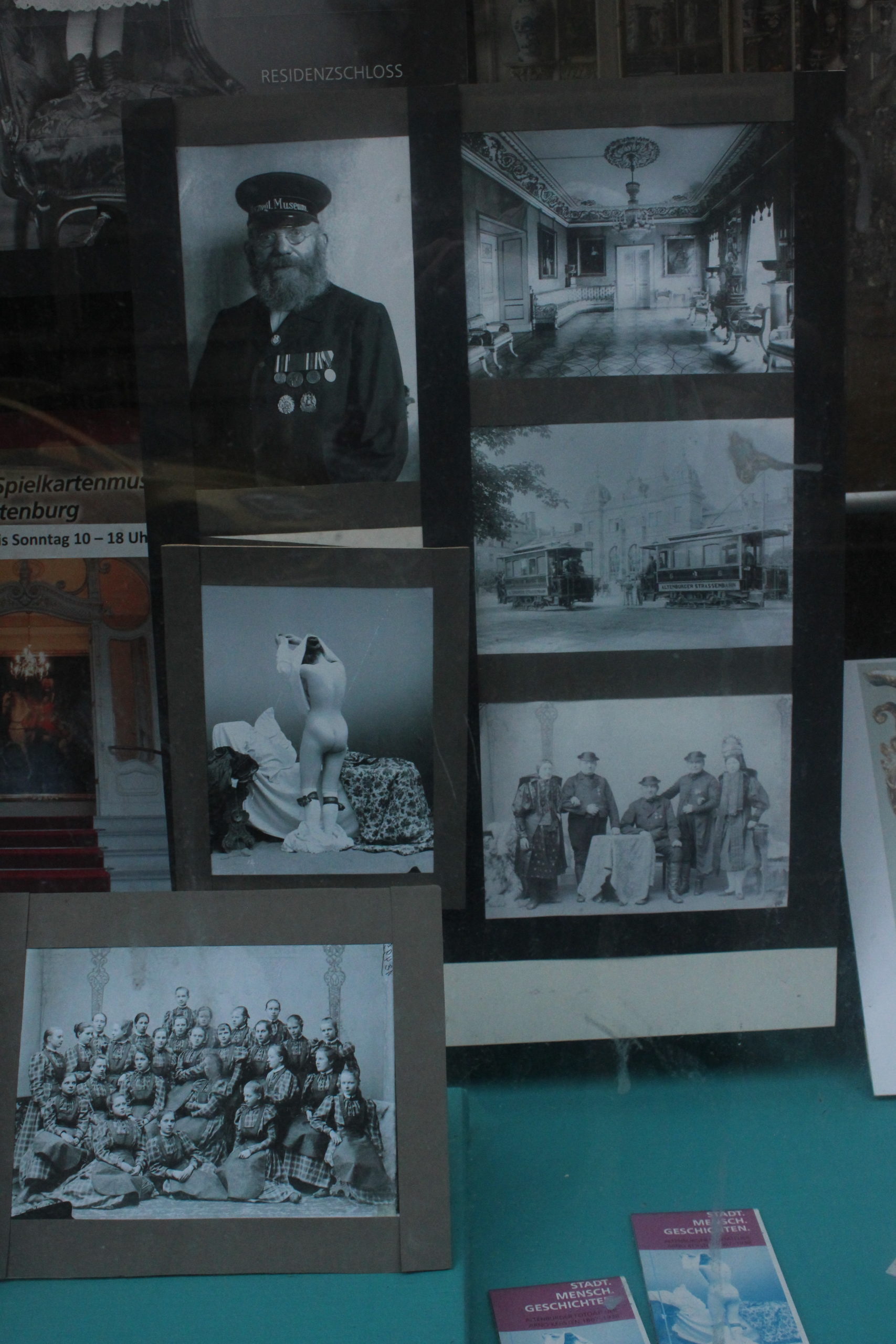
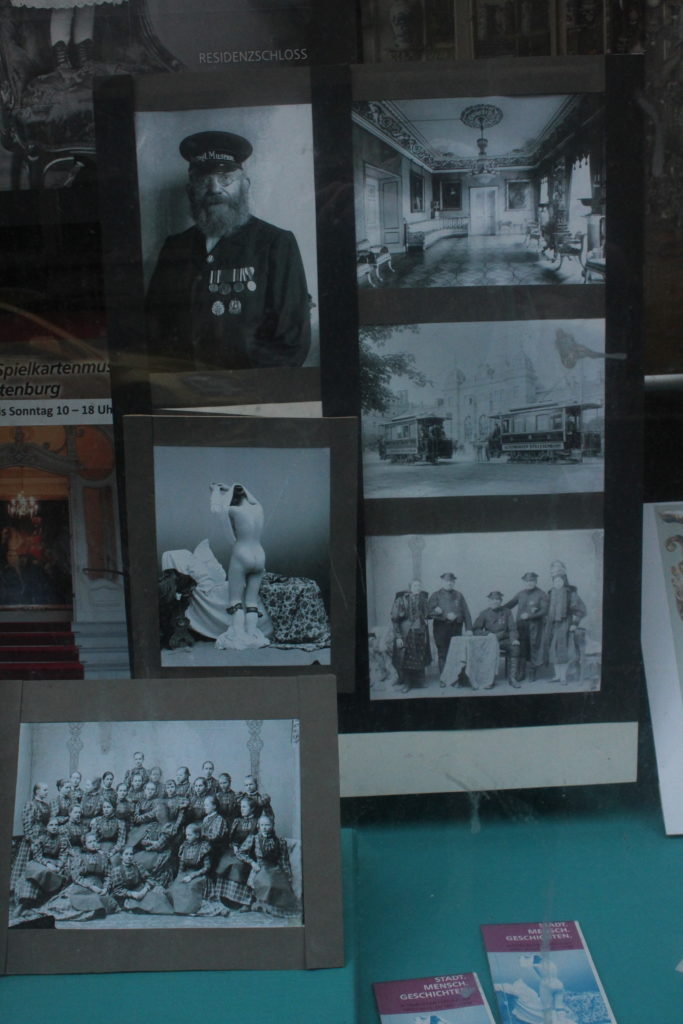
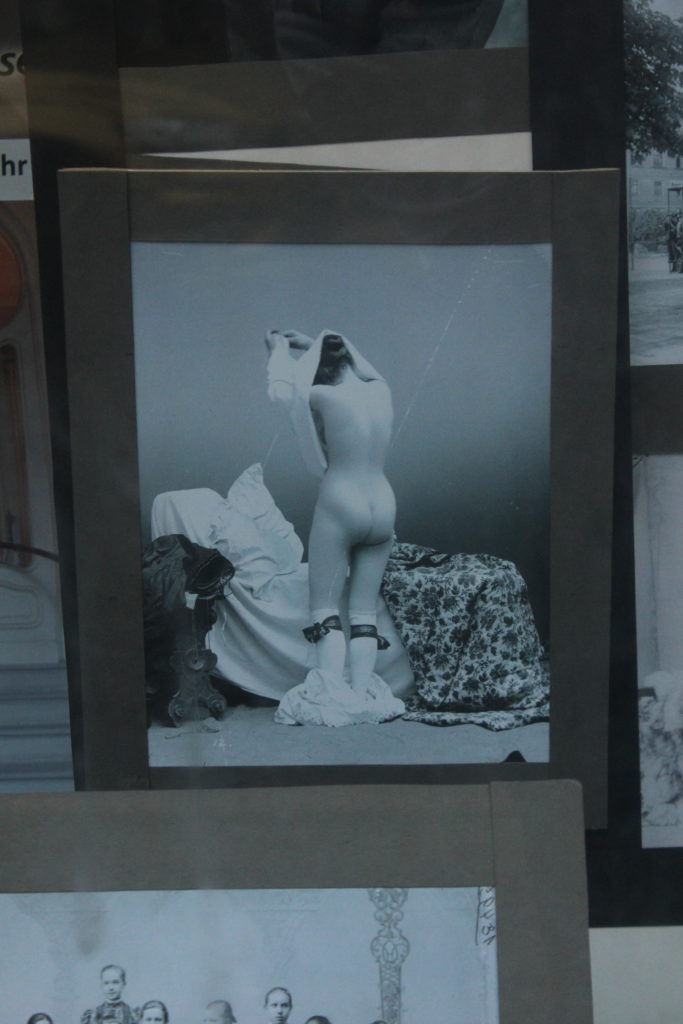
    The photographs below (the photographs of photographs) were taken at a shop window in Altenburg, Germany, a few weeks ago. I don’t now what’s the context of the pictures, but I found interesting the juxtaposition of the images of the group of ladies dressed all the same way with aprons (workers in a factory?) with the vintage erotic photograph. The pictures seem to be from the beginning of the 20th century and of course all those people are long dead now.

    It was said that certain primitive tribes of the Pacific didn’t like their photographs taken because they believed that “photographs can capture your soul”. Maybe they were right about that… There is something eery about mirror-like images that freeze your aspect in time and can last even beyond your earthly life. But of course, in those initial times of photography (early 20th century), taking a picture was a special event, you didn’t take one every day or every hour to post online as we do now. But what to think of the thousands of images that each of us now will leave for posterity, or at least to the limbo of the digital realm in the “Cloud”…?