There’s a lot of doom in the Internet, especially among the alternative news crowd. People can’t get enough of the “end of the world/end of the West” type of thing. While I do understand that we are living in highly worrying times, with war expanding everywhere, economic downturn, birth rate collapse, mass migration, and radical technological and social changes, I try to avoid falling in the trap of looking only at the collapse, as there are occasionally good things too. Besides, it’s a bit depressive to only having to write about doom, gloom and conspiracy theories.
Recently I’ve been doing much more reading than writing — I haven’t published a text here in months — and I decided to revisit classic novels, reading or re-reading them. I started, where else, with the Russians. I’ve recently finished Dostoevsky’s “The Brothers Karamazov” — it took me only forty years. I kid, but in fact I started reading this novel when I was 16 or 17, and never finished it. Then a few months ago, I found the book in my local library and decided to pick it up again, reading it all from the start. It took me just a couple of months. I really enjoyed it, so much so that I am reading Dostoevsky’s “The Idiot” now.
The following is a somewhat disjointed digression about a famous sentence found in the Karamazov book — the text can also be watched in video form, perhaps it works better this way — and how it could apply to our current reality. Or not.
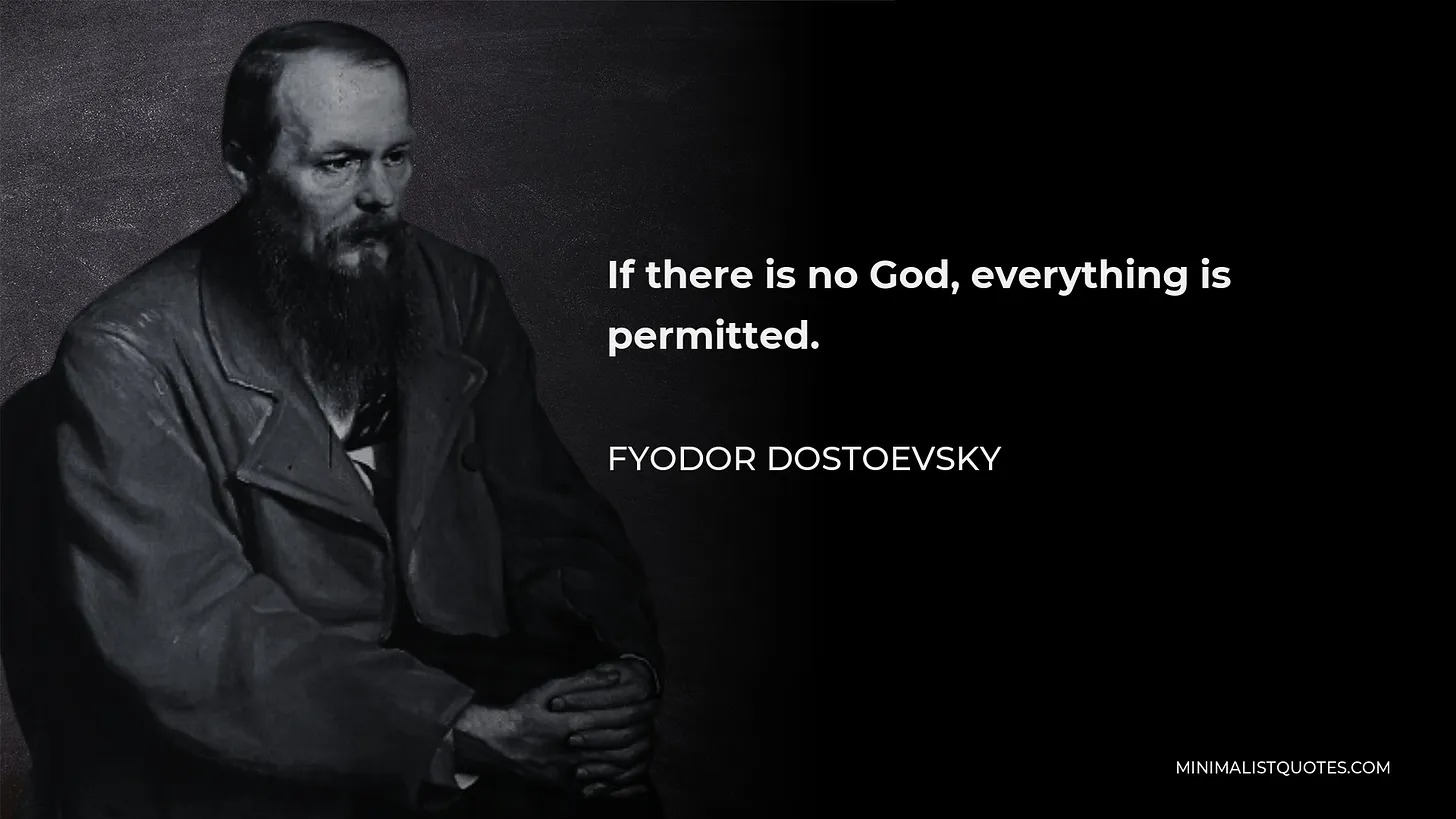
“If there is no God, everything is allowed.”
This sentence that became famous appears in the great novel by Fyodor Dostoevsky, “The Brothers Karamázov”, one of the greatest novels in the history of literature. A great, great book which I’ve only recently read. Without giving any spoilers, let’s just say that it is the story of three brothers with three very different personalities and destinies. Dmitri is the impulsive and reckless one, Alyosha is the moral and good-hearted one, and Ivan is the intellectual and cynical one. And Ivan is the one who says this sentence.
But what does it mean?
It means that without God there are no moral rules, and man can do anything he wants. Rape, incest, murder.
“Do what thou wilt, that shall be the law”.
There are two consequences to this. One is that moral notions of good and evil have to come from God, from above. Otherwise it just comes from one man to another group of men, and it becomes merely a question of power.
The second part is that you should have clear, inflexible rules.”Thou shall not murder.” “Thou shall not covet thy neighbours’ wife”. Otherwise, you have relativism. Or things like utilitarianism: “the greater good for the greater number of people”.
But then, if you have four people and three of them don’t like the fourth one, they can kill him, because that would be “the greater good for the greater number of people”, right?
And so we are back to “Everything is allowed.”
This idea comes, a bit, from Nietzsche’s sentence that “God is dead”, and the growing nihilism that was already at the time very noticeable in society, not just in Russia but in Europe in general. We are talking here about the late 19th century, when science was advancing, society was changing and more traditional notions of behaviour were starting to disappear.
The 20th century saw even greater changes, with feminism, the sexual revolution, the rise of modern democracy, and the further secularization of society, as well as incredible technological changes.
Today, things have gone much further. We live in times of extreme moral confusion, or maybe we should even say moral inversion. Good is called bad, and bad is called good. Black is called white, and white, black. Women are called men and men are called women.
Since we can’t even accept Nature as it is, the rules of society have become increasingly nonsensical.
As people are increasingly stabbed in the streets by foreigners, governments worldwide react by banning knives. Or scissors. Or hammers.
Or social media posts.
Newspapers were always full of lies, but, with the rise of modern digital mass media and now what is called, incorrectly, “Artificial Intelligence”, which further increases the possibilities of image manipulation, we don’t even know what is real and what isn’t. Perhaps we never knew. History was always written by the winners. Not everything we were told in school and history books was true.
Our leaders, the ones who should rule us and protect us, have become our worst enemies. There have always been tyrants, but this is probably the first time in history where there’s a whole worldwide government system that hates its population, or, at most, sees humans as replaceable cogs in a machine. Animals with no souls, to be hacked by vaccines and gene manipulation.
Even religious leaders offer little solace. Most of them are also part of this global system that wants to destroy traditional society in the name of a new global order.
What to do? How can we get rid of this evil global that seems to increasingly control everything and lead us into a global technological dystopia?
In Dostoevski’s novel, there is another character, called Father Zossima, a monk who is the mentor of the young Alyosha. And he says some interesting things which may be worth repeating.
At one point omeone asks him, “How can you prove that God exists?” And he says, well, you can’t. But if you love everyone and everything, if you spend your life actively loving your neighbours, one day, you will understand. But he warns that such love has to be active, real love.
Because the truth, as Dostoevsky observes in the novel, is that many people love humanity in the abstract, but they don’t really love humans. They just love a certain notion that they have about humanity, or perhaps they just love the idea of being considered a “good person”.
And so you have a lot of what we call virtue-signallers. People who like to appear as if they are noble or good and are always fighting for the right causes. But it is just status-mongering. It’s not real love. They love humanity as an abstract concept. But loving real people is hard. Most people are annoying or ungrateful. They lie, they cheat, they stink. When Jesus said that you should love your neighbour, he never said it would be easy.
Father Zossima also asks: “what is Hell?” And he says something very interesting. He says, “I maintain that Hell is the suffering of being unable to love.” And if we think about our rulers — and I don’t mean just the politicians, but the billionaires, the bankers, the real rulers behind the façade of the state — we see a lot of people that have a lot of power and riches. They have yachts, mansions, cars, women. But despite that, many of them don’t seem happy, and in fact many seem really wretched. “What does it profit a man to win the whole world and lose his soul?”
They may have power, but they are unable to love their fellow human beings. And as such, they are in fact already living in hell. Because Hell is the suffering of being unable to love. If God’s love is the hidden grammar of the Universe, then Hell is being permanently away from it.
So what is the answer to our current troubles? The same one that ever was. Reject excessive materialism and consumerism. Try to avoid mass media, or, if you can’t at least be skeptical about it. Work, love your family, love the people close to you, help your community. Try to change yourself before attempting to change the world.
The current system is based on lies, and, as such, it can’t last long. It will end at some point, perhaps sooner than we all think. As Yeats said, “All things fall and are built again.” When the time comes, we have to be ready to build them again.