• Articles

    Midsummer rain, Midsummer sun

    In Finland, Midsummer week is usually when people take their holidays and go out camping, boating, fishing, swimming naked in a lake, or doing all kinds of things outdoors. (No, not that. Well, maybe that too).

    It is also when it usually rains.

    This year… Well, for a while it seemed as if it was going to rain. While the whole previous week and even this same week until yesterday has been warm and sunny, feeling almost more like Spain than Finland, yesterday it started to rain, and I thought it would go on raining for the whole weekend, so I got a bit depressed.

    But now the sun has come back, and I’m happy again. It’s funny how a little change in the weather can make such a huge difference in our mood.

    However, it is still unclear if it will be rain or shine during the whole weekend. Midsummer this year is June 24-25.

    Midsummer is usually commemorated with bonfires, but this year they have been prohibited because of the risk of forest fires, at least in this area. Getting drunk is another popular past time, and that’s why the number of people drowning in lakes seems to increase exponentially in Finland during those two days. This has not been forbidden, however — at least, not so far.

    I hadn’t realized, but Midsummer is actually Saint John’s Day (and its eve), or the feast of Saint John the Baptist, commemorated every year on June 24, which is a popular feast in Portugal, Spain and other European countries, and also what, in Brazil, is called “Festa Junina”, or June festival, but also “Festa de São João”. The only thing is that, in Brazil, being in the Southern hemisphere, it is midwinter, so people drink mulled wine and eat pine nuts. The large bonfires, however, help you keep warm, although it doesn’t get all that cold in Brazil, even in winter.

    In Finland, the holiday is called Juhannus, also because of Saint John, but it is rarely religious these days, and since 1955 it is no longer fixed on June 24, but scheduled to fall always on a weekend. It can be any day from 20 to 26th of June.

    As usual in those cases, pre-Christian pagan celebrations have become mixed with Christian religious festivities, and so it is unclear when the bonfire tradition began. In medieval times, they were said to keep witches and evil spirits away. It was also common to swim in lakes or rivers to wash away the sins, and in remembrance of the baptisms performed by Saint John. But there are evidences that celebrations of the Summer solstice in general are a much older affair, although the actual solstice, of course, is on June 21 and not 24.

    These are my final days in Finland, so that’s why I felt such melancholy when I saw rain falling after what seemed a very promising summer. (I was told that, on the contrary, this has been, so far, a very good summer for Finnish standards — sometimes, it really rains for months).

    It has been a nice if uneven experience to be here for a while in these Northern lands, and writing a little bit about it, even if it doesn’t seem to have interested many readers. I guess the world is becoming too crazy right now for anyone to focus on more innocent subjects such as travel and culture and art.

    Besides bonfires and lake swimming, there are also some traditional folk rites associated with love and fertility during those two days — i.e. if a young maid collects seven types of flowers and puts them under her pillow on the eve of Midsummer/Saint John, she will see her future husband in a dream. As you may remember, it is very similar to the tradition of The Eve of Saint Agnes, about which I wrote a while ago.

    I don’t know if this works for men, too. I don’t think so.

    One of the main characters of the Kalevala, Finland’s national epic, is the singer Väinämöinen, an old shaman and magician. Many of the episodes are about him trying to find a wife — always unsuccessfully. The most famous story is that of Aino, a young girl whom he wins the right to marry after winning a song contest with a rival, Aino’s brother. But she prefers to drown herself instead of marrying the old sage. Disappointed, Väinämöinen goes fishing to forget his troubles, and when he’s in the boat, lost in thoughts, she comes back as a fish and mocks him. Then she disappears forever.

    Poor Väinämöinen. I feel his pain. I think that I, too, haven’t found what I’ve been looking for in Finland, whatever that was. But it has been a nice ride.

    At the end of the long epic poem, replaced as King by a wise Child born of a virgin, Marjatta — an obvious Christian allegory, even if the details are different — Väinämöinen leaves the country, giving his musical instruments to his people as a legacy.

    Perhaps it is time for me to take my leave too?

     

  • Articles

    Plastic Jesus and the Passion story

    Brief notes on “Cool Hand Luke” (spoilers ahead)

    I just watched “Cool Hand Luke” (1967) for the first time yesterday. One of the first things that called my attention is how many similarities it has with the later “One Flew Over the Cuckoo’s Nest” (1975), only that it’s in a chain-gang prison instead of an insane asylum, and with the “rebel outsider” played by Paul Newman instead of Jack Nicholson. But really, they should have sued for plagiarism.

    Or perhaps, the theme of rebellion against authority or against an unjust system simply was the main motif of the times. After all, it was present in a lot of popular music of the 1960s and 1970s, too.

    Both films have a similar structure. “Cool Hand Luke”, however, is much more direct in its Christian allegories and visual references, which might seem a bit strange, since the film was directed by a Jew called Rosenberg. (Milos Forman, director of “One Flew”, was of course also Jewish).

    There are too many references to count to the New Testament, direct or indirect, from the name of the character (Luke, like the Apostle) to the “raising from the grave” scene, to the “cross” image over the picture at the end — but also the songs used in the film are relevant and play on the religious theme.

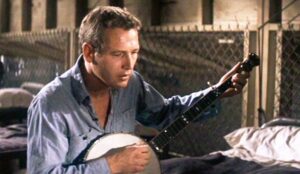
    At one point, Paul Newman’s character sings a song called “Plastic Jesus”. While some may see the lyrics as flippant, in the context of the scene, sung after the death of the character’s mother, they become actually very moving. You can watch the scene below.

    https://youtu.be/_-0BCUPM4tk

    For that and several other reasons, the movie made me think about the basics of the Passion story — you know, the theme of sacrificing yourself for others. “Greater love hath no man than this, that a man lay down his life for his friends”. To die, so that others may live.

    I don’t think it was a very common theme before Christianity. In some of the Nordic or Greek ancient myths you have a warrior or even King who dies in battle, in a way sacrificing himself for his people, but it is more about the courage of facing death or about fighting until the end. Then you do have some stories of self-sacrifice as revenge — for instance, in the story of Samson in the Old Testament, he kills himself in order to kills his enemies too — like a suicide bomber avant-la-lettre.

    But the idea of someone simply forfeiting his own life for the benefit of others seems a somewhat novel idea, which however has become common in many later stories and movies. Not always in a good way, of course. I can think of many movies where it becomes corny or annoying. For instance, in Clint Eastwood’s “Gran Torino” (2008), while not a bad movie, the ending with the self-sacrifice annoys me a bit. Maybe it’s just me, but it feels false.

    In “Cool Hand Luke”, however, it works, even though here it is perhaps not so much about self-sacrifice for others (does Newman’s death change anything for any of the other prisoners? Not really) as about dying and thus becoming an undying myth of hope, a story that people will tell over and over again.

    Some may say that the intention of the film is subversive — after all, it seems to be comparing a petty criminal to Jesus — but I don’t think it’s the case here, or, at least, I didn’t see it as offensive at all. I wouldn’t call it a religious film either. But it’s one that uses Christian imagery and themes in an effective way.

    I don’t think it has much to do with belief either. I don’t know what the screenwriters’ beliefs were, but Jorge Luis Borges, who was an avowed atheist, used Christian images and references in a few of his stories, while J. R. Tolkien, who was a fervent Catholic, set his universe in a fantastic, mythical pre-Christian land, where the references are only indirect.

    I think the explanation is that “Cool Hand Luke” was made in 1967, and portrays an even earlier time, which looks like the 1940s or early 1950s. Back then, religion and religious references in fiction were not completely out of common people’s universe, as they are now. Today, in the age of Drag Queen Story Hour, it has become almost impossible to refer to Christian imagery in a way that is not ironic, cynical or just purposefully offensive.

    And, in fact, as if to prove the point, more recent covers of “Plastic Jesus”, such as the Billy Idol one, tend to accentuate the parodic, blasphemous meaning with additional lyrics that have little to do with the original song.

  • Articles

    While the world burns

    AIDS, Covid and Sex Robots

    A few days ago, I wrote the following comment at another blog:

    Kary Mullis (who invented the “PCR test” and died mysteriously just before “Covid”) always said that there is no causation link between HIV and AIDS. And there’s a video of him heavily criticizing Fauci for his management of the “AIDS p(l?)andemic”.

    Also, it is quite obvious that AIDS in Africa and in the U.S. were two different things, as one affected mostly middle aged homosexual men, and the other heterosexuals and even children. I think AIDS in Africa was/is mostly a scam to get Western aid. They called anything “AIDS”, just as they called anything “COVID” later on, to get money.

    Looking back at the AIDS phenomenon, it is clear that there were many similarities with COVID, including the presence of Anthony Fauci at the forefront, and very dubious claims that were later disproved.

    It seems that, both back then and now, the main interest was to promote panic.

    But why?

    I think now that it might be about reducing birth rates.

    As someone who grew up in the 1980s and 1990s, I remember the propaganda about AIDS, making teenagers terrified of having sex, in particular if having sex without a condom. It was really hammered in not very subtle ways that, if you didn’t use a condom, you would die.

    But even back then it was known that the main form of contagion, if there was such, was anal sex and drug use (sharing injected needles). Most AIDS victims were either homosexuals or drug users, with some unfortunate hemophiliacs who received tainted blood transfusions.

    However, some say that the AIDS epidemic was more a lifestyle disease than a viral disease, as the HIV causality was never properly proven. Some say that the real causes of deaths were the so-called “poppers” (drugs used to facilitate anal sex) — which were banned in the early 1990s, and after that, coincidentally, the AIDS death started to subside — and AZT, a “cure” promoted by Mr. Fauci which was anything but — it killed you more than it helped you.

    Whatever the case, in the media, AIDS was about making you terrified of sex.

    Now, what about Covid? What was the function of the lockdowns, since they did nothing to stop the spread?

    I think now it was also about birth rates. People are already afraid of sex — let us now make them afraid of all other kinds of interpersonal contacts. Let’s make everyone lonely.

    It seems to have worked. People are having less and less babies, and birth rates, which were already very low in most Western countries, have really dropped in the post-Covid world.

    What’s next?

    Some argue that the next thing to be promoted are going to be AI sex robots. Basically, sex dolls with some kind of app similar to Siri or ChatGPT inside, which will provide some kind of pseudo-human interaction which, even if primitive, will be enough for most people.

    Sex dolls don’t transmit diseases and, best of all, don’t produce babies. Also, since they can have any “gender” or sexual organ, or even both — or even new kinds of sexual organs — they will help to increase the general confusion most young people have today about sex.

    I suppose it’s a possibility.


    Pockets of Sanity?

    Regardless of their political orientation and their view about pandemics, I think most people will agree that the world is slowly going mad, and has been at least since the beginning of COVID in 2019.

    The other day a famous University professor in the UK was caught having sex in public with his dog. I don’t know what to make of that, but it seems to be yet another symptom of a general social malaise.

    Crime and general random violence seems to be increasing, together with drug use. There were at least six cases of people being pushed onto the NY subway tracks just in the past two weeks. Homelessness is very visible in most large U.S. cities and some European ones.

    In France, homeless migrants are attacking old women and children almost daily. Just days after a Syrian stabbed children, now an Algerian was filmed hitting a grandmother and her granddaughter. (Luckily, it seems neither suffered great harm). The media says he is “French”. Well, yeah, I guess everyone is French now, just like everyone is an American.

    But why are such people in France in the first place?

    Why are such people all over Europe, from Italy to Finland? Yes, even in Helsinki I saw some Somalis loitering around. I thought they had come to Europe to find jobs? Well, I suppose that if the state supports you and pays your rent, you don’t need to worry about that too much.

    Then, also a few days ago, the currently installed U.S. president twitted a message about giving “love” to “transgender children”. If that is not a direct call for child abuse, I don’t know what is.

    First of all, there are no “transgender children”. I’d argue that there are no “transgenders”, period, but saying that children who did not go through puberty yet are of a different sex because they play with dolls instead of with toy cars or vice-versa, is just ridiculous. There are only two possible cases of “transgender children” — those who are being mentally abused (convinced of an impossibility), and those who are being more directly sexually abused. I can understand that teenagers may feel confused about their sexual identities thanks to the media, but not pre-pubescent children, who are really mostly just playing out the wishes of their parents (or, more likely, single mothers, as I doubt many fathers would approve of a “transgender child”).

    But secondly, what kind of world is that in which the president of the most powerful country of the world is publishing such messages as part of his job? With the economy tanking and crime rising, with homelessness and drug overdoses at the highest rates ever while billions are spent in wars abroad, with psychotic “refugees” stabbing children while no one does anything to stop the flow, surely there are more pressing concerns?

    But it is weird to see the “transgender” and “LGBTQ” issue acquiring such importance, even at the geopolitical level. Estonia has just approved “gay marriage”, the first Baltic state to do so, marking the border of the new Cold War, which seems to be between supporters of these new types of sex-based identity and supporters of more traditional arrangements (basically, Eastern Europe and most Asians, Indians and Muslims).

    For those of us who grew up in the 1980s and 1990s, when the old type of “normality” was still a given, it is strange to see the world today. I guess we didn’t know what we had until we lost it.

    Why are the people in power doing all this, when there seems little to be gained? Well, I’m reminded of that famous line from a popular movie: “Some men just want to watch the world burn”. Ordo ab chao and all that.

    Writer Lihn Dihn says: “It’s not all hopeless. There are pockets of sanity. Get yourself into one.”

    Well, yes, sure — but easier said than done. Where are the pockets of sanity in Western Europe? And for how long?

  • Articles

    Was it bad for the West to abandon religion?

    Looking at it from a secular perspective

    I’ve been thinking about religion lately. As we all know, the West has all but abandoned Christianity: the little of it that remains is not very different from progressivism; and progressivism itself seems to have morphed into a new type of religion, with its own processions, prayers and rituals of penance.

    Of course, the process is not even barely new. It has been happening for a long time, some say since the French Revolution, and others say that even before, during the Reformation. In 1867, Matthew Arnold wrote “Dover Beach”, a beautiful poem about the “sea of faith” retreating into nothingness, and that was before Nietzsche famously sentenced that “God is dead” in 1882. The ending is sort of a description of our current post-religious world, a scary place with no safety net to fall back on:

    Ah, love, let us be true
    To one another! for the world, which seems
    To lie before us like a land of dreams,
    So various, so beautiful, so new,
    Hath really neither joy, nor love, nor light,
    Nor certitude, nor peace, nor help for pain;
    And we are here as on a darkling plain
    Swept with confused alarms of struggle and flight,
    Where ignorant armies clash by night.

    However, I don’t want here to talk about God or miracles or supernatural events. I am sure they exist, and demons and ghosts too: there are more things between Heaven and Earth that are dreamt in our limited human imagination. However, what I’m concerned here is with something else: religion as a form of community.

    The Church as meeting place

    A week or so ago, while outside in the streets of Jyväskylä a yearly music festival was taking place, which included a DJ dressed with rainbow colours and scantily clad Finnish ladies “twerking” to the latest American hip hop rhythm, I was attending Latin Mass and playing innocent board games with a group of young Catholic Finns. Well, to be fair, not all were Catholics — there was one infiltrated Protestant. Not all were young — I am pretty old, and there was someone else my own age. And not all were Finns — there was a German, a Brazilian and a Vietnamese too. But enough of them were Catholic Finns, and most of them were Catholic converts from Protestantism.

    And I realized that a church is (or used to be) a great place to meet people, in an environment of relatively better values, that is, with a higher probability that the people there would be more wholesome than at a nightclub and that there would not be robbers, drug dealers, perverts or scammers among them. Of course, these days, you never know.

    But part of the reasons for the infiltration and dismantling of churches — and not just there, but even innocent organizations such as the Boy Scouts — was to remove from existence those small peaceful shrines, and substitute them for increasingly obnoxious “safe spaces” that are anything but.

    In the old times, a church used to be not merely a place where you’d go to hear mass once a year. It was a place to celebrate each holiday and season, to learn values, to meet your neighbours, to meet a husband or a wife, to get married, to educate your children, to seek guidance, to find comfort for pain. The local priest was a teacher, a psychiatrist, a newscaster, an entertainer, a doctor, a leader.

    Of course, churches were not perfect, and today they are much worse. They are also part of today’s corrupt system, and, as such, they took part completely in the Covid operation, forcing masks and vaccine passes and all. It was not even possible to have holy water in the fountain because of a “virus” — something that for some reason had never been a problem before.

    Material comfort is good, but it’s not enough. Even those who are up to their necks in the secular material world are searching for something, “something else” as they call it, be it in new age cults or “Science!” or BLM marches. Everyone wants some kind of explanation or “meaning” for this dream called life — or, at least, some reason to wake up and go to work every morning.

    Christianity used to provide this, as well as some sort of unity in society. But in the modern progressive world, Christianity is no longer fashionable, or, in the rare cases where it still exists, it has been changed into a different type of religion that is more concerned with political and social issues than with saving souls.

    Besides, in today’s society there are so many different groups living together in permanent conflict (a conflict that is gleefully stoked from above) — blacks versus whites, natives versus immigrants, transgenders versus TERFs, vaxxers vs antivaxxers, etc. — that most people can’t even get along with their neighbours, much less be part of any type of community, be it religious or not.

    Now, the problem in particular of the Catholic Church, is that while they are still some good people inside it, the hierarchy at the top is mostly rotten. Pope Francis is no pope, and the current Vatican has been transformed into a den of homosexuals — it’s not me saying this, but traditional Catholic bloggers such as Ann Barnhardt, who probably knows what she’s talking about.

    The Conversion

    But then again, perhaps it was always so. In his Divine Comedy, Dante put several Popes in Hell, and there’s a famous story by Boccaccio about the conversion of a Jew. The story goes like this: Giannotto, a Christian man, tries to convince his Jewish friend, Abraham, to become a Christian. The Jew accepts, but on one condition: that he will go first to Rome, to see up close the vicar of God and his Cardinals to check the holy life they lead.

    On hearing this, the Christian becomes desperate. His friend will never convert, “for if he goes to the court of Rome and sees what foul and wicked lives the clergy lead, not only will he not become a Christian, but, if he had already turned Christian, he would become a Jew again without fail.”

    Giannotto, therefore, tries by all means to dissuade his friend from going to Rome, but to no avail. Abraham goes there, and in Rome he closely observes the Pope and Cardinals, realizing that “practically all of them from the highest to the lowest were flagrantly given to the sin of lust, not only of the natural variety, but also of the sodomitic, without the slightest display of shame or remorse…” And greed, avarice, gluttony, too.

    On his return, Giannotto asks what opinion has he formed of the people in Rome. Abraham’s reply:

    “A bad one, and may God deal harshly with the whole lot of them.  And my reason for telling you so is that, unless I formed a wrong impression, nobody there who was connected with the Church, seemed to me to display the slightest sign of holiness, piety, charity, moral rectitude, or any other virtue.  On the contrary, it seemed to me that they were all so steeped in lust, greed, avarice, fraud, envy, pride, and other like sins and worse (if indeed that is possible), that I regard the place as a hotbed for diabolical rather than devotional purposes.  As far as I can judge, it seems to me that your pontiff, and all of the others too, are doing their level best to reduce the Christian religion to naught and drive it from the face of the earth, whereas they are the very people who should be its foundation and support.”

    Giannotto is naturally crushed, but just then Abraham continues:

    “Since it is evident to me that their attempts are unavailing, and that your religion continues to grow in popularity, and become more splendid and illustrious, I can only conclude that, being a more holy and genuine religion than any of the others, it deservedly has the Holy Ghost as its foundation and support.  So whereas earlier I stood firm and unyielding against your entreaties and refused to turn Christian, I now tell you quite plainly that nothing in the world could prevent me from becoming a Christian.  Let us therefore go to the church where, in accordance with the traditional rite of your holy faith, you shall have me baptized.”

    The Future

    You may think that Bocaccio’s satirical story is a harsh criticism of the Catholic Church, and while it is so in many ways, Boccaccio worked for the Church and was a good Catholic until the end of this days. Like Dante before him, he criticized the corrupt hierarchy in order to try to improve the Church, not to destroy it.

    Seeing young people celebrating Latin Masses and discussing theology and current events from a decidedly non-mainstream perspective makes me a bit more confident in the future. One of the girls, a beautiful young woman with a luminous smile, said that the challenge of being part of a Christian minority in an increasingly anti-Christian world gave her even more reason to go on. Difficulties make our strength and faith grow. Far from giving up, she was even cheerful in the face of adversity.

    Many people feel despair at the current state of the world. But perhaps that’s not the correct way to see it. Only God knows what the future will bring. Yet, not all is lost, not all is bad, and hope springs Eternal.

  • Articles

    Get woke, go broke? Not really

    It’s okay. Relax and enjoy the decay.

    And now back to political commentary. Some “conservatives” like to parrot the idea that went companies “go woke”, they lose money.

    But this is not really true. Even if they eventually lose money on a particular film or product, they make up for it with something else.

    Disney, for instance, keeps making live action remakes of their old animated movies recasting traditional characters as black, female, gay or transgender, or changing the stories to fit some feminist/globalist/whatever agenda, and even if many of the movies are not exactly hits, they do not seem to be losing money either. In fact, they are probably making more money than ever.

    Amazon, the same. Most people hated its version of Tolkien, but so what? They do not seem to be going anywhere. People still use Amazon, even as it destroys small bookstores and local grocery stores.

    Sometimes some naive conservatives try to organize boycotts against certain brands, but this rarely works. And even when a boycott works, results are mixed.

    The most recent example is Bud Light beer. This awful, disgusting, watery American beer (but I repeat myself) had an advertising campaign involving some sort of “transgender influencer”, which wouldn’t seem to be its main demographic target, but then again, it’s been a long time since advertising was about selling products to customers and not annoying or lecturing them.

    People were upset, they boycotted Bud Light, and sales went down 21%. Victory, right? Sort of. Beer sales just went to other, equally watery beers, such as Miller Lite and Coors, and some of them are even produced by the same giant multinational company that sells Bud Light. There are just a handful of multinational companies that produce most of the famous beer brands.

    Then there was the even more recent backlash against Target shops, because they were selling some kind of “gay” or “transgender” clothes for children (I have no idea what it was, exactly). Their stock went down a few points, but so what? It will likely not affect them in the long run.

    I think that those outrages are actually calculated, done in purpose to irritate people and create division. Stimulating constant infighting and even boycotts among people are part of the plan. If they worry about “transgender clothes” they won’t worry about who’s ruining the economy or stealing the taxpayers’ money.

    I think Prof. Charlton is right in saying that boycotts are in general ineffective because it’s not just one big corporation or another that is the problem — the whole system is corrupt. So boycotting just one thing among thousands is rather pointless. The whole system would have to be boycotted for this to work. Of course, you can always stop using certain products for your own personal good such as, say, avoiding processed foods, or brands that sell unappealing ideas, but do not expect the system to change because of that. And in any case, it’s not just the “system”. We are the “system” too, as we all belong to this society, one way or another. And if we ourselves are part of this corrupt system… Then what?

    Accept it. It’s just silly people like me who rant against the modern world, AI, globalism, mRNA vaccines, and think that we are in the verge of societal collapse, for the dubious benefit of my 30 readers (soon to be less, after this rant). Most people are perfectly happy with the woke world and its woke products. They tattoo themselves head to food, consume MacDonald’s and Coca-Cola, watch Disney and CNN, and believe that we are on the right road to an equalitarian utopia. That’s how it is.

    It’s going to continue like that, for who knows how long. Until the money-printing machine breaks, I suppose, or until a large number of people realize that the “utopia” they’ve been sold is actually more like chaos, mayhem, war, poverty and crime.

    Whichever comes first.

    Since I don’t think my opinion is going to change things one iota, I might as well use my time in a better way, and occupy myself with more rewarding or productive activities. As, in fact, I should.

    And, you know what? Perhaps they are right and I’m wrong. Perhaps we’re really heading towards utopia and unicorns, and not towards the four horsemen of the Apocalypse.

    In any case, it’s time to forget it and relax.

  • Articles

    Sauna, Karaoke and other Finnish inventions

    Sauna is a great Finnish invention. It is not the only one: there’s also Moomins, Angry Birds, the original Nokia cell phone, and my favourite, the dish-drying cupboard or Astiankuivauskaappi, which, perhaps because of the long name, didn’t catch on in the rest of the world, but I find very practical. (In Finland, all apartments have dish-drying cabinets like that on top of the sink.)

    But I want to talk about sauna. It is really their greatest invention and shows the resilience and resourcefulness of the Finns.

    Now, think about it. These people were born in a place where it’s winter for six months. They have hundred of lakes and even sea beaches, but the water is usually ice-cold most of the time, even in Summer. So what to do?

    The Finnish solution was to create small cabins where you can artificially warm up your body until it gets extremely hot — in some saunas, even close to incineration point — that afterwards even swimming in an ice-cold lake becomes a relief. Rinse, and repeat. Warm, cold, warm, cold, warm cold.

    There are usually two types of saunas in Finland. The traditional ones, where male and female saunas are separated, and you have to go in completely naked (except for swimming in the lake, where you have to put on your swimsuit again). And then there’s the mixed saunas, where you usually have to be in the sauna with a swimsuit as well. There are a few mixed saunas where nudity for men and women together is the norm, but they are an exception.

    Now, remember, saunas are not beaches. People don’t go here to look at each others’ bodies, they go to sweat. You may talk about having a “beach body”, but there is no such thing as a “sauna body”. And you have to be comfortable enough with yours to be there.

    Some say that sauna helps you to lose weight, but I saw no evidence of that. Most people I’ve seen in public saunas were overweight, including a guy who seemed to be Finland’s sumo champion and occupied a whole bench just by himself.

    I was recently in Tampere, which is considered Finland’s sauna capital. Before that, I had visited only a local sauna frequented by tourists and artsy types, where the temperature was usually kept mild, but in Tampere…

    Oh, you haven’t really been in a sauna until you’ve gone to a public sauna in Tampere, such as Rauhauniemi, where they crank up the temperature to the max and pour water on the rocks to form water vapor (löyli) every 30 seconds, in a room crowded with old people, young people, and even families with small children. And then, when you feel your skin burning, you go to swim in a very cold lake while it’s windy and cold outside and strong waves chill you to the bone. The coldest the water, the better. If you think the place is crowded in spring and summer, wait to see it in winter, when supposedly there are long lines to get into a hole in the frozen lake.

    Just to give you an idea of Finns’ obsession with sauna, there are more saunas in Finland than there are buildings and cars. Most people have at least one sauna in their home or apartment complex or holiday home, and some more than one. A retired factory worker that I met in the public sauna told me that, if he won the lottery, he would use the money to “build a big sauna, like this one, in my home.”

    There was a yearly sauna championship in Finland until 2010. The idea was to see who could withstand the highest temperature for the longest time. But in that year’s competition, one of the finalists, a Russian man, died (thus earning second place), and the winner, a Finn, got third degree burns and ended up in the hospital.

    The competition has been banned since then.


    At night, I went to Helsinki to a karaoke place with a local friend. Karaoke is another Finnish passion. I was almost going to say “Finnish invention”, but of course they didn’t invent it, the Japanese did. And yet… Just as there is a “Finnish tango”, we might have to talk about “Finnish karaoke”, too.

    Karaoke is popular all over the world, but it is particularly loved among Asians and Nordics. I don’t know why, but some say it may have to do with the general introversion of people. The more introverted a society, the more karaoke is successful. It is a rare social occasion where you are allowed to let yourself go.

    Now, if you go to a karaoke in Finland, you will notice that things start very slowly. At first, say, around 9 or 10 PM, no one or almost no one is singing. The stage is empty even if the tables are full — Finns have to drink at least three beers or “lonkeros” before they feel uninhibited enough to sing. By midnight, however, you have one song after another, and waiting for your turn can take over one hour in the most crowded bars.

    Finns are also very supportive of anyone who dares going up the stage. There is no such thing as bad singing in Finnish karaoke. Finnish pop songs are particularly loved, of course, but ABBA and Queen’s “Bohemian Rhapsody” are also clear winners. But you can sing almost any song in any language, including Spanish, Estonian, Russian and Mandarin, and you will be sure to get an applause and smiles.

  • Articles

    Midnight in Kolho

    Losing the way, or finding a new one?

    When asked what are their main characteristics, Finns themselves will tell you that they are usually quiet and do not tend to talk too much. Paradoxically, the ones who tell you that are usually exceptions to the rule.

    Yesterday I made a short visit to the nearby town of Orivesi, where there was an Argentine tango festival that I wanted to check out. It was really just a dance event for people who are learning to dance, but it wasn’t Finnish tango, but the classic Argentine tango that I know too well. Still, it was nice to see Finns dancing to the voice of Gardel. (I myself can’t dance, as I have two left feet).

    I took the last train back at 22:37, and, sitting next to a Finnish woman, I ended up interviewing her for my documentary about Finnish identity. In reply to my question, she also said that Finns do not talk too much. However, in her case, she ended up talking quite a bit, and even after the interview she told me all kinds of things about Finland and Finns, and the best saunas to visit in Tampere and so on. It was really very nice of her, but I ended up losing track of time, and when I said goodbye and got off the train, I realized too late that I had missed my stop and had descended one station after.

    Finnish trains are very nice, and they all have free wi-fi, but they don’t announce the stops in the loudspeaker. At least, not on the small regional trains. And for some reason — perhaps too entranced with conversation with a nice young Finnish woman, or out of mere tiredness — I didn’t notice it at all when the train stopped at my station. In fact, I was sure I had counted only the two usual stops, so I was sure I was at the right one. But when I got off, I was in a very dark, unfamiliar place with no one around, and the sign read: “KOLHO”.

    I suppose there was a time frame of perhaps one or two seconds when I could have gotten back into the train, but, still too confused by the situation, I could just watch as the doors closed and the train departed. The young woman through the window was looking again at her phone and didn’t even see me as I waved, lost and forlorn.

    Now it was dark.

    Kolho. There was nothing there, really. Just a small wooden building which I suppose was the train station, which was of course closed, and forest all around. The village supposedly has 1,300 inhabitants, but the station seems to be located away from the main city entre, if it even has one. On one side of the station, there was just an empty parking lot, on the other side, a huge lake.

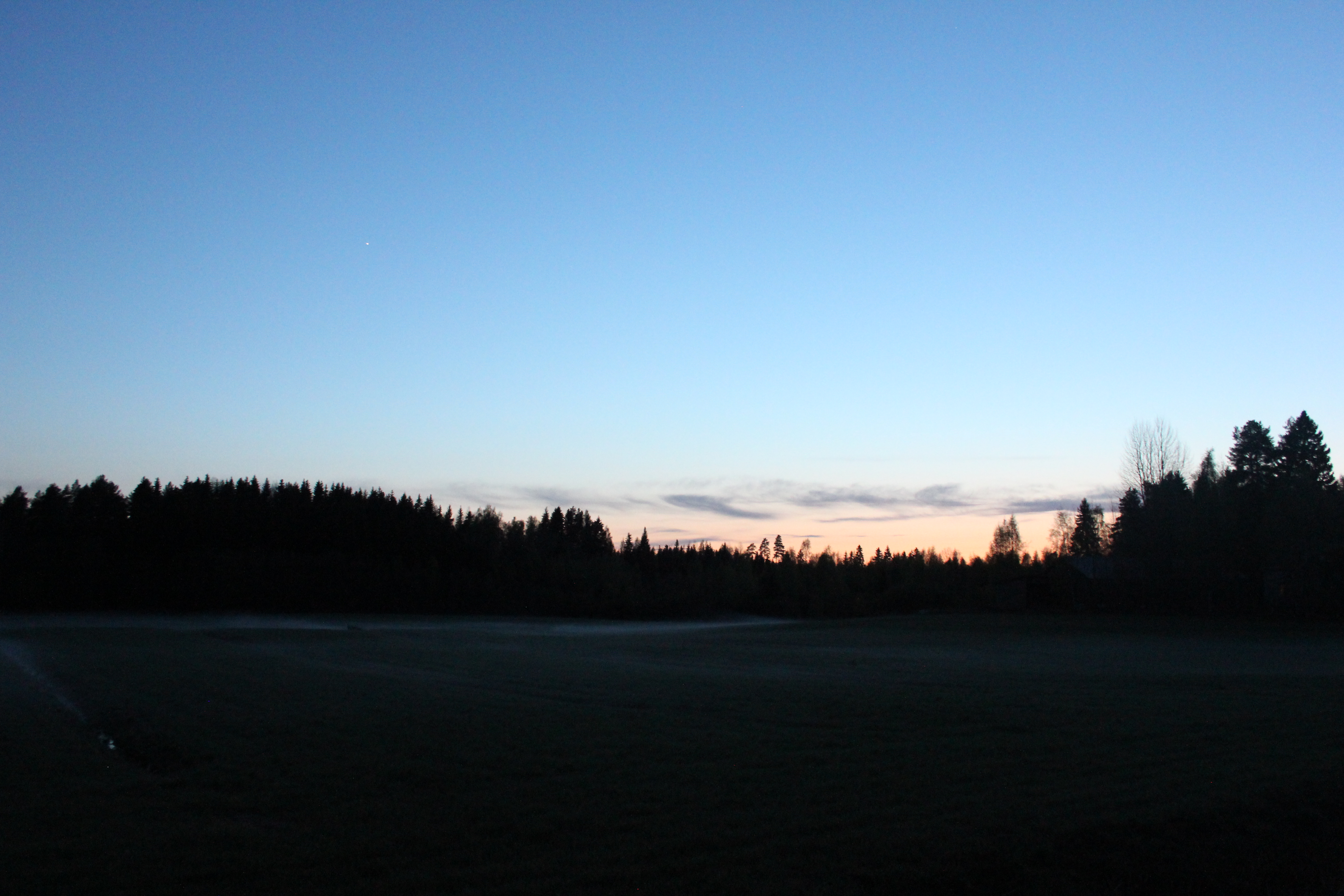
    I was lucky, though. For one, I had a bicycle with me, which I had taken on the train. And two, it was almost summer, and in Finland during this period it’s warm and it doesn’t really get dark until very late. In fact, it was about 23:20 then, but one could still see the light from the sunset on the horizon. The sky was still blue and only one star could be seen — perhaps Venus?

    A road sign further on indicated that the distance to my town was 15 km, which didn’t seem too bad, even if in the end it actually turned out to be 18 km, and I had a heavy bicycle with no shifts. Still, it was better than having to sleep in the forest.

    For many kilometres there were no houses, just trees all around. There was not even any road sign, except for the usual “Moose crossing” warning, so I wasn’t even sure if I was going in the right direction.

    By midnight, it was a bit darker, but still not completely. During the whole time that I was on the road, only one car passed by, just once. There were occasional farm houses here and there, but mostly it was just woods and lakes. No one to be seen for miles. Not even a moose, despite the several signs. A lonely place, indeed.

    The woods are lovely, dark and deep,   
    But I have promises to keep,   
    And miles to go before I sleep,   
    And miles to go before I sleep.

    I did arrive home — or at my temporary “home” — at around 00:30, after one long hour cycling. In the end, it wasn’t too bad. A little adventure to change routine.


    Sometimes I wonder. Did we, also, as a civilization, “miss our stop”? We seem to be advancing frightfully towards some kind of strange dystopia, although not many see it that way. In fact, most people seem to think that we are progressing, and that things are getting better and better, or at least tend to agree with the basic ideology of the status quo that says that we’re on a road to utopia.

    And yet, in most Western countries today, a large majority, close to 70% of people, think that the next generation will have it worse than we do, at least, in economic terms. Asked if they think their children will be better off financially than their parents, 82% of Japanese said “no, worse”; and the same think 78% of French, 76% of Italians, 75% of Canadians, and 72% of Americans, Brits and Australians. The only developed European country where the “better off” won, but just barely (47% against 46%), was Sweden. Finland was not part of the poll.

    When I was a child, back in the Pleistocene, we imagined that in the year 2023 (if we could even see that far) we would have colonies on the Moon and Mars, spaceships, robots, flying cars, incredible medical advances and a society with no crime, no poverty, no war. But now, all we have from that list are robots, and mostly they are of the annoying chatbot kind. When, a couple of years ago, I asked students to describe in a short essay their visions for the future, most painted a gloomy landscape of totalitarian governments and economic doom. The future ain’t what it used to be.

    Sometimes this darkness overwhelms me and I even ask myself if I should keep on writing. It all seems a bit pointless. Who am I even writing for, and why? I don’t really know. I wish I could write just about classic movies, but that doesn’t have a large public either.

    But, then again, why be so gloomy? A missed station and a detour can also be an adventure. It’s also possible that I have been reading too many negative news in too many questionable sites, and things are not that dark.

    It might be close to midnight, but the sunlight can still be seen on the horizon, the sky is still blue, and there’s a lone bright star in the sky, showing the way.

  • Articles

    Drifting Clouds

    How to survive harsh times in an increasingly difficult world

    If you should watch just one film by Aki Kaurismäki, I suggest “Drifting Clouds” (1996), which is probably his masterpiece. Well, to be honest, I haven’t watched a lot of his movies, but it’s the best from the four or five I’ve seen so far, both in technical terms — cinematography, camera, art direction — as in the balanced use of humour and pathos. Wonderful colours (no grey Helsinki here), and, as usual for Kaurismäki, excellent use of music, both classic and popular, including, of course, Finnish tangos.

    The story, such as it is, is about a working-class couple falling in hard times, due to mutual unemployment and a growing economic crisis. But there isn’t really a “plot” in Hollywood terms, as the film is mostly made up of little sequences which are almost independent of each other, showing the cumulative disasters that the couple, and a few other people, have to go through in order to… merely go on living.

    Is it a drama? Is it a comedy? Hard to say. It seems almost unbearably bleak at times, and yet, it does have many gags and even an optimistic feeling. Perhaps it is even the most optimistic film of this notoriously pessimistic Finn. The scene where they have their loan request rejected is both one of the saddest and funniest — “Banks don’t take risks!”

    Kaurismäki: “When I started working on Drifting Clouds, I looked for Frank Capra’s emotional story of salvation, It’s a Wonderful Life, on one side, Vittorio De Sica’s Bicycle Thieves on the other, and the Finnish reality somewhere in between.” (I would also add Robert Bresson as an influence, and in fact a poster of “L’Argent” by Bresson appears at one point.)

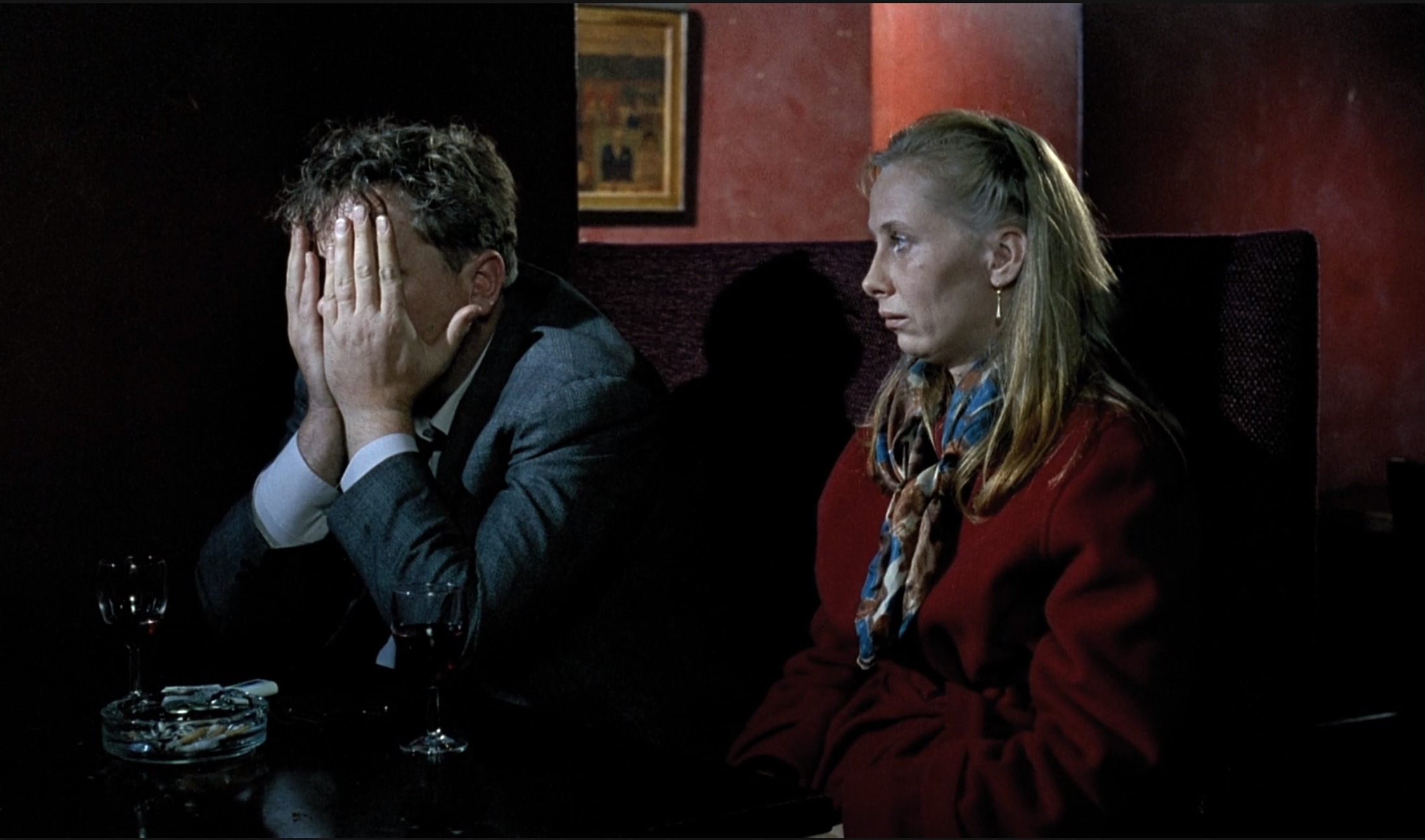
    Kati Outinen plays the wife, Ilona, and Kari Väänänen plays the husband. The role was supposed to be played by Matti Pellonpää, from Shadows in Paradise, to which this film was going to be a sequel, but he died just before shooting started, at only 44 years of age. Almost like the characters that he played in movies, Pellonpää (who also appears in Jim Jarmusch’s Finnish sequence in “Night on Earth”) lived constantly drunk and in debt. He managed to pay his last debts thanks to an advance payment he received to star in this film, but he died shortly afterwards. At least, he died debt-free. A very Kaurismäki-like ending, I suppose. The film is dedicated to him.

    Drifting Clouds is, at the same time, a very Finnish and a very universal film.

    At a time when recession seems to be rearing its ugly head again, and lots of people will probably go through what this couple goes through (or worse), there is much here to identify with.

    Many European countries are right now heading into a recession. Even mighty Germany is predicting economic doom. In the United States, inflation is worse than it has been in ages, and homelessness and drug addiction are at all time highs. Just go to any major city, from New York to Seattle, you will see it.

    And it’s not only the U.S. and Europe. Argentina is in an economic crisis that resembles the 2001 one and might even be worse, and most of South America appears to be heading into economic or political turmoil. War between Ukraine and Russia still rages, with thousands of Slavic young men killing each other for no fathomable reason, and other possible conflicts (Serbia vs. Albania? China vs. Taiwan?) also seem to be instigated here and there.

    A storm, maybe even a hurricane, is coming. Most people don’t seem to realize it, or, if they do, it is just with a general, abstract feeling, like someone who sees dark clouds in the horizon but thinks they are too far away, and even takes a photograph thinking they have some droll shape.

    HAMLET: Do you see yonder cloud that’s almost in shape of a camel?
    POLONIUS: By th’ mass and ’tis like a camel indeed.
    HAMLET: Methinks it is like a weasel.
    POLONIUS: It is back’d like a weasel.
    HAMLET: Or like a whale.
    POLONIUS: Very like a whale.

    How to get through hard times, then?

    The lesson from the movie seems to be: do your best to survive with what you have, but never stop dreaming. Things are bad now, they might become even worse in the future, but they may also unexpectedly get better. Clouds come and go. It’s grey now. It will rain later. But the sun will return one day.

    As a character at one point says, with unbridled Finnish optimism:

    “Life is short and miserable. Better enjoy it while you can”.

  • Articles

    Lost in Kaurismäki land

    Kaurismäki movies. The Finnish character. Russia and Sweden. Tango.

    Aki Kaurismäki is probably one of the most famous Finnish filmmakers abroad. He also has a brother, Mika, who makes documentaries. But Aki directs fiction movies and is more well-known, having won main prizes in Cannes and being nominated twice for the Oscars in the Best Foreign Language Film category.

    His characters are usually blue-collar workers down on their luck, in simple stories about simple conflicts, all told with a sort of dark humour delivered with deadpan seriousness. Far from Hollywood’s fake overproduced glamour, his actors are local, average-looking Finns, such as the wonderful Kati Outinen.

    In many of his films, people don’t talk much, and when they do, it’s in a straight-forward, almost abrupt manner. Consider “The Match Factory Girl” (1990), where there is very little dialog, and even the female protagonist barely speaks in the whole movie. You may think this is a style to make it closer to silent movies, but it isn’t. It’s just Finns being Finns.

    Or consider this dialog from another film, “Shadows in Paradise” (1986):

    “How much does a single room cost?”

    “With breakfast, it’s 100.”

    “And without breakfast?”

    “The same.”

    “Okay, I want to book a room.”

    “Sorry, we have no rooms left.”

    “You should have told me before.”

    “Why?”

    Before I came to Finland, this sounded like some type of absurdist comedy. But now that I am in Finland, I can see this dialog happening in real life. Not saying that it would necessarily happen, just that it could. Finns tend to dislike small talk and prefer to be straight-forward, even literal in their answers.

    There is one scene in that same film where a few characters sit round a table and, unable to say anything to each other, reach our for their pockets and… take out a pack of cigarettes, starting to smoke (today, they would reach for their phones). A foreigner might think that this means that they are feeling uncomfortable with all that silence. But not really. Finns can be comfortable in silence, too.

    In some ways it’s a relief. Compare it to the American custom of always having a forced smile, of always feeling that you need to say something to your co-workers or even to perfect strangers if you happen to share a corridor or an elevator with them, even if it’s just a comment about the weather.

    In American restaurants, the waiter or waitress will come every now and then with a smile to interrupt you and ask: “Is everything alright?” This invariably happens when you have just put another piece of hot potato in your mouth and can’t answer properly. (But when you actually need anything, the help is nowhere to be found.) Finnish restaurants follow the more appropriate European custom, which is ignoring you and letting you eat in peace until you call them to pay the bill (and no tips).

    Migration and Russian relations

    Kaurismäki’s two most recent movies seem to deal with the subject of migration, so I haven’t watched those, as I am afraid it might be just more immigration propaganda (even if, coming from Kaurismäki, I would expect a more nuanced approach, so I might watch them one day). But, in general, it seems to me that old-school leftists like Kaurismäki don’t seem to understand that immigration is actually bad for the working class, and a tool of big corporations to reduce salaries and the general quality of life. Just as they don’t seem to understand that phenomenons like “transgenderism” are not related to the protection of minorities, but again, tools used by big corporations and other powerful people to further destroy the family and reduce birth rates.

    (Whatever the case, it is certainly strange to see old-school leftists pushing exactly the same things that big corporations push.)

    Finland, or at least the small towns away from Helsinki, seems to be still relatively homogeneous, even when comparing it to Sweden, which already has 15% of immigrants, and several problems and political division associated with it. Finland does have foreigners, but most of them are neighbouring Russians, Swedes and Estonians (and now, a few Ukrainian refugees, but not as many as in other countries). However, Iraqis and Somalis have increased in the last years since the 2016 engineered “migrant crisis” and are now in fourth and fifth place respectively.

    Relations with Russia have become complicated by the current war and the joining of NATO. Well, to be fair, they have been complicated for a long time, as Finland used to be initially part of Sweden, then part of the Russian Empire for almost 200 years, until they managed to obtain their independence thanks in part to the Bolshevik Revolution of 1917 which ended the Russian Empire. The Baltic states were eventually gobbled up by Stalin and the Soviets, but, thanks in part to their victory in the Winter War, Finland wasn’t (although they failed in the subsequent Continuation War and lost a small part of their territory to Russia).

    So their concern with Russia is understandable, although perhaps it would have been more prudent to wait and see, as Finland wasn’t and isn’t in any immediate danger. But with the end of the decades-long neutrality and the coming of American military bases, things are probably going to get more complicated again.

    Besides Helsinki, most Russians in Finland live in the Karelian region, close to the Russian border. In fact the old historical region of Karelia was divided between Russia and Finland after the Winter War. Finland, today, has two provinces, called South Karelia and North Karelia, and Russia has the Republic of Karelia (even if ethnic Karelians are currently just a small minority there).

    In the event of a future conflict between NATO and Russia in Finland, watch out for this region.

    Sweden vs Finland

    Relations between Finland and Sweden seem to be in general more amicable, as both countries have more in common (and Finns and Swedes have been intermarrying for centuries). Swedish is even the second official language in Finland.

    However, it is true that Finland was politically dominated by Sweden for a large part of its history, and, even today, the Swedish-speaking minority in Finland comprise a more upper-class segment compared to Finns in general, a hidden aristocracy, you might say. So there is a certain historical resentment, which can be seen in the fact that Finns love to make jokes about Swedes, and have a great rivalry with them in ice hockey, among other competitions.

    The recent victory of Sweden against Finland in the Eurovision contest last Sunday certainly did not help to soothe things.

    Note: the Eurovision contest seems to be particularly loved in the Scandinavian countries. I suppose this is because of the victory of ABBA in 1974, which made that band internationally famous. But, for the life of me, besides ABBA (which was kitschy but at least had good and attractive singers), I never saw the appeal of Eurovision. It just seems very trashy to me, the epitome of kitsch and camp, and I never cared for it.

    But let’s go back and wrap it up with Kaurismäki again, since mentioning music gives me the opening to talk about him again. After all, Kaurismäki movies may sometimes have little dialog, but they do have a lot of music, and in particular Finnish tangos. And while most people of course associate tango with Argentina, Finnish tango — sung in Finnish with a slightly different rhythm — is a very interesting form of “cultural appropriation”, as it has become also a relevant part of Finnish culture. Just watch any Kaurismäki movie and you will see.

  • Articles

    Catholic Finns and alcoholic introverts

    In my constant quest for finding islands of peace and harmony in a corrupt and decaying world, the other Sunday I visited a Catholic Church in Helsinki, which organizes a monthly Latin Mass. (Finding Latin Masses all over the world is my latest hobby, as you may know.) I arrived late, however, missing the Tridentine mass, but I was kindly invited to join the church’s coffee break afterwards.

    If Finns, comprising about 5.6 million people, are a small minority among Europeans, Catholics in Finland are an even smaller minority. Only 14 thousand souls. Less than 0.25% of the population. And almost half of them are recent migrants from Catholic lands, and not native Finns.

    Most Finns are either Lutheran (66.6%) or have no religious affiliation (30%), and a few follow other religions, from Islam to Judaism to Buddhism. Arguably, there could be more practitioners of Buddhism or Wicca than Catholicism in Finland. Back in the woods up north, I was informed that a community of Theosophists following the teachings of Helena Blavatsky live around there, in a big house with their own sauna and even a theatre. I wasn’t aware Theosophy was still a thing. I don’t know how many of them exist in total in Finland, but they could be more numerous than the Catholics. Who knows.

    It was an interesting group, nevertheless. (I mean, the Helsinki Catholics, not the Theosophists, which I haven’t met yet, but will.)

    They told me that there is currently no Catholic Bishop in Finland. The last one, Teemu Sippu, the first native-born Bishop of Finland, retired due to poor health four years ago, and Rome hasn’t bothered to send a replacement yet.

    They also do not get the tax benefits that the Lutheran Church, which is the national church, gets, so they are strapped for cash and dependent on donations.

    On the other hand, they seem to be left mostly in peace. Since the community is so small, the government doesn’t really care about them, and they are not harassed by protesters as in other countries. For instance, in the U.S. and Canada, dozens of Catholic Churches were burned since 2021 by abortionist and leftist activists.

    There was a nice Finnish couple whose teenage daughter sung at the choir and whose son celebrated First Communion that day; also a group of recent Finn converts to Catholicism. I wanted to interview some of them for my short documentary about Finnish identity, but Finns tend to be camera-shy, so no one accepted. Still, asked off camera what he thought about Finnish people, a Catholic Finn defined them half-jokingly as “alcoholic introverts”. Again half-jokingly, or perhaps not, he blamed the “Protestant work ethic” for that. He said he became more extrovert since he converted to Catholicism, as the Catholic church promotes the creation of communities and the idea that life must also be enjoyed, and it’s not all just suffering and hard work.

    As for the alcoholism — well, like in other Nordic countries, alcoholic drinks are heavily taxed and regulated, and can only be bought in special shops. Fact is, winter is very cold, long and dark, and people tend to get depressed. Or, as a retired paper factory worker whom I met at the sauna said — Finns will get drunk and depressed in winter, then in Spring they start to smile again. (Perhaps a seasonal ban on alcohol could work?)

    Historically, whenever such rigid rules against alcohol are relaxed in such countries, alcoholism and public drunkenness become a big problem. Russia, for instance, was historically more liberal with the sale of alcoholic beverages, but that’s why they had more of a problem with alcoholism (it has decreased in recent years, in part due to more restrictive measures such as not selling alcohol in shops after 8 PM).

    For years, Finns used to go to Russia to buy their cheap booze, already during Soviet times, stupefying even the vodka-soaked Russians with their drunken antics. Now, with relations with Russia becoming more complicated due to the NATO-Ukraine war, I don’t know where Finns go to get stoned — maybe Estonia?

    The painting below, by Aleksi Gallen-Kallela, caused commotion in 1894 for showing the highest members of Finnish intelligentsia seemingly drunk. From left to right: Gallen-Kallela himself, composer Oskar Merikanto, conductor Robert Kajanus, and composer Jean Sibelius. (There is a second version of this painting which is more refined, but I like this one better).