• Articles

    Death Games

    From school shootings to Squid Game

    What is it with all these school shootings? Recently there were two in Serbia, another one in Pakistan, and a month ago an attack in Brazil — already the second or third one there. Also Russia, Germany, Denmark have all had school shootings recently. Not content with just shootings, Germany and the UK have had several school stabbings too. Even peaceful Finland seems to have had at least three school shootings since 2008. And of course the United States has at least one every other day.

    While I do believe that some of those events are either false or not exactly what they seem — Sandy Hook and Nashville, for instance, were pretty strange — it is not very conceivable that they are all fake, all over the world, even in poor countries that would lack the money or organization for such type of “false flag”. So we must assume that mass shootings in schools are, unfortunately, a real phenomenon of modernity.

    But why?

    Bullying in schools is not new. It existed at my time too, but no one back then would have dreamt of taking a gun and shooting up his classmates. It just wasn’t part of the mental landscape. Most people have little imagination and take their cues from the media or movies. It was only as school shootings became a “thing” after Columbine, that many unimaginative youngsters started to copycat such events.

    Obviously, SSRIs seem to play a part, too. Most mass shooters were taking those drugs, which appear to affect our perception of reality, and, in some cases, conduce to suicidal or even murderous thoughts.

    Could violent “shoot-them-up” video games be a factor too? There was a discussion about this in the 1990s, but for some reason no one talks about it now. I guess video games make too much money today to be questioned. And I wonder if social media, which has increased the reach and the impact of bullying, plays a part in all that too.

    But one thing that seems interesting for me is the huge number of recent movies and series dealing with the idea of mass murder as a sort of competitive game. It seems to have even become a genre in itself, like the zombie movie or the super-hero movie.

    “Hunger Games” was not the first of those films — perhaps that was the Japanese “Battle Royale” — but it was one of the most popular, selling this idea of a “game” in which peasants kill each other for the entertainment of the upper classes. The earlier “Saw” had a similar concept, only it was a lone psychopath organizing the games.

    “The Squid Game”, the recent Korean series which became a phenomenon in Netflix, likewise tells the same tale: poor, indebted people killing each other, while rich people watch and bet on who will win.

    And a new Japanese series that just came out in Netflix, “Alice in Borderland”, is almost like an even more violent and surreal copy of “Squid Game”, showing a group of young people who are sent to a parallel universe to take part in competitive games where people have to kill or die in the most gruesome ways.

    I am not sure why such stories have become so common and so popular, but it seems to me that they reflect the current zeitgeist.

    One of the current themes in such movies is the idea that life is just a “game of survival”, and that you must kill in order not to be killed. Some characters even say that they prefer this new world of deadly games to the life they had before, and refer to the old world they left behind as boring, depressing or uneventful.

    Now, I guess that warriors or soldiers might have felt this way (at least before bullets and bombs start raining on their head), but what is different here is that these characters are not killing or dying for a country, a king, a religion a or even an ideology, not even for money — but just for a few points in a nihilist game. A meaningless victory, soon to be forgotten in the rivers of Time.

    In some ways, it seems very similar to the mentality of school shooters. What do they intend to achieve? Fifteen seconds of posthumous fame in a newspaper? Perhaps this would be still remotely possible in the 1990s, but in an age where shootings happens almost daily, who even remembers the name or face of the last school shooter? It seems a supremely stupid, random, and evil thing to do, so why even think of doing it? If you hate life so much, why not just kill yourself? Many governments now are offering euthanasia for people suffering from depression, and even children can apply.

    Yes, this really seems to be about finding the most evil thing imaginable — hurting innocent children. I am not sure if I believe in supernatural demonic influences, but there seems to be something evil in the air that is leading people to all kinds of bad stuff that didn’t happen normally before. Such kind of horror wasn’t common, at least, not outside of wars or revolutions.

    At a time when the schools themselves have become more about brainwashing than teaching, not to mention constant bullying and violence, I don’t really understand why more people don’t homeschool. Even when not having actual shootings, many schools these days in the U.S. have shooting drills every six months, which seems traumatizing enough. Actually, just normal public school is traumatizing enough for many people. I guess school shootings are in some ways also the result of forcing public schooling on everyone.

    There must be something terribly wrong in a society in which such violent events happen so frequently, just as there must be something terribly wrong in a society where movies selling random wholesale murder as a fun game have become so common.

    Are the movies just portraying reality, or influencing it? Has murder become a nihilist game because of its promotion by the media? Or are those movies just a reflection of a scary new way of life, where everything, even murder, is gamified?

    Now, I do agree that “Squid Game” was fun to watch, and there is a morbid interest in some of the other series or movies with such themes. Still, after watching one of those recent violent series, I had a nightmare. Like in those series, there were violent games in which people had to kill each other to survive. The only difference was that, in my dream, no matter what happened to them — falling from great heights, or being chopped into pieces — people just wouldn’t die, or would respawn immediately after death, like in a video game. So there was no escape. Everyone would keep torturing and killing each other, for all eternity.

    There is a known name for such a place: Hell.

  • Articles

    In Finland: between Art, Industry and Nature

    My experience in Finland is turning out to be very different from the one in Sweden last year, and not just because of the different seasons. While superficially both places seem to resemble each other (a small village somewhere lost in the woods, near lakes), the similarities end there. Björkö was, or seemed, lonelier and wilder. While I never really saw a lynx around there, the possibility wasn’t completely far-fetched.

    Here in this small Finnish town, nature is more curated. There are forests and lakes, sure, and hares and all kinds of birds, but also a paper mill that uses timber from the forest and the water from the lakes as its main raw materials. It was built here last century by Finnish magnate Gustaf Serlachius, even though today it belongs to another multinational company. It was the cellulose industry that put this small town in the map. In fact, I am not sure the city even existed before the paper mill.

    Its founder, Gustaf Serlachius, along with his nephew and heir Gösta Serlachius, was a great patron of the arts, and that is why there are not just one but two museums in this small town, which started from their private art collection. There is also a arts residency program and an art festival, which is unusual for such a small village. But the paper factory makes a lot of money — they had a boom thanks to the toilet paper sales during Covid — and they must spend it somehow.

    As part of the residency program, I am staying in a little house right next to the Gösta Serlachius Museum with its beautiful gardens, a forest and a lake nearby, and, not far away, on the other side of the forest, the paper mill.

    The Museum is surprisingly interesting, especially its classic collection. I suppose not many people are familiar with Finnish artists (I know I wasn’t until very recently), so here’s a basic primer about Finnish art.

    Albert Edelfelt is perhaps the first name worth mentioning. Born in Finland in 1854 from Swedish parents, he studied and lived in Paris, like many artists of the time. In a short time he became famous enough to be commissioned to paint a portrait of French scientist Louis Pasteur and, in 1896, of the Russian Czar Nicholas II — yes, the one who was later murdered, together with all his family, by the bloodthirsty Bolsheviks. It is worth remembering that the time, Finland was a self-governing Duchy that was part of the Russian Empire, who had wrestled it from the Swedish Empire. Finland has been independent since 1917, thanks in part to the Russian Revolution that put an end to the Russian Empire.

    But my favourite work by Edelfelt is a painting of a Finnish Mary Magdalene kneeling before a Finnish Jesus, in a very Finnish landscape (that ain’t Galilee). It is based on the poem “Mataleenan vesimatka” (“Magdalene’s journey across the waters”) from the classic Finnish collection of folk poetry Kanteletar. The model for Magdalene was Edelfelt’s servant, who had recently lost her husband (he had drowned in a lake). Apparently, the painter would ask her to think about her deceased husband during the posing sessions, to achieve the right suffering expression.

    The second artist worth mentioning is Akseli Gallen-Kallela, the closest that you may find to a Finnish national painter. He was a family friend of Gustaf Serlachius, and painted the most famous portrait of his patron, as well as of his wife and daughter. But he painted many other famous paintings (well, famous in Finland), several of them inspired by the Kanteletar and Kalevala, the Finnish national epics.

    Among my favourite paintings by Gallen-Kallela is “The Enchantress”. I saw this painting at the Gösta Museum, standing by itself at the end of a long corridor, and was immediately struck by it. A witchy naked woman holding an apple and a drink beckons you from the end of a corridor in an empty museum… I thought that I had made a photograph of the painting, but turns out I hadn’t. So a few days later I went to the Museum again to take a picture, only to find that it wasn’t there anymore! Something else was on its place. Had it been just a dream, a figment of my imagination, or some kind of witchery? (Which wouldn’t be wholly inadequate for the painting) But after some inquiries, I discovered that it has just been sent on loan to another exhibition.

    Helene Schjerfbeck is another important painter from this period. She started as a realist painter. “The Convalescent”, recently voted the second best-loved painting in Finland, is perhaps her most famous work from this period. Later on she changed to a more modernist, sketch-like style, which is perhaps more original, and not bad at all, but I still prefer her earlier work.

    Another interesting female painter from this period is Elin Danielson-Gambogi. While initially she — like every other artist of the time — moved to Paris, in 1895 she obtained a scholarship to study in Florence, and a year later she moved to Antignano, in Livorno. There, at 36, she married an Italian painter who was 13 years her junior, and lived most of her life in Italy, painting its people and its landscapes. “After breakfast” (1890) is one of my favourite paintings of hers.

    Hugo Simberg, from a slightly later period, is another relevant Finnish painter, associated, like Gallen-Kallela, with the Symbolist movement. His “The Wounded Angel” was voted as Finland’s favourite painting in the poll mentioned before. But I think I prefer “Sheep Girl” (1913).

    Finally, we should mention Eero Järnefelt, whose striking painting “The Wage Labourers (Brush wood burning)” (1893) caused a big discussion at the time for its unromantic depiction of the suffering poor. It is also at the Gösta Museum.

    I visited Helsinki briefly today — I will write about it later on — and as I was going back to the train station I saw that there is currently an exhibition of Albert Edelfelt at the Ateneum, so it might be a good excuse to visit the city again.

  • Articles

    Meeting the Finns

    Initial contacts with an alien race

    Finns are stereotyped as being extreme introverts who don’t like small talk — or even to talk at all. The series of cartoons “Finnish Nightmares” is a good general introduction to the Finnish psyche, and pretty funny too.

    But, so far, most people that I talked to have been kind, polite, and not afraid to start conversations. The most introvert person I met was a Lithuanian girl — or perhaps it was an Estonian, I forget. We didn’t talk more than 2 seconds.

    I suppose a difference with the Swedes is that, in Sweden, whenever I crossed paths with someone, being a small village, they would exchange a smile and a “Hey”. Here, people just cross each other in silence. It is true that, when I passed, perhaps a bit too closely, an old man in a narrow path with my bicycle, the man murmured something in Finnish, but I am not sure what it was. It could equally be “hello”, “have a nice day” or “damn, you bastard, watch where you’re going!”

    If you’re wondering how to meet Finns, the best answer is, in a sauna, of course. You’re all close together with strangers in a very hot and very limited space, so people tend to talk to each other. It does help that, in Finnish mixed sauna, people are not usually fully naked. In the one I go, they use swimsuits. (Finns tend to find strange the more common custom in saunas in Germany where everyone is nude — not that I would know, as I haven’t been to saunas in Germany. But it’s what they say).

    I haven’t been here long enough to fully understand the Finnish character, but I guess that the usual stereotypes about being reserved mostly hold out. While they are kind and polite, and surprisingly conversational in saunas, I suppose making long-lasting friendships takes a whole lot more time. They are more like Germans than Catalonians or Italians.

    Some go as far as describing them as grumpy, but it is not true. They just have a curious way of smiling, with the corners of the mouth going down instead of up.

    Another stereotype about Finns is their general honesty. In an experiment they did in different countries, leaving 12 wallets lying around to see if people would pick them up or just take them, Finns had the highest return rate — 11 of the 12 wallets. And I suspect the 12th one was either not found, or found by someone other than a Finn.

    I can attest to that — in the sauna, I forgot to close my locker. In fact, I left it completely open, with my phone and my wallet in full view. Everything was still there when I returned. In fact, I noticed that someone else had made the same mistake, and his phone and wallet were still there, too. You’ll say that this would happen in Germany too, but I’m not sure — I had too many things stolen there, including three bicycles and even a bag with library books (!), to be so casual about my personal items.

    Another thing Finns like is their personal space. They say that the Covid “social distancing” thing didn’t catch on in Finland simply because it would actually have moved people closer together.

    With 17 people per square km, Finland is one of the less densely populated European countries, so they have enough room to move around.

    Another thing about Finland is that they live mostly in small towns or villages, like the one I am in, and Finns like it this way. As someone said, Finns don’t do big cities, it’s not their thing. Even Helsinki, which concentrates about 1 million of the 5.6 million Finns, feels more like a village that grew too much than a big cosmopolitan European town.

    In general, Finns like to have a forest and a lake within walking distance. And with more than 200,00 lakes and 75% of forest covering the country, they usually do.

  • Articles

    Who really wants AI and why?

    The mystery in the rise of technologies that no one asked for

    Since no one is very much interested in my travel articles about Finland, I will go back to ranting about AI and automation — which interests even less people, but that’s fine. I get paid by the word…

    I’ve noticed that self-checkout is taking over more and more shops and supermarkets. They have existed for a while, of course, but more as an alternative to reduce lines.

    In Germany, they were not very common until recently, but suddenly they started appearing in most supermarkets. In Finland, they are a regular fixture of most stores and probably have been for a while.

    Yet, self-checkout appears not to be very effective or convenient, neither for shops nor for customers. Many customers tend to dislike self-checkout, as evidenced by the fact that there are always lines for human cashiers but none for self-checkouts. They give you the perception of more speed, but it is just illusory. Professional human cashiers scan and move your products faster (specially in Germany, where they go so quickly, basically throwing the stuff at your face, that you can hardly keep up).

    “Nobody likes self-checkout“, says an article at CNN, “Here’s why it’s everywhere”.

    Basically, as it is typical in the “digital economy”, it is just another way of passing the work to the customer and making think he’s gaining something with the exchange. Now, it may work for some — and I guess it is good if you want to avoid human interactions with a cranky cashier, which sometimes has its benefits.

    You’d think that this type of automation would reduce the work of human cashiers and therefore save money for the companies and therefore make products cheaper, but it is not so. First of all, the machines need constant maintenance. Even if companies reduce the number of cashiers, they need to hire more technicians, which are paid more. The machines cost a lot, too, and require programming. And are supermarket products becoming cheaper? I don’t think so, quite the opposite in fact…

    But not even the reduction in the number of human cashiers is a given. When people have to do their own checkout with machines, there is always something that goes wrong, or some product that won’t be scanned, so many people constantly require assistance even when using the self-checkout. In the end, cashiers and supervisors actually end up having more work, instead of less.

    Of course, self-checkout is more conducive to shoplifting — sometimes voluntary, sometimes accidental. There are items, such as bread, that have no barcodes, and it becomes more complicated to register them in. Even if most people are honest, some are not. Companies lose more money with that, too — according to that same CNN article, losses are about 77% higher than at stores without self-checkout.

    Since it doesn’t save money for companies, nor makes the products cheaper or the experience better for customers, one has to wonder why most companies are moving to self-checkout anyway? CNN‘s and The Guardian‘s answer is that “most companies are doing it, so they feel that they have to do it too”, which seems a stupid explanation.

    The same is true of customer service — most people dislike bots as costumer service agents and prefer talking to a person. Yet bots keep being used, more and more. I suppose they are cheaper than paying a person to answer the phone, but my suspicion is that it’s about something else entirely. And in fact an article gives it way when it says that bots can easily record, memorize and access all your information, in order to provide for a “better customer journey” (the new marketing buzzword is “journey” instead of “experience”).

    Obviously, there is something else behind the hype. Like with everything related to AI, there is a huge push by Big Tech for making everything automated and AI-dependant, from cars to journalistic essays to art works. And the reason is “big data”. Getting all the information they can about you.

    In “1984”, George Orwell predicted screens observing us 24/7. But now we have not just screens, but cameras, satellites, location tracking apps, facial identification apps, voice recording apps, AI. They will know what you eat, what you poop, how much money you make, how much you spend, what hereditary diseases you have, and what you did last summer.

    In the end, what “Artificial Intelligence” is really about, is not “intelligence” in the sense of “being clever”, but “intelligence” in the meaning understood by the CIA — gathering “intelligence”. Recording, remembering and accessing all kinds of information from everybody.

    Soon, all objects are going to be spying on you.

    And it will not be just governments and big corporations. A recent story about a mother who received a message about her daughter’s (fake) kidnapping using the daughter’s cloned voice, as well as the emergency of very believable “deep fake” videos, show the huge boost for scamming and crime provided by these new technologies. If you thought spam mails and spam calls were a nightmare, get ready for the new AI-powered identity thefts and scams.

    Unfazed by the relative failure of self-checkout, Big Tech is pushing for even more of it. Amazon, who owns Whole Foods and other physical stores, has introduced “smart carts”, where your products are scanned and weighed as soon as you put them in the cart, no checkout needed (your debit card or phone is charged automatically).

    Other new versions of self-checkout include shops where each movement is tracked by AI cameras and motion sensors, registering each item you take from the shelf and billing you later. All you need to do is swipe a credit card or smartphone, at least until the new methods that allow you to pay by facial recognition are installed.

  • Articles

    Walpurgisnacht

    Or just Vappu in Finland

    German might not sound as musical or romantic as French or Italian, but it is a great language for solemn, intriguing, seemingly fateful words. Take Walpurgisnacht, for instance. It may sound like a curse or an omen, but it just means Night of (Saint) Walpurga (or more exactly, if less literally, The Eve of Saint Walpurga’s feast).

    However, the current holiday, called more simply Vappu in Finland, is actually a mix of three different celebrations, one Christian, one Pagan and one political, all converging on May 1st and the night before.

    Saint Walpurga or Walburga (710 – 777) was an Anglo-Saxon woman from a prominent family who became a Christian missionary in Germany (Bavaria), and lived as an abbess in a monastery in the Bavarian village of Heidenheim. She was canonized and her remains were transferred to the town of Eichstätt on May 1st, 870. Since then, May 1st became her traditional celebration, and the night before, Walpurgisnacht.

    During Medieval times, people prayed to Saint Walpurga to protect themselves against the effects of witchcraft. A tradition holds that during Walpurgisnacht, the night before her feast, witches hold their Sabbaths and the evil powers are at their highest. According to German historian Johannes Praetorius (1630-1680), it was believed that on that night witches rode to the top of the Brocken, Germany’s highest mountain, where they danced and fornicated with the Devil.

    Meanwhile at night in Walpurgis Eve
    In large numbers as I report
    The Witches with her offspring
    Generally hold a meeting
    The young as well as the old
    Which all the devil leads there
    On which they dance and jump
    Spending time drinking too
    Fornicating with evil spirits

    Goethe probably used this as a reference for a scene in his Faust play, called Walpurgisnacht, where witches ride to the top of the Brocken with “stinking old goats” (devils).

    As you can see, the association of Walpurgisnacht with witches and devils is probably quite old. In medieval Germany, during that night, people would hold bonfires on hills, as a form of protection from evil. The tradition still remains in some parts of the country even today.

    It was common in the early development of Christianity for a few Pagan feasts or symbols to be incorporated into Christian traditions, but this is a slightly more complicated case. While the date of the canonization and transfer or the remains of the Saint might have been a coincidence and not chosen for any specific reason, many associate May Day/Walpurgisnacht with the Scandinavian and Germanic early pagan celebrations of Spring, which took place around the same period in late April or early May, and included lighting bonfires, among other things. So it is possible that both celebrations became, with time, mixed together. Or, perhaps more accurately, the new religious feast allowed for a continuation of traditional folk eastern rites. According to the Encyclopedia Britannica, “Although it is likely that the date of her canonization is purely coincidental to the date of the pagan celebrations of spring, people were able to celebrate both events under church law without fear of reprisal.”

    Some even say that the word Walpurgis (Valborg in Swedish and Norwegian) has another meaning unrelated to the name of the Saint. In the Old Norse language, Val means dead or slain (think Valhalla, which means Hall of the Slain, or Valkyrie: “chooser of the slain”). “Borg” means mountain or mount. So Valborg could mean something like “mountain of the slain”. But it seems a convoluted explanation, and the relation with the feast is unclear, except perhaps for its association with mountains (and witches gathering on top of mountains).

    There are other etymological theories for Walpurgis/Valborg/Vappu, but none of them are completely convincing. Since Valborg (Walburg in German) is still a common female name in Scandinavian countries, it is more likely that the feast’s name comes from the Saint’s name indeed. “Walburg” comes from High German waltan (to rule) with burg (fortress). Perhaps a possible translation could be “mighty fortress”.

    May 1st may still have some religious tones in Bavaria, where there are still processions to Saint Walburga’s tomb in Eichstatt. But, in Finland, the celebration became mixed with the Labour Day holiday on May 1st, which was important for political reasons, and has become almost completely secularized. Few people even seem to remember its origins, either Pagan or Christian — it’s more an excuse for students to party, if anything, as it coincides with the beginning of their Spring break. I quote the Encyclopedia Britannica again:

    “Initially, Walpurgis Night was celebrated by the Finnish upper class. Then, in the late 19th century, students (most notably engineering students) took up its celebration. Today merrymaking begins on the evening of April 30, often augmented with the drinking of alcoholic beverages, particularly sparkling wine. The carnival-like festivities carry over to the next day, frequently taking on a family dimension, as friends and relatives picnic in parks among balloons and consume sima, a homemade low-alcohol mead.”

    Sima is a fermented beverage traditionally made with lemon, honey and yeast, but today it is sold ready-made in supermarkets as a soft drink. Its alcoholic content is less than 1%. I tried it. It tastes more or less like a lemonade.

    So — Vappu in Finland is neither witches’ day nor pagan ceremony nor religious festival, but just a night for partying and a day for picnic. Another tradition, exclusive to Finland and connected to its appropriation by university students, is to put graduation caps on statues. In Helsinki, it means the statue of Havis Amanda.

    So, basically, even if it is considered the fourth most important holiday in Finland, it seems to be, today, mostly just an excuse to party. So much so that, in an introductory book that I’ve read about Finland, they talk about the holiday but do not explain its name or origins. They just mention, very vaguely, Labour Day.

  • Articles

    Waiting for global warming

    And warming up to Finnish sauna

    So today I went to a Finnish sauna at the Museum. Sauna at the Museum? Well, this is Sparta! I mean, Finland. There’s sauna everywhere. Who would think that sitting in a steamy room at 75 degrees Celsius then submerging into a lake at 5 degrees Celsius would be fun? But it was better than I expected. Then I went out for a walk in the forest as the sun came out later on.

    Last year I was in Sweden for a month, exactly in the worst of winter (January), and I wrote a lot about it (you can find it in the archives starting here). It was mostly a very nice experience. And of course I lived in Canada for years. So I am used to VERY LONG AND VERY COLD WINTERS. I generally dislike them — I much prefer the Mediterranean climate — but well, at least I am used to them.

    But it turns out that Spring can be sometimes more depressing, because it doesn’t look like Spring at all, at least as I understand it. It is more like a very slow de-icing with lots of clouds and rain and occasional sunny days, until suddenly one day, Summer comes.

    Yet, for weird some reason, Sweden and Finland (together with Germany, and perhaps also Canada), seem to be among the countries most obsessed with global warming. I find it very odd. If there are countries which would benefit immensely from a global increase of a few degrees in temperature, wouldn’t they be the Scandinavian countries? African countries might boil, and people in Sardinia and Sicily might fry, but what are Swedes and Finns worried about? Fewer ice hockey fields? Ruining the sauna experience?

    My theory is that global warming is a kind of pagan religion, and the Scandinavians haven’t completely forgotten their old pagan traditions. They did worship trees or forest nymphs, after all, and Nature is still pretty much sacred in all of Scandinavia.

    But does global warming really exist? I am no scientist, so I can’t say anything from a scientific perspective. But speaking from personal experience, I can’t really say that it has affected my life, or anyone’s life, very much. Say what you want about Covid, at least it caused a visible impact, even if most of it was because of the bad policies.

    As far as I can remember, the fear of global warming, later called also more generically climate change, started being promoted already in the 1980s. By the 1990s they were already promising the end of the world in 20 or 30 years. Yet 30 years have passed and things look pretty much the same. Sure, there are minor variations in the climate every year, but I can’t really say that I have seen anything catastrophic in my lifetime.

    In the 1980s, they used to talk a lot about the “hole in the ozone layer”, and supposedly they closed it, or at least, no one talked about that hypothetical problem anymore after they banned CFCs. Could it have been yet another fake, and they banned CFCs for some other, probably commercial, reason? Who knows. But that’s the only real change I remember.

    Maybe winters have become less rigorous in some parts of the world (but not in Canada), maybe it is a bit warmer everywhere on average, but the world didn’t end, the polar ice caps didn’t melt, the oceans didn’t rise, even the polar bears are still around. So I find it hard to worry too much about the new apocalyptic theories.

    Even if climate change or global warming were real, none of the proposed solutions make any sense, except as a form of tax to make people poorer or breed less. That’s not to say that there are not a lot of very serious environmental problems, from forest burning to the pollution of the oceans to the extinction of species to micro-plastics all over even in our food. But climate change or global warming doesn’t seem to be one of them.

    Greenland used to be green — that’s why it’s called “Greenland” and not “Iceland” — so the Earth has been warmer before. It has also been much, much colder. So big global variations in temperature are not something new, and they are probably caused by the sun. If there is some anthropogenic influence, it can’t be more powerful than the sun.

    The sun — that’s something that you occasionally miss up here in the North. I for one could do with a bit more of it.

  • Articles

    Finland: The Land of the End

    The Happiest Country in the World? Well, happiness is subjective

    It was quite a shock teleporting from the sunny beaches of Catalonia to the still half-frozen lakes of Finland, and I wondered for a while if I had not made a terrible mistake. To be honest, I still have not recovered. Today it’s not cold, 16 degrees, which I was told is quite warm for this period. In fact, the lady at the Museum told me that today was “the warmest day on record in all the history of Spring in Finland”. I think, or hope, that she was joking or exaggerating. But perhaps not.

    So far, I am having a bit of a trouble understanding if Finns are joking or being serious. Yesterday I went to a local pub and I asked if there was any “typical Finnish shot” that I should try. The waitress wasn’t sure if there was a typical Finnish drink, but she said that I could try the house’s special shot.

    “What’s it made of?”, I inquired.

    “Liquids”, she replied.

    If this was in Spain, I would have moved to another pub, but this is Finland so I took it as a joke. Also, I think it was the only pub in town. The next one was probably 5 or 6 kilometres away. Toto, I’ve a feeling we’re not in Catalonia anymore.

    The shot wasn’t bad, but I still don’t know what it was made of.

    The next morning, someone else told me that the ice was “almost all melted” and that she had gone to take a swim in the lake. Again, I am not sure if it was a joke or not. I assumed this time that the person was serious and that swimming in ice-cold waters is what Finns do for fun.

    I am fascinated by Scandinavian countries and people, but it is a fascination filled with some kind of dread. It is like visiting an alien super-civilization. A super-civilization, where everything mostly works, and where there’s lots to admire, sure, but alien all the same. I confess that I feel more at home in my disorganized, noisy, dirty, confusing and less civilized Southern Europe. What can I do.

    Still, people here have been very nice and polite, and the landscapes are awesome. Pristine forests and lakes all around. Not a single sign of littering, as I would probably see in Spain or Italy (and, to be honest, even Germany). Not a single plastic bottle or even a piece of paper, for miles.

    Recently there was a poll saying that Finland is “the happiest country in the world“. I don’t know what are the metrics exactly, but I always take such polls with a grain of salt, especially when they are promoted by some spooky organization. I think it is really about how well a society functions — road construction, public transportation, trash collection, education, etc. In that sense, Finns are probably more satisfied than people in Spain, where construction work takes years, metro trains are crowded and someone can steal your wallet, and education is so-so.

    But happiness? How can you measure that? I, for one, would probably be happier sitting in an average cafe in Barcelona than in the best sauna in Finland. To each his own.

    And yet, the reason I accepted the invitation for a residency and teaching a workshop and came and will — if I survive — still stay here for a couple more weeks, is that for me Finland always had an aura of magic. Perhaps it was the name: Finland, which to me (in Spanish: Finlandia) translated as “Tierra del Fin”. Final Land, Land of the End. The last possible destination on Earth. A country unlike any other.

    In a way, that may be true. And yet, it is not completely dissimilar from Argentina. I heard that tango is very popular here. They even have their own variation, Finnish tango. It is the same rhythm as in Argentina, the only difference is that the lyrics are in Finnish. Oh, and that they dance it out in the snow.

    As I said, an alien super-civilization. May God help us all.

  • Articles

    Where are we going?

    Some final thoughts on the “Reset” stuff — mine and de Tocqueville’s

    There is a short animation that came out recently about the “Great Reset” aka Covid operation and how it could evolve into some kind of permanent totalitarian dystopia. The film has some moments, but I think that, in the end, they get it wrong. The future is more Brave New World than 1984, although perhaps a mix of the two, with Mad Max, Blade Runner and a few other dystopias thrown in would be a more accurate prediction. 

    Also, the film feels now slightly anachronistic, because since 2022 it seems we have moved on from pandemics to war, school shootings and transgender overdrive, and a bit of global warming alarmism too. People can’t keep too many worries in their mind at the same time, so I guess the pandemic stuff had to take a little break.

    That said, the global reaction to Covid was indeed a wake-up call to many people, because they saw how quickly our society could turn authoritarian with the flip of a switch, with the flimsiest of excuses, and basically everywhere, with nowhere to run to. And if we don’t have even basic freedoms in the West, then what good is it for? Isn’t “freedom” the whole selling point of the West?

    But even if there was a form of totalitarianism during those two years (and which in some cases continues albeit in milder forms), it was a soft totalitarianism. You didn’t get shot or sent to the Gulag if you didn’t take your medicines. You just lost your job, or couldn’t have dinner, or had to stay in your room: the global government more as a loving mommy who sometimes has to be strict. The point was not so much about forcing you to do things, but about convincing you that this was the right approach. Alexis de Tocqueville got it right, almost 200 years ago:

    I seek to trace the novel features under which despotism may appear in the world. The first thing that strikes the observation is an innumerable multitude of men, all equal and alike, incessantly endeavoring to procure the petty and paltry pleasures with which they glut their lives. Each of them, living apart, is as a stranger to the fate of all the rest; his children and his private friends constitute to him the whole of mankind. As for the rest of his fellow citizens, he is close to them, but he does not see them; he touches them, but he does not feel them; he exists only in himself and for himself alone; and if his kindred still remain to him, he may be said at any rate to have lost his country.

    Modern man lives in isolation from his countrymen. In fact, it fair to say that he has no countrymen at all. When his “countrymen” can actually be from any country, from Eritrea to Nepal, when being Spanish or Italian or German or even Eritrean is just a matter of geography and paperwork, what real country does he have? But it’s not just that, of course. The extreme individualism of the West has reached a point at which man is also aloof from his community, his neighbours, and in many cases, even his own family. Tocqueville goes on:

    Above this race of men stands an immense and tutelary power, which takes upon itself alone to secure their gratifications and to watch over their fate. That power is absolute, minute, regular, provident, and mild. It would be like the authority of a parent if, like that authority, its object was to prepare men for manhood; but it seeks, on the contrary, to keep them in perpetual childhood: it is well content that the people should rejoice, provided they think of nothing but rejoicing. For their happiness such a government willingly labors, but it chooses to be the sole agent and the only arbiter of that happiness; it provides for their security, foresees and supplies their necessities, facilitates their pleasures, manages their principal concerns, directs their industry, regulates the descent of property, and subdivides their inheritances: what remains, but to spare them all the care of thinking and all the trouble of living?

    Indeed, what remains? As I said, the authority of a parent, but as Tocqueville beautifully adds, with the intention not of making the child grow up, but to remain in perpetual childhood. And what is not modern man if not a child that never grows up?

    The will of man is not shattered, but softened, bent, and guided; men are seldom forced by it to act, but they are constantly restrained from acting. Such a power does not destroy, but it prevents existence; it does not tyrannize, but it compresses, enervates, extinguishes, and stupefies a people, till each nation is reduced to nothing better than a flock of timid and industrious animals, of which the government is the shepherd.

    So there. I think we are at that point now. The Great Reset was not exactly a plan to create a global Gulag. Nor was it a plan to reduce the world population by half, or whatever is the number desired (they can get that through other means, and in fact, birth rates keep going down). But it was created to make you accept the new products they are bringing out — one, the mRNA vaccines, which are really just a gateway drug for the mainstreaming of genetic manipulation of humans, and two, a new form of digital identity — digital cash, the “metaverse”, AI, digital passports, implants and other technologies are just many aspects of this same general idea.

    The other day a friend showed me one of these new AI toys. You type in some words and the bot creates a silly story for you. The first attempt wasn’t very memorable, so to make the story a bit more exciting, in his second attempt, my friend typed in a few new random words, one of which was “killer”. Instead of coming up with a story, the bot replied some excuse that it is programmed for peace, understanding and tolerance and could not create a story that promotes or shows violence. (There goes the idea of using it to create the next best-selling mystery thriller.) Meanwhile, on the sidebar, the same search engine was showing all kinds of news about school shootings, war, and random criminal attacks.

    I thought it was very representative of the world we live in.

  • Articles

    Daily Routines

    Taking life as it comes day by day

    Cats and dogs love routine. They must eat at every day roughly at the same hour, take a walk or play at roughly the same hours, sleep at the same hour, etc. They find it strange if people or places around them change too much. Cats in particular are very fussy about any object that is not in its usual place inside the house. (For those interested, I wrote a brief book about the history of our interactions with pets).

    Humans love routine too, even though sometimes we think we don’t. The proof is how quickly we adapt to a new place and create a new daily routine, almost instantly.

    I’ve been in Catalonia for less than two weeks and, since I am only working remotely these days, I already have my daily routine of walks and cafes, with only a few variations. In the mornings I usually go to the fancy cafe up the hill, which has the best croissants but is a bit expensive for anything more substantial; in the evenings, I go to the “bar del chino” near the beach which has the cheapest bocadillos and the coldest beer.

    Today, however, I inverted things and I am in the evening in the cafe up the hill. (I am a bit more flexible than cats and dogs, plus, I will — alas! — leave Barcelona soon and my routine will change, again.) The waiter here is a sympathetic young man with black-painted fingernails. I don’t think he’s gender-fluid or anything, it’s just that it’s that kind of fancy, alternative, modern place. If it was a girl, she would have lots of tattoos, blue hair and a nose ring.

    He seems to be an exception. Young people here in Spain, or at least in this lazy suburban place, seem to dress more conventionally than in other places. In Germany, at least in the big cities, most young women you come across have hair painted in unnatural colours, several nose rings, weird clothes, tattoos. Here tattoos are — unfortunately — common too, but young people in general look a little bit less conspicuous.

    Drinking a cappuccino instead of a beer, I am more alert and attentive to my surroundings. I overhear the conversations around me. A woman is talking to a man about her recent experiences as a failed migrant in Australia.

    “Because in Australia, they don’t like the Spanish so much. They think Spanish people are… Well, they discriminate against us,” she says.

    “Ah. Like us with the Argentines,” replies the man.

    “Exactly!”

    (I am an Argentine by birth, but I have never felt any discrimination here. To be fair, neither my accent nor my looks give me away.)

    On another table, someone is saying that you have to choose well your profession. “If you are, for instance, a translator, you won’t find many jobs.”

    (I am, among other things, a translator. And he’s right, there’s no much work lately, and what there is, is not well paid. AI is taking it all.)

    The only consolation is that it is taking everybody else’s jobs too. In Germany, I’ve noticed that many shops and supermarkets started transitioning to automatic cashiers. Some places do not even accept cash anymore, in a transition to digital money. Yet people still cheer and hype about AI, even as it steals our jobs and makes us redundant. The newspaper I’m reading at the cafe — a real news-paper, those still exist here — has several articles about AI. It will probably make many journalists redundant too. Yet, the only complaint they can find is that it “consumes a lot of energy and therefore contributes to climate change”. (Modern life is all about stressing yourself with imaginary problems, while ignoring real ones.)

    Me? Well, you know, I’m basically a Luddite. I still listen to vinyl records and read paper books and old style newspapers (if I can get them for free, as I don’t like to pay for propaganda, thank you).

    Here in this suburban town in Catalonia, time seems to have stood still — at least, a little bit. There are no self-checkout cashiers around, and all places accept cash.

    I wish I could stay longer, but, like a stray dog without a home, my routine has to adapt to the circumstances. Here today, gone tomorrow.

    In the end, isn’t this how we all live?

  • Articles

    Barcelona

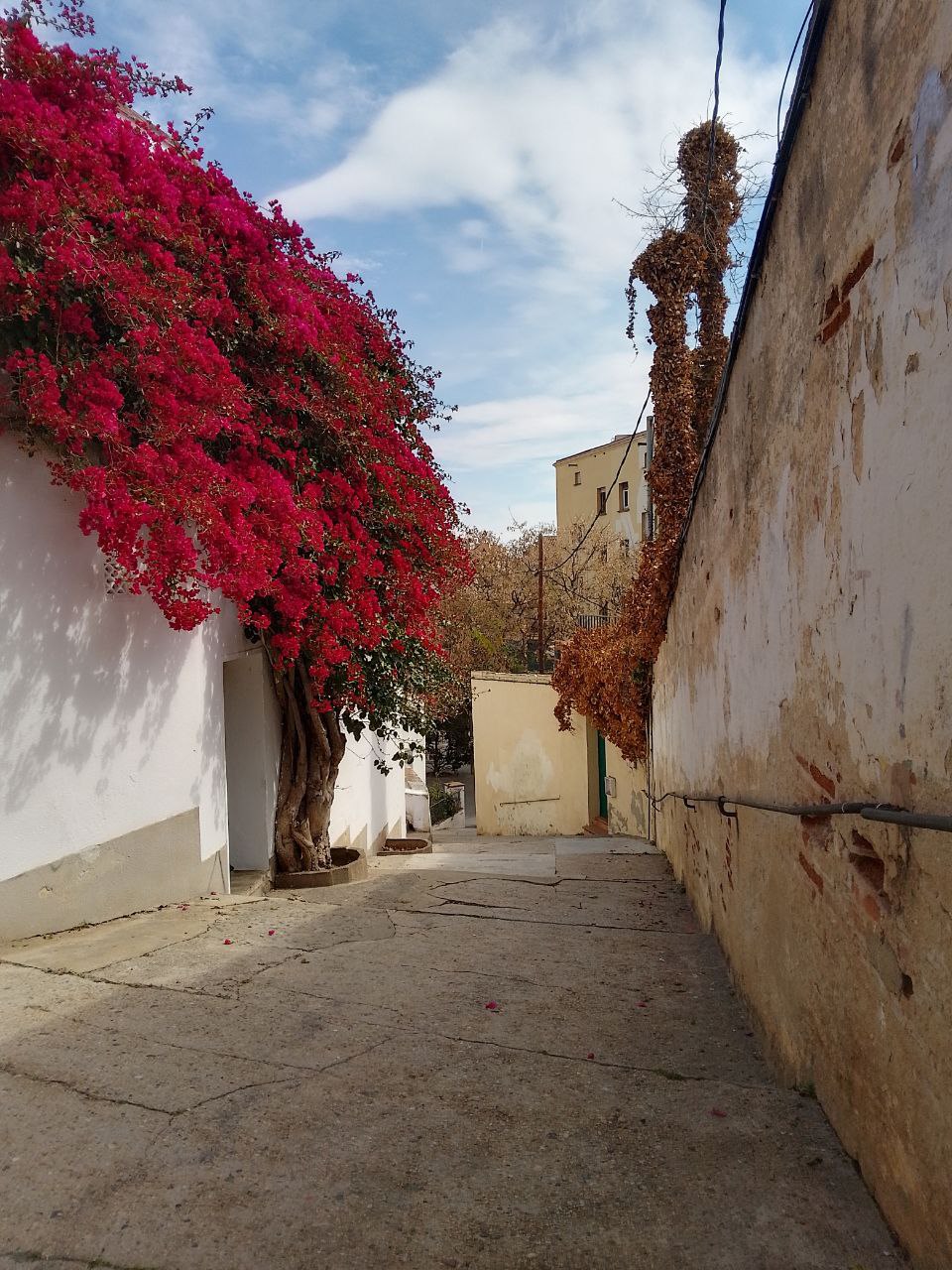
    I’ve written about movies, books, politics but I haven’t written as much about Barcelona as I would have liked. But I’ve been here several times already and I’m not really doing tourism, plus I’m not exactly in Barcelona, but in a suburb coastal town thirty minutes away.

    People in this suburban town don’t tend to wake up early, much less on a Sunday. The streets are almost empty at 7:30 in the morning — the sun has risen maybe just half an hour ago — and even the unnamed bar of the Chinese man (“bar del chino”) which is usually the first to open is still closed. There is another bar a few meters away that is open, though, and three or four drunk old men are sitting at the tables outside, singing some songs in Catalan. I suspect that, rather than opening early, the bar simply did not close yet, and these are the last drunks that still remain from the previous night. I sit at the table behind them and ask the waiter — a Moroccan, or perhaps a Pakistani — for a cup of coffee and a croissant. The drunkards keep on singing.

    “Transphobia is gender violence”, says one sign posted nearby, written just like this, in English. “Feminism should be inter-sectional“, says another. “Abortist sluts are my favourite people”, says yet another one, right next to it. I wonder who put them up, probably some local NGO. While people seem to be mostly socially conservative around here, there are lots of international NGOs in Spain pushing for feminist, transgender and all kinds of causes, and the current government seems to be extremely left-wing. Just a few months ago, they put up a new law that allows anyone over the age of 14 to “change their gender”. In Spain, people can vote and drive only after completing the age of 18 years, and the so-called “age of consent” for sex is 16. But people can already “change their gender” at 14. Go figure.

    In the meantime, the drunkards appear to be now complaining about the politically correct. One of them says he was accused of being racist for some reason or other. “Yes, I’m racist”, says another one. “So what?” But they are laughing as if it was all some funny joke and soon start singing again. Just harmless drunks having a good time. The Pakistani waiter brings them another beer. Does this bar ever close? The Chinese man meanwhile is setting up his tables. The neighbourhood starts to wake up, and some people are now out with their dogs.

    In the afternoon, I go to Barcelona proper. I walk around Passeig de Gràcia, where there are two famous buildings designed by Gaudí — La Pedrera and Casa Millà. Crowds of tourists parade in front of the famous houses taking selfies. I’d like to enter, but the line is too long. I keep walking on.

    I arrive to the same church where I went last Easter Sunday for the Latin Mass. They have mass today too, and I go in, even if I am 30 minutes late and mass is half-way. No matter. There’s another priest today, but the mass is again in Latin. It’s always in Latin and there’s always Latin songs. Benedicamus Domino. Afterwards, I talk to one of the women, a brunette in her 30s, who explains to me a bit about the congregation. She introduces me to some of the others. They are going to a restaurant, and they invite me to go eat with them. Why not? I accept. It’s now 2:30 PM, which seems late for me, but, in Spain, or at any rate in Barcelona, people tend to have lunch at 2:00 or 3:00 or even 4:00 PM, and dinner can be as late at 10:00 PM. (You can see now why not many people are awake at 7:00 in the morning.)

    Lunch is good — I choose tortilla, croquetas and salad, but they also have pizzas and crepes and all kinds of stuff — and the people in the group are very nice. There is even a man from Argentina, from the same city I was born in, so at least we have something in common to talk about. As wine and beer start to flow, the discussion becomes more lively, but hard to follow. I remain mostly silent, catching a few words left and right. To my left, mostly men, having an intellectual discussion: Monsignor Lefebvre, infiltrated freemasons, anti-semitism, Franco, Latin, Old Slavonic, Saint Athanasius, Novus Ordo, Padre Pio. To my right, mostly women, talking about mystical experiences. Lourdes, the words of Jesus, spiritual strength, Padre Pio again, Garanbadal (some place in the Basque country where the Virgin Mary supposedly appeared in the 1960s to a group of children). I start to feel a bit dizzy. Maybe it’s just the wine. Lunch is now over, so I thank them all for the invitation and say goodbye.

    It is still sunny and warm as I get back to the suburban town. I don’t want to go home yet, so I go to the beach. The water is cold but the sand is warm. Now it’s 7:30 PM and there’s still people on the beach, walking or playing volleyball, and there’s even some children swimming. Dinner won’t start for most people until much later on.

    It’s always sunny in Catalonia. It still hasn’t rained at all, all the time since I’ve been here, and even months before, except perhaps for a just a few drops for about 5 minutes one day. I don’t mind, but the situation seems to be desperate for local farmers. Even the priest today asked people to pray for rain. I am now looking at the weather report, and they are predicting rain next Tuesday. Benedicamus Domino. But it’s just a light rain which won’t probably solve the farmers’ problem. I don’t mind. It can rain every day after I’m gone.

    “April is the cruelest month”, wrote T. S. Eliot. Well, maybe in England, not here. Here, April is almost summer.

    Tomorrow it will be sunny once more and I’ll probably be up again at 7:00 AM and walk around the empty streets, or maybe even on the beach. I like it best when it’s empty.

    It’s a nice town, Barcelona. People are friendly and invite you to lunch even without knowing you, it’s always sunny and warm, there’s a beach, there’s lots of bars and cafes, and drunks sing instead of fighting and breaking things.

    It’s a good place to be.