Today is the 4th of July, and I am for the moment still in America, (although I fly out today), so I thought it would be a good moment to jot down some notes about the good old USA.
Many people, and in particular Americans, like to say that the U.S. is the “land of freedom”, and in many ways, that is exactly right. But what kind of freedom? There are so many contrasting freedoms in America; sometimes they are so contrasting that they do not get along very well.
Politically, it is said that the country is divided between Republicans and Democrats, but that’s not exactly true. It is divided between two different ways of seeing and understanding the world, and even the word “freedom”.
Both camps talk constantly about freedom. But Democrats, or progressives, see it as basically sexual and social freedom. Freedom to identify as any gender you want. Freedom to have sex with whomever you want, and to abort the child if you or your partner get pregnant afterwards. Freedom to dress and behave as you want.
For Republicans or conservatives (it’s not really the same thing, but let that slide) “freedom” is better defined as the lack of state interference on property and on life. That’s why guns are so important to this group — something that Europeans do not seem to understand. In America, guns are a metonymy for freedom. Freedom from state tyranny (it is stated in the Constitution that citizens should be able to form an “armed militia” to resist any government encroachment on their rights), but, more practically, freedom to protect yourself from crime and violence without depending on the police or the state.
America is a multi-ethnic, multi-racial, multi-religious country, and all those groups do not always get along. Violence is in the American DNA, and part and parcel of its colonial and multi-cultural origins.
America is also a very unequal country. It offers incredible opportunities, and it is, still, very prosperous. But that prosperity lives side by side with uttermost misery and poverty. This is also related to “freedom” in a way. In America, and this is increasingly more so, you are on your own. The country offers opportunities for advancement, but if you fail, tough luck. You’re just a loser and you deserve what’s coming to you.
You can be very rich, or you can have a comfortable middle-class life, but you can also become a homeless derelict living inside your car — that is, if you have the luck to still have a car.
In America, wonderful cities and amazing views can live side by side with awful public services. Public transportation in particular. This is also something that Europeans do not understand. But in America, everything is about the individual, and, by extension, about the car. The car is for current Americans what the horse was to cowboys. I remember reading once about an American teenager who had killed himself because, after an accident, his parents forbade him to drive the family car. The boy took a gun — that other symbol of American freedom — and shot himself in the face. “Without a car, I have no social life, I am a loser, I am no one”, he wrote in his suicide note.
Everything is centred in the car, even long-distance travel. American airlines are probably among the worst in the world in terms of service. Their train service is pretty bad too, at least when comparing it to Europe or Asia (although there are a few routes in the East Coast that are not completely terrible). And buses… Buses in the U.S. are the worst. For inter-city service, there’s Greyhound, which is perhaps the closest to Hell that you can find on this Earth. A few years ago, a young man was decapitated inside a Greyhound bus. That’s the level of Greyhound for you. If you want to travel around the US, my advice is to rent a car.
Many say that America is right now in decadence, and in a lot of ways this is true. Looking back, its heyday was probably in the 1950s: a country coming from victory in the Second Word War and with the Great Depression having become only a distant memory. It was still a 90% White European country, and it didn’t have such a large population as today.
A few decades later, massive immigration, several stupid wars, demented plans of social engineering and the offshoring of manufacturing to China have completely changed the country, making it a shadow of what it once was.
And yet… America is still very prosperous and very beautiful in some of its parts (the parts are better than the whole), and, more importantly, it still captures the imagination of the world. American culture is everywhere. It seems almost as if, the more the country slides into decadence and corruption, and, at least domestically, disappointment grows among its population, the more its dream-like culture spreads abroad. Hollywood still dominates worldwide cinematography, and, all over the world, T-shirts with American slogans or brands are sold and worn everywhere, from Germany to Vietnam.
In this recent travel to the U.S., I spent a few days in New York City, but mostly I spent the time in the countryside. And, let me tell you, it is like being in two different worlds. I think that to fully understand America, you need to go to the countryside, to its small villages, to its farms. That’s where the “real America” lives, and, if there is any hope that the United States will survive into the future, and that it will ride out into the sunset after the many catastrophes that are probably coming, you also have to look at the countryside.
Never mind New York, L.A., Chicago. America is still a cowboy country at heart.
Some people are leaving the big city for the countryside
I am here in upstate New York, somewhere in Sullivan County, about two and a half hours (northwest) from the hustle and bustle of New York City. I came to visit family and ended up staying for a few more days in the countryside, where my brother has a restructured barn turned into house and art studio.
He’s not the only one. Since the pandemic, many people have been escaping from New York City and moving towards the countryside or to smaller towns. Covid regulations, the rise of crime — NY seems to be slowly inching back to the bad old days of the 1970s — inflation, higher rents, or just the growing stress of living in big cities have made people reconsider their living arrangements.
I wrote before about the difference between country people and city people in the context of Sweden, but here, it’s like two completely different nations altogether. The little country village nearby (population: 389) is only two and a half hours from New York City, and is still in the same state, but both places couldn’t be more different. While NYC is mostly Blue or Democrat, up here it is definitely Trump country. There are already several “Trump 2024″ and “Fuck Joe Biden” bumperstickers and American flags all around, and I doubt many people around here lost sleep over the recent Roe vs Wade abortion overturn.
People in the country tend to view people in the city as smug, annoying liberals, while people in the city view those in the country as ignorant rednecks or reactionary bumpkins, but the truth is more complex than that. From what I’ve heard and seen, there are quite a few lesbian or gay couples in the area. There are even Democrats. But you won’t see many “Pride” flags. What people around here most object is the politicization of issues, but country people are much more open-minded than they are given credit for. Of course, if you come up with a Biden T-shirt and say that you support gun control, you may get a few angry looks. But — probably — you won’t get shot.
Guns are a hobby, and may be a necessity for many around here. After all, there are wild animals around. Bears, foxes, coyotes, eagles, snakes, to name just a few. Most are not dangerous. Perhaps the most dangerous ones are the bears, but they are black bears, which usually not as aggressive as the brown ones. I haven’t seen any yet, but a few neighbours have reported close encounters with them.
But most of the dangers are imaginary. A strange shadow in the forest… Is it a bear? No, it’s just a tree stump with a weird shape. Something is moving behind the bushes. A coyote? No, just two chipmunks, you shouldn’t worry, unless you’re Donald Duck. A green shape moving in the water. An alligator? No, we’re not in Florida, dummy, it’s just a beaver carrying a mossy piece of wood.
Mostly, the main worry are bugs. Living in the country basically means daily encounters with bugs of all kinds. Big flies, little flies, microscopic flies, butterflies, bees, wasps, spiders, beetles, mosquitoes, ticks — perhaps the most dangerous ones, as they may transmit Lyme’s disease — and a whole lot of other insects, many of which may not have been officially discovered yet.
It’s just a different way of living. The worst dangers in the city come mostly from other humans: contagious respiratory diseases, robbers, shooters, a crazy guy pushing you into the metro tracks. In the country, it’s perhaps more likely a bear, a snake, a car accident, a hunting accident, drowning in a river, a gun going off by mistake.
Because so many people left New York City in the last two years during the Covid pandemic, the demographics of a few towns have changed a bit. In Callicoon (population: 3,057), about 20 miles from here, there are quite a few former New Yorkers that have moved in and brought a bit of their “city culture” with them. The town now holds film, literature or music events, and a couple of more “sophisticated” furniture or wine shops. They may even sell good European wines! So it’s not all black and white. Even in terms of people — sure, the countryside is on average whiter than NYC, perhaps even 90% or 95% white, but there are a few black, Latin American or Asian families too.
There is certainly a lot of division currently in America — political, economic, social, sexual, racial — and some of it lead to resentment or violence, but here in the countryside you don’t see it so much yet. People tend to be friendly, and although perhaps some may be a bit suspicious of strangers, when you explain to them that you’re the brother or the cousin of someone who lives here whom everybody knows, all is well.
New York City still has a lot of appeal, for sure. And, for certain jobs, you may have to live in the big city anyway, even in this age of remote work. But country living, as many are discovering, also has its charms.
For the past two years, I have been publishing “Geist“, an independent magazine of literature and art. We have now reached the fourth number. It is in printed paper and not online, which I suppose is something very old-fashioned these days (although we do make the pdf available for free online). It is printed in a very small edition and has an even smaller number of readers. After all, who reads an independent magazine of literature and art these days?
I say “these days”, but literature, and, even more, independent literary magazines, have always been an affair for just a few. I wonder, how many people at the time have read any of the only four numbers of “The Exile”, Ezra Pound’s 1925 literary magazine, who nevertheless published important writers such as T. S. Eliot, W. B. Yeats and Ernest Hemingway? How many copies were printed? I doubt more than a few hundred, if that. And Jorge Luis Borges’ first literary magazine in 1921, “Prisma”, had only two numbers and didn’t even have individual printed copies —- it was a mural magazine, posted on the city walls. How many people read that? (Now one of the few remaining copies is being auctioned at a price starting at 22,000 dollars).
Of course, my little magazine has no such pretensions of achieving literary or artistic fame. I prefer to see it as just a reunion of friends. After all, most of the collaborators are people I know personally, or people whose work I know.
Is it just a vanity project? Well, I certainly do no expect to obtain any profit from that, as it runs at a loss. But I think promoting art and literature these days may be a noble endeavour in any case. We are bombarded with text and images every minute of the day in our computers and smartphones, images and texts that we soon forget second after seeing them. But a printed magazine with short texts and art, well, perhaps it can offer some repose for the eyes, the mind, or the spirit — “Geist” means spirit in German, of course.
Now, this blog is perhaps a little bit strange for some people. Most blogs are specialized in certain fixed subjects, but I tend to publish about different topics without a specific focus. I would write only about film, art and literature, if I could, but people tend to be more interested in politics or in social issues, so I try to balance things, and also add some travel articles to the mix. Also, I get bored easily if I write about just one subject.
The philosopher Isaiah Berlin once wrote an essay called “The Hedgehog and the Fox“, inspired a phrase of ancient Greek poet Archilocus: “The fox knows many things, but the hedgehog knows one big thing.” The idea is that there are two kinds of people in the world (I hear now the voice of Tuco from Leone’s The Good, The Bad and The Ugly in my mind: “there are two kinds of people in this world, my friend.”) Some people focus on one subject and devote their whole life to it. I remember, for instance, someone who dedicated his whole life to study potatoes and wrote several volumes exclusively on that subject. Others — like me, as you’d have guessed — have many interests and little focus, and tend to jump, like a quick fox, from one thing to the next.
Well, I think this is enough promotion. Check out the magazine if you like. Next post will be about politics, or perhaps about travel. See you, and thanks.
In a harbinger of bad things to come, France has prohibited outdoor events due to a heat wave, which according to the media is being caused by “climate change”. There is no way to prove the causality, of course — anything can be “climate change” (except when they are actually changing the climate by bombarding clouds, I suppose).
In continuing the process of infantilization of the public that started with the “Covid” measures, governments now are declaring that people are too stupid to realize that it is too hot just by themselves. Everything has to be done by mandates and regulations.
Meanwhile in Germany, politicians are proposing masks to become mandatory again for everyone, starting in October. Because of “corona”? No, just because of the simple flu this time. They argue that less people get sick when wearing masks, something by the way that has never been proven, and most studies say the opposite in fact. (Masks are still being used in public transportation even now, in the middle of summer.)
EU leaders Mario Draghi (Italy), Macron (France) and Olaf Scholz (Germany) — is it a coincidence that all three come from banking/financial backgrounds? — have recently visited the Ukraine and proposed sending even more weapons and financial assistance to the beleaguered country. “Europe must help”, they say. But no one asked European citizens what they think of sending their tax money to fund wars, especially at a time of crisis. Shouldn’t they have been consulted before?
Why have “democratic” leaders become so openly undemocratic?
They do not even pretend to believe anymore that they care anything about the thoughts of the people they rule over. It’s all about pleasing Big Finance, Big Tech, Big Pharma, Big Business — or anyone, except the voters.
Justin Trudeau from Canada is perhaps the worst of the lot. Even as Canadian police was trampling old ladies and people were being arrested or having their accounts frozen while having committed no crime, but simply legally and peacefully protesting against vaccine mandates, he has babbling something or other about “democracy”. He has also recently complained that Canadian media being banned in Russia is “undemocratic”, but somehow, banning Russian media in Canada is “democratic”.
It is not clear anymore what these people even mean by “democracy”. It is not as if anyone is ever consulted for any decision that these supposed “world leaders” take. Almost everything is decided by decree. And, by they way, they are supposedly the elected leaders of democratic countries, but is there anyone who actually likes them? I couldn’t find a single person, either left or right, who likes Mario Draghi in Italy. Everybody along the political spectrum seems to hate him equally. Granted, the Italian political system is so bizarre that it is not clear for me how he even got to the position anyway, but I doubt anyone voted enthusiastically for him.
In America, Joe Biden has now one of the lowest popularities ever on record. And yet, we are supposed to believe that he is also “the presidential candidate that has received the most votes in a U.S. election in the whole history of the United States” (While this can be partially explained by mere population growth, I doubt such high number of votes is even real – Biden was never in his life charismatic or popular.)
What is happening? Is democracy ending? Or it was never real to begin with?
Whatever it is, what we have seen in the last few years, starting with Covid measures (or maybe even before with the “war on Terror”) and continuing with current economic measures, is certainly a worrying trend, and all those who care about personal freedom and about the accountability of the democratic leaders should be rightly concerned.
On the death of friends and the fleetingness of life
I hate social media. If it wasn’t for that damned, demonic invention, I wouldn’t have found out that a friend of mine, whom I knew for almost 25 years, has suddenly died at just 40 years of age. True, I hadn’t seen her in almost 5 years, but that was because I no longer live in Brazil and rarely visit. The last time I was there, at the end of 2019, just before the corona pandemic, I thought of visiting her. But she lived in another town, and I did not have many days in the country, so in the end I didn’t go. I regret it now. Soon after, Covid regulations made travel to Brazil all but impossible for almost two years, and now she’s gone.
Gone! I still cannot bring myself to believe it. Cancer, apparently, although I had no idea she was ill. In some of her last pictures in social media she appeared with short, dyed hair, which somehow didn’t seem to suit her. When I met her for the first time, in 1998, she was a pretty young woman of 17, and for years she sported such beautiful long hair. But now I think: chemo. It was probably chemo. Although she looked healthy in the pics, and her hair wasn’t completely cut, just short, so I don’t really know.
I cannot even imagine her as an ill, dying person. She seemed so full of life. She had always a smile on her face and was one of those people who seemed to exemplify the idea of “living for the moment”. She seems to have had different boyfriends during her short life but I think (I could be wrong) she never officially married, and had no children. She was an actress, and a very talented one at that, but she worked sparingly, having appeared in only a few plays in her life, and, as far as I know, only in one short movie. Here she can be seen at 2’09” in her only scene in the short movie “Novembrada”, from 1998 — the year we met, at a film workshop taught by the director of that film. I think once I told her that, one day, I would direct a film with her in the main role, and of course I never did — but then again, my own career as a film director seems to have fizzled out for the most part.
I have several memories of her and her family — both of her parents were well-known local visual artists, very interesting people in their own right, and they lived in a house with a large garden near the beach — but even all those memories are fading fast now, and I struggle to picture the exact surroundings of the house. I vaguely remember a living room full of art objects of all kinds; I remember more clearly a backyard full of trees and quite a few dogs and cats always roaming around. And while the house was not on the beach, you could reach the sea by crossing through a vacant lot behind the backyard.
I saw her for the last time almost twenty years after our first meeting, in or around 2017. That’s when I went with her and family and friends to a trip to the mountains in her native state. I seem to have lost all pictures of that trip — or perhaps it didn’t really happen, and it was just a dream? And yet I remember having taken lots of photographs, but now in my computer I find tons of useless random photos from decades ago, bot not a single image of that trip. It as a wonderful but also slightly melancholy moment, or perhaps it just seems so now in retrospect. The death of friends, especially if they are younger than us, make us aware of our own mortality, and of the general ephemeral quality of life. Here today, gone tomorrow. “Don’t ask for whom the bells toll, they toll for thee.”
I’m not sure if she knew that line by John Donne, but she liked to recite poems, and I always remember a line of a poem that I wouldn’t have known were it not because of her, by local poet Rodrigo de Haro: “Somos todos crianças que o tempo separa”.
We are all children whom Time separates.
Another favorite of hers (and mine) was Portuguese poet Fernando Pessoa, and so it seems apt to end this melancholy memoir with a couple of his poems, that, as usual for his heteronym Ricardo Reis, is a reflection on the fleetingness of life. “Vem sentar-te comigo, Lídia, à beira do rio” (Come sit with me, Lidia, by the riverside) is perhaps the most famous one, and one that I’m sure I must have heard her recite at least once. But I offer you, dear, unknown reader, another one below, in Portuguese and English, which seems to suit the poignancy of the moment:
Ao longe os montes têm neve ao sol, Mas é suave já o frio calmo Que alisa e agudece Os dardos do sol alto.
Hoje, Neera, não nos escondamos, Nada nos falta, porque nada somos. Não esperamos nada E temos frio ao sol.
Mas tal como é, gozemos o momento, Solenes na alegria levemente, E aguardando a morte Como quem a conhece.
* * *
Snow-leaden peaks shine by sunlight, afar, But it feels soothing by the calm chill air Which tightens and tapers The darts of the high sun.
Today, Neera, let us not hide ourselves; – We lack nothing, for we are nothing. We have no expectations And feel cold by the sun. –
But, such as it is, let us seize the day, – Solemn in joyfulness, delicately, And kindly waiting for Death As if for an old friend.
P. S. On a happier note, did I tell everyone that the new Geist magazine is out? Buy it, read it, share it. Thanks.
Birth rates are abysmally low in Europe due to COVID, war, and digital technology
I just finished editing a new documentary, “Childless in Europe” (you can watch it it here), but almost all of its footage was filmed before COVID and of course before the current war. Now the situation is even worse, as the lockdowns and other measures have further decreased birth rates in Europe, and inflation and the incoming economic crisis (partly but not wholly caused by the war sanctions) will probably further reduce them.
I actually started to think about this issue because of the war in the Ukraine. See, the Ukraine has 48.5 million people in the year 2000, in its first census realized since its independence. Since then, because of outmigration, lower birth rate and a high number of abortions, it started a depopulation spiral. (In the early 2000s, it seems to have become the place to go to buy stem cells from aborted fetuses, used by the pharmaceutical industry.)
Twenty years later, in 2019, even before the war, the population had decreased to 37.3 million. Now, with the still ongoing war with Russia, it may have lost at least an additional 10 million. Worse, most of the refugees that left are young women and children, while many young men are being killed in the war. All this will of course further reduce the population in the future. This war is a tragedy for the Ukraine, and that’s why NATO policies to keep the war going are incomprehensible in this context.
But of course, the rest of Europe is not in a much better shape in that regard. Countries such as Germany, Italy and Spain are also in depopulation spirals, and, while it is not so extreme as in the Ukraine, it is also a bad sign for the future. In Italy and Spain, whole villages are disappearing or becoming “ghost towns”, as people move to big cities or to other EU countries.
The COVID lockdowns in particular seem to have been a disaster for Europe. In 2020, Italy’s fertility rate decreased from the already low 1.3 children per woman in childbearing age, to 1.2, a historically low record. It has not recovered yet. And of course, current inflation and economic problems are making it even harder for young people to think about having children. How can they think about having children, if many don’t even know if they can support themselves?
Economic worries, however, are just on of the problems, and probably not the most serious one. In fact, poor people usually have more children than rich people. There is something else about the modern age that reduces population growth. And I think perhaps the problem is not so much one of birth rates, but of relationships. People are not marrying, or marrying late, or marrying and separating shortly, which is not good for stability or for children. It has become very difficult, as of recent, in particular for young men, to establish long-term relationships with women leading to a family and children. Dating apps and modern technology, in that regard, have been a disaster for young men. They may lead to short-term hookups (only for the most attractive ones), but rarely to long-term relations.
Another problem is urbanization. Right now, 72% of the European population lives in big cities or suburbs. Only 28% live in small villages or in the countryside, and most that live there are old. As I mentioned before, many villages in Italy and Spain are disappearing, but the phenomenon can also be seen in some regions of Germany and France. Living in cities is more expensive and, probably because of psychological reasons due to the perception of lack of space, leads to a further decrease in birth rates. (Historically, people living in the country had more children, simply because children could help with farm work, but I don’t think that’s the case with machine-based modern agriculture).
The incoming of a large number of immigrants and refugees from other countries to Western Europe, instead of solving things, seems to further exacerbates the problem, creating more competition and lower wages. And of course, even if the birth rates rebound, many will be from a different population than the native one, which creates a whole new set of problems and conflicts, as we can see in countries such as France.
Some also blame secularization and the decrease in religious attendance for the lower birth rates — perhaps people had more children when it was something “ordained by God”. After all, raising children is hard. In Germany, most people have one, two or at most three children. The only couple I met who had more was a very religious Catholic couple — they had 10 children. No one else I met came even close. They said people looked at them as odd or even as irresponsible. “Who has 10 children in this day and age, with climate change and so on?”
The problem is global, not just European. The situation in East Asian countries is even worse. And even the United States, supposedly a still more religious or more “birth-friendly” country, is going in the same direction.
What are the solutions? No one knows for sure. Some countries have tried offering incentives and benefits or directly paying couples to have more children, but it doesn’t seem to have helped much.
It is not wrong for individuals to choose not to have no children — and actually, in many or even most cases, it is not even a choice, but just a result of current bad circumstances. Many people would probably prefer to have children (or to have had them, for those to whom it became too late). It’s just that, for a large number, it’s become impossible. Biological, economic, familial or relational issues just make it very hard to consider the prospect of having children, let alone a large number of them.
Not everyone has to have children. For centuries, many European men and women who chose a religious life as priests or nuns did not have children, but the rest of the population more than made up for that. The problem happens when it becomes a massive collective issue affecting all of society, and even threatening its future.
It is not as if European people will disappear from one day to the next, but in a context when at some point the number of those who will be old and retired may outnumber the younger ones, it can become a huge social problem (as it already is in places with even lower birth rates such as Korea and Japan). As the economy worsens, and if destructive policies such as the “lockdowns”, “digital passports” and other attempts of political control and social engineering keep being mandated by governments, things will keep worsening.
My documentary ends on a hopeful note, observing that History in general is made of cycles of death and rebirth.
I had a nightmare yesterday: I dreamt that Covid restrictions were back on, all over the world, and that they were even harsher than before. You could be arrested if you didn’t have a face mask on, and to go anywhere, besides a “vaccine passport”, you had to be scanned, as in the airports, by a special machine that could detect if you had a specific mRNA code in your blood. I woke up with a bad sensation. It was only a dream — or was it?
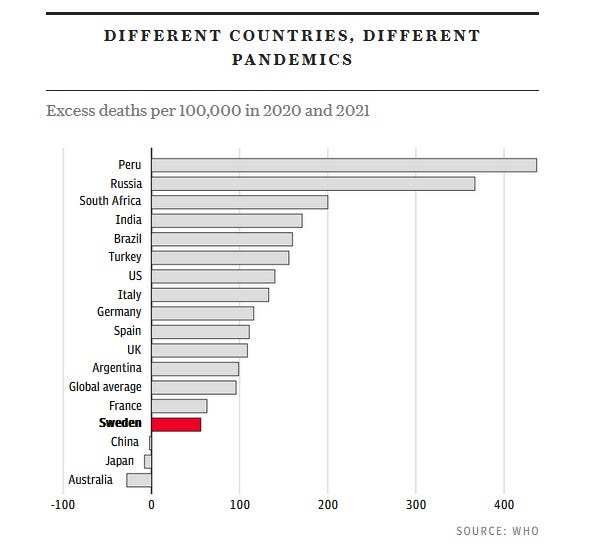
Recent data, from the WHO none the less, shows that despite being very light on lockdowns and mask mandates and vaccine passports — in fact not even doing a real lockdown — Sweden had a much lower rate of excess deaths from Covid than a lot of other countries that had. The conclusion of the media is that “harsh restrictions were not the key to beating the virus.”
And now they tell us! After two years of annoying measures and forcing people to do things they didn’t want to do, causing a lot of mental health problem and business closures, some people even led to suicide, now we find out that the laissez-faire Swedish approach was the right way to go… Well, they could just asked me, I knew that from the beginning.
If you look at the graph published in the article listing excess deaths, and reproduced also below, Sweden is down at the bottom. Peru, at the top. It is worth remembering that Peru was one of the countries with some of the harshest measures and one longest lockdowns. A friend of mine, who was living in Peru at the time, told me that for a while people were required to wear not just one, but two face masks. One on top of the other. If you wore only one, you could be fined. I am not sure how the police checked that, but that’s how it was.
Now it’s almost June and the whole thing seems just a bizarre nightmare, pretty much like the one I had last night. It is hard to believe that even just months ago we could not enter into shops or restaurants without a monstrosity called “vaccine passport” and a mask covering our face.
And yet, I’m not sure if the lessons will be learned. Yes, now it’s summer in the northern hemisphere and things are pretty free, but I wonder if restrictions will come again next winter, as there are lockdowns in Shanghai and Beijing right now, and this may later spread to other countries — and I’m not talking about the virus, but about the restrictive measures. I am not sure I and most people (even those who believed it all) could go through it all again.
I suppose they got most of what they wanted — a vaccine basically forced onto millions (billions?) of people, a test for new authoritarian measures of population control, a push for digital cash. Hopefully, they will leave us in peace now?
Transcription of a debate about Donbass, Nagorno-Karabakh, and other wars.
This is the transcription (translated by me from French to English) of a recent debate on April 6, 2022, for a French TV show, with documentarist Anne-Laure Bonnel, director of the war documentaries “Donbass, 8 years of war” (2016, English subtitles), and “Silence dans le Haut-Karabakh” (2020, French only). The original French transmission can be seen here. I apologize for any possible mistakes, French people love to talk over each other and sometimes it was hard to hear… I’ve been interested in Anne-Laure Bonnel’s work since I saw a video of her in Donbass, and then I watched her documentary. This is a debate with her presented at the French show “Touchez pas mon poste”, some kind of sensationalist, trashy talk show which is not that great, but the things she says are interesting nevertheless.
PRESENTER: You say that you refuse to be called a journalist, why?
ALB: So, a little nuance–
PRESENTER: It starts well.
ALB: Because everything is a question of nuance. It’s not a question of hierarchy, it’s good, or not good, it’s that I don’t do news, I go to the field and make documentaries. Like Paul Moreira, he calls himself a documentarist. My job is to make documentaries. It’s different from being a journalist.
PRESENTER: For you, journalists, are good, or do they create misinformation–
ALB: Not at all, there is this great guy who [crosstalk]. There is Renaud Girard, for example, who knows well how to express things, he’s covering there now since I got back, and I’m going to be very honest with you, I turned off my TV, because I didn’t want to see the news, because when you come home from three weeks of bombings, having seen shredded bodies all over, there’s blood, it stinks, it’s violent, we were shot at, we received death threats.
At some point you just need silence, only silence. And especially, to get away from people.
Really, I don’t sleep much, I said, at this moment I can’t sleep [crosstalk]. You know, one does not come out unscathed from a conflict, and I think that all those who cover it, feel the same. So that’s why I turned off my TV, it’s that the noise… still sensitizes my ears a little.
PRESENTER: In 2014, pro-Russian separatists declare the independence of Donbass, Ukrainian territory where the inhabitants are mainly Russian-speaking, the Ukrainian army and the separatists start a war. You were in the Donbass, how many times?
ALB: Three times.
PRESENTER: Three times.
ALB: But if I may say something, because I see there’s not much time, I would just ask you, once, Cyril, a favour, I came here yesterday, I could not express myself, I would like just, because the time is short, just to be able to express myself on some things I could not say, to say them now, and afterwards I can answer all your questions, as I said yesterday to your team.
PRESENTER: Ok.
ALB: Thanks so much. So before talking about this conflict, that is a disaster, a butchery, I will never endorse a war, I did not endorse it in Nagorno-Karabakh, I did not endorse it anywhere, neither in Yemen, anywhere.
But to understand this conflict, and Sergey, I would like to come back to this, because I listened to one of your interviews with that young man that I didn’t quite understand, but what you need to know and what I would have asked, is why, since 2014, there were “bugs”. “Bugs”, all I want to say, “bugs”. On December 2, 2014–
PRESENTER: Bugs?
ALB: What I mean is Russian and American interferences. You said, in the area which has been bombarded for eight years, Donetst and Lugansk, there were Russians, but there were also Americans, and I have proof.
I would just like to state it. Colleagues have spoken about it, but it was not released. This investigative work was done beforehand.
So I continue. On December 2, 2014, Natalie Jaresko, an American national, is placed as Finance Minister of the Ukraine. The Ukraine granted her the Ukrainian nationality on the day of her inauguration. The Ukraine also benefited from the assistance of the American government through the visit to the Ukraine of the CIA director John Brennan, in April 2014. I invite you to fact-check all that.
So the problem of Ukraine, Mr. Sergey, is that the US and Russia were there since the beginning, and also NATO was there, we know there were military trainings since 2014, also Russian instructors, I’m not here to take the Russians side, I am not anti-Ukraine, or pro-Russian, or anti-Zelensky, or anti-Kiev. or anti-Russian, I’m here simply to balance this debate because it is leading to a butchery, and a terrible butchery, war is awful. When you live it, when you see bodies torn to pieces, but all of the Ukraine is in pieces.
And we have to say that the responsible are not the civilians, but they are the ones who pay the price. It’s the government there. It’s the government there, and the United States that were not playing fair.
Is that you find normal, or can we even imagine, that the French appointed an American as Minister of Finance? Would that be possible? And even someone who was the CEO of a private company.
SERGEY JIRNOV [Former KGB spy]: So what are you saying?
ALB: [crosstalk] Simply that the Russians and the Americans… I think it’s clear [crosstalk]
PRESENTER: What is the cause of that war for you?
ALB: I think there are geopolitical and energy issues, also the Ukraine is badly located, it is like a buffer zone, between, uh, the Eurasian continent and Europe. And today I have the feeling, but it could be just me, that we are witnessing a showdown between new alliances that are particularly worrying, Russia, China, India, versus Europe or the West, and that can end very badly. I don’t think one makes war for charity. Unfortunately. And I’m sorry for the victims, because I know. Because I filmed the victims, I filmed them in many countries, and for a few months I was, I was in Nagorno-Karabakh, and I can tell you that it was so savage there, I still can’t sleep now.
When you see living people having their throats cut, you don’t sleep, believe me, Cyril, you don’t sleep.
So what I mean is, it’s that, there are things that go beyond, beyond just this war, there are other issues behind it. there are other issues, and now we are plunged into a conflict under an American subservience, that since 2014 is not very clean, not very clean, and I regret that we don’t have a [PM Dominique] De Villepin, like in 2003, to say, yes, it’s unacceptable what’s happening.
Even if we can’t find other means to stop this conflict, but the Minsk Agreements, after 8 years, could have avoided this butchery?
PRESENTER: [crosstalk] Wagner, that, how can you explain that?
ALB: How do I explain it, it’s very simple. I discuss a lot with, in general my sources are French generals, and besides that there are American sources and NGOs, I don’t see any Russians, OK?.
PRESENTER: Okay.
ALB: Okay, thank you. So how can I explain, to do investigative work, in a war zone, Sergey, it takes a long time, it’s slow and we don’t know what’s going on. Mr. Gomart, the former director of a French military think tank, he explained to me that, for Bosnia, to find [evidence of] war crimes, it took more than 6 years. So for the moment I say caution, be careful of the media, because you know– I want to say [crosstalk], I say, watch out, because we are running straight into a wall.
PRESENTER: A little digression about this, there is also a massacre in Mali, about three days ago and I would like that we talked about it a little more on the media– because there were a lot of civilians massacred in Mali, I think that we should also move quickly for Mali because it’s very worrying, and we don’t talk about it, we can’t compare to the media war in the Ukraine, but we have to talk about–
ALB: Allow me to say that there are no hierarchies for me [crosstalk]
PRESENTER: We need to talk about everything, it is important. Sergey, when we hear from your side that Anne-Laure, she says here that… That what she, you complain, it’s that, that the European media say that Russians are always to blame, for you they are not to blame?
ALB: No, no, listen to what I have just said, the blame is shared, what I reproach the media—
SERGEY: The Americans and the Russians, it’s that?
SOMEONE ELSE IN TABLE: And the Ukrainians also, the Ukrainians.. [crosstalk]
ALB: Sure, the Minsk agreements were not respected. I sent you videos. I remind you all the same that even if there was or not Russian influence at Donetsk and Lugansk, a president who, with combat helicopters, shoots point-blank on its own people, that right there is a war crime.
I informed French intelligence in 2014, there is a war crime there. There were bodies shredded, a woman still talking, with no legs. You have seen these images.
Is that normal? I am not defending anyone, I am the first to say that the Russians share a responsibility, I am open about it.
SERGEY: You are saying it tonight.
ALB: And I said it before, and if people had done their work, I mean Libération [newspaper], thank you, Libération. I announce to you that I am suing for defamation, because all that they said is false. Everything, everything, everything. Know that if you read the articles that I put on Twitter, I also accused the Ukraine of being corrupt, and even Yanukovich, I never defended him, but that was never put in the media.
It’s as if they did everything to discredit my words, and to make my work, which is neutral, to be passed over in silence.
Just know one last thing, Sergey, in 2015, I left with an Ukrainian woman of French origin. This dossier, you ask me if it concerns you, and no it doesn’t, I wouldn’t dare do that to you, I still have professional ethics, but you know, the person who accompanied me, and that’s not related to, the French Army is not involved, but it’s to answer the accusations by Benoît Viktine, who said, oh, this young woman must have been hired by the Russian Ministry.
SERGEY: Well that’s what we heard.
ALB: Well, then look with whom I went there, sir. Sergey, sorry. I went with a former member of the French Army, so I think that in terms of information, the French army knows how to do their job. So you can look, you can fact-check.
PRESENTER: We are not here to do your trial.
ALB: It’s not a trial but it’s normal to make things clear, because Vitkine said that I had been manipulated, but it’s false.
PRESENTER: Excuse me, we are not on the social media. On social media, on Libération, it’s all very nice, but here we are an hour of time and [inaudible].
ALB: OK, so now I answer to the questions.
PRESENTER: Ok, it’s good, you have specified your positions, and that’s fine. Sergey. About what Anne-Laure said.
SERGEY: Already, at most, if you had said that for eight years, we might not be here studying your story. Because in fact it is absolutely unclear from what I saw in the media, you clearly show that you are pro-Russian, that you are manipulated by the Russians, you work for the Russians, and you accuse the Ukrainians. You spoke of 13,000 dead in the conflict, and you presented that as 13,000 dead produced by the Ukrainians, when it’s both sides, and–
ALB: Mister, allow me, I never said that, and all the viewers that saw my YouTube channel…
SERGEY: [crosstalk] Listen to me.
ALB: Please, I recorded my talk with newspapers Libération, Le Monde, I told them everything you say, and they wrote things which contradicted everything I said, that’s why I’m suing for defamation, listen to that again, and it’s a shame that–
PRESENTER: Ok, we want to talk about the situation now in Russia, and you want to have your view, we’re not here to say if it’s pro-Russian or not, we want to know what’s happening, and what’s your view.
WOMAN ON ROUND TABLE: First of all, it’s good to hear you, when we look at your work we see how you can’t sleep, because I have seen your documentary on Nagorno-Karabakh, and it’s very traumatic, everyone has to see it, because it’s about the horrors of war. That said, I hear you, Ok, very well, the conflict, the geopolitics, who’s to blame. Today, concretely, there is Russia that invaded Ukraine. There are four million refugees. There are mass graves, abuses, horrible scenes. I don’t know who did what, but overall, it’s a horror. Concretely, how do we do? That is to say, do you agree, do you think Putin should stop? You mentioned the Minsk Agreements, the cease-fire, but the Ukrainian people are sovereign, there are 44 million people in Ukraine that want, who voted for Zelensky, 73% in the second round, and they do not want to be under Putin’s yoke. So what do we tell them, “well, it’s like that”? See what I mean?
ALB: So I don’t do politics, but personally, what I think is that we have to try diplomacy, to listen again to Védrine and Villepin who talked about it and who are much more informed than I am, to put back on the table people who try to find solutions, to say, “this is not acceptable”, I agree, and I say it.
WOMAN: But, how to do it?
ALB: You have to listen to the specialists. Hubert Védrine is a specialist. De Villepin is a specialist, Renaud Girard is a specialist,
WOMAN: And Ukrainian people are not the specialists in their own fate?
ALB: Yes, but how can you say [crosstak, inaudible]. You have to make diplomacy work, because you know that when diplomacy doesn’t work anymore, then the cannons command.
PRESENTER: But diplomacy has never worked with Putin. He never wanted it. [crosstalk]. But in Donetsk and Lugansk, it was a problem between Ukrainians and Ukrainians.
ALB: Excuse me, but if we had not had a De Villepin, we could say that diplomacy [crosstalk]
PRESENTER: We are off topic.
WOMAN: Do you criticize the Russian intervention on Ukraine?
ALB: Listen, I condemned the bombings [crosstalk], obviously, and I condemn all bombardments, and the— [crosstalk]
WOMAN: Putin is a dictator or not, in your opinion?
ALB: It’s an authoritarian regime, clearly.
SERGEY: You talked about the American who was appointed minister in the Ukrainian government. Is that you find it normal that in 2004, Putin comes to Ukraine, a sovereign country, to propose them their president, Yanukovich, and say, here, you must vote for this person, and I, the president of a neighbour country, I bring you this person, elect him.
ALB: I don’t find anything normal in the world today. There are few things I find normal. [crosstalk] But when I give interviews, they are cut, edited out.
SERGEY: But you have your channel, you have your blog.
ALB: So now I have to correct everything? I’m not going to [crosstalk]
SERGEY: In Donbass and Lugansk, it’s not the Ukrainians against Ukrainians. It’s the Russians, it’s the Russians! Yetkin is an officer of the FSB. The Minister of Defense in Donetsk is an officer from the FSB. From 1996 to— [crosstalk]
ALB: There were American officers, since 2014, there were also American instructors…
SERGEY: It was the Russians!
ALB: …Americans training Azov. The Americans and the Russians want the war [crosstalk]. I want to say, there are the Russians, and the Americans, we need to say that the Americans are there— [crosstalk]
MAN IN ROUND TABLE: I have a question about Bucha. We saw the images, the world is horrified about Bucha. There are humanitarian organizations, Human Rights Watch, who say there are apparent war crimes in areas controlled by Russians, like Bucha. And you tell us all the time that one needs expertise, that it takes years, we must investigate…
ALB: Remember Timisoara [crosstalk]. Mister, we need investigations. You may not like it, but it’s the reality.
SERGEY: Bucha is Russia’s responsibility, that’s what shocks Anne-Laure Bonnel!
ALB: This is absolutely not what I said…
MAN: You said it will take years to find out. That’s how you continue to remove Putin’s blame! [crosstalk]
ALB: No, what I said… Is that, in times of war, lies and propaganda and rumours are what’s most harmful.
MAN: So the Bucha massacre is a rumour?
ALB: I didn’t say that, I… Listen…
MAN: Do you recognize Russian–
ALB: You keep changing my words, so I prefer not to answer you.
MAN: There you go.
PRESENTER: So, do you have any last words to say?
ALB: I hope, and I am sorry for the pain for all Ukrainians. What’s happening is a disaster. No war is clean. All wars are massacres, and I condemn them, and all my work, be it in Nagorno-Karabakh, Syria, and in Russia, in the Donbass, and Yemen, and Libya, I could spend all my time denouncing abuses, I’m against that. I’ve always been on the side of the civilians. I am, I’ve been against the first Yellow Vests, who went to the Champs Elysées to protest, and destroyed– [crosstalk, inaudible]
SERGEY: …Russians!
ALB: But I am explaining to you, what interests me is the civilians. Only the civilians. Because while everyone is fighting, the jet setters, all the people with money have already left. In all wars this happens, but tomorrow, it can happen to all of us.
As the war in Ukraine drags on, I’m reminded of another war: the Falklands War, between Argentina and the UK for the control of the Falkland/Malvinas islands. It started almost exactly 40 years ago, in April 1982, when I was 8 years old. I was born in Argentina, even if I haven’t lived there for decades now. But if had been 18 then, just ten years older, I might have been drafted and sent to fight. Military service was mandatory at the time, and there was conscription.
I don’t remember much of the war, except occasional flashes from the television news, and children making jokes or commenting about it at school. I remember that my parents were against the war; and in retrospect it seemed like a reckless adventure, perhaps the last attempt by the current military junta to remain in power. In fact, less than a year after the war was fought — and lost — the government fell and democracy returned to Argentina.
Many people in Argentina are still bitter about it, and the islands are occasionally used to rekindle nationalistic sentiment. Even recently there was a protest.
Me? I never really cared.
Jorge Luis Borges said memorably at the time that the war reminded him of “two bald men fighting for a comb”. Is there anything of value in the Malvinas? Well, perhaps it is a strategic location, and I suppose that’s why the British wouldn’t let go of them. But, other than that, it doesn’t have much in terms of natural resources, except for a few sheep, and lots of penguins.
Besides, the few people who live there seem to be of British origin and have consistently voted to remain under British rule — and, in a way, who can blame them, given the disasters that most Argentine governments, including the current one, have been?
I know it is unpopular to say it, but there is an easy way for the current war in the Ukraine to end — the Ukrainian government just needs to surrender the Donbass region, the area that declared independence and that is pro-Russian. Why don’t they do it?
Well…
I suppose that, besides the obvious nationalistic pride, the Donbass is a mining region which appears to be rich in all kinds minerals, and so it’s of interest for the Ukrainian government to keep it. Unfortunately, a minority of Russian-speaking people live there, and that explains why their independence was not granted and why they were bombed for several years. For those who think that the war started yesterday for no reason, here is the French documentary “Donbass: Eight years of war”, made in 2016 by French journalist Anne-Laure Bonnel.
Basically, there was a civil war going on in Ukraine since 2014, and more recently Russia entered on one of the sides. Unfortunately, that turned a local conflict into a much bigger thing. But, even if Russia hadn’t entered the fray, it’s unlikely that the violence would have completely stopped, at least in the disputed region.
The Ukraine is very divided. Given that people in the pro-EU West and in the pro-Russian East appear to hate each other, separation seems a sensible course, at least to me. But then again, I also didn’t care very much about who owned the Malvinas- Falklands.
The Falklands War started on April 2, 1982, and lasted for 74 days (Argentina surrendered on June 14). The current war in Ukraine has already lasted 55 days. Let us hope it doesn’t last much longer.
I went to the supermarket today and the cheapest pack of 10 eggs, which costed € 1.69 on Friday, is now costing € 2.29. News sites inform us that there are food price increases of 20-50% in German supermarkets in many other products, and this not mentioning the increase in electricity, gas, etc. Of course, increases in fuel cause increases on the transportation cost of food, so it’s all related.
There are already protests against the government in several towns, in Germany, France, Spain, Italy. The current sanctions seem to have affected more Western Europeans than Russians, from the look of it, although I don’t know how things are in Russia right now, and there are other reasons besides the war behind the rising inflation, including the hidden economic cost of all those lockdowns.
Incidentally, today was the first day in months that people didn’t need to use a mask anymore in the supermarkets in Germany, but either because of ignorance or habit, most people were still using them, so it was difficult to see if they were shocked at the price increases.
Meanwhile, some Danish politician said that Europeans need to “help the Ukraine” but taking shorter showers, and afterwards saying “take that, Putin!” I kid you not. Many European politicians are completely out-of-touch, when not actually insane. They live in a bubble and are not affected by the crazy rules that they impose on their own population.
Even though mask mandates and vaccine passports were — for the moment — lifted or reduced in many European countries, including Germany and Italy, they may come back pretty soon. In Quebec, Canada, mask mandates were not even lifted yet (they are supposed to end on April 15) but some politicians are already talking of extending it, due to the “new wave” (how many are there now?). I wonder if with the growth of protests due to price increases, news of a “new variant” will have to be anticipated? After all, social distancing help to stop protests too.
In any case, things seem to be getting harder and harder for the common people, everywhere. Even if this war in Ukraine ends (hopefully soon), and even if the harsh and arbitrary “Covid rules” do not come back (here’s hoping, but I doubt it), the economy is going and will continue to go south. And it hurts most when people’s pockets are hit.