• Articles

    "Be fruitful and multiply" – or else?

    Why are birth rates plummeting all over the world?

    Something very unusual is happening that is not being discussed very much. Global birth rates are plummeting. I even did a documentary about it, focusing on Germany and Italy, with interviews from a few years ago, pre-Covid. The problem became much worse since then, of course.

    People are just not having many children anymore. In most European countries, the fertility rate is about 1.5 child per woman, and in some countries it’s around 1.3. In Italy it’s 1.24 and going down. In Japan it is also about that low, between 1.3 and 1.2, and the Japanese Prime Minister recently sounded the alarm about the problem. He said the country might cease functioning if things go on like that.

    South Korea’s situation is even worse, an appalling 0.79. Russia has a TFR of 1.5, the U.S. 1.6, not a lot better. But even China is having trouble, and right now they also have sub-replacement levels. (A TFR has to be higher than 2 just to keep the same population.)

    It’s not just the developed world. It’s happening in South America too (Brazil’s rate is 1.8), as well as in most of the Arab/Muslim world. The only exceptions are Israel (well, the Haredim there), then a few, still more rural regions of India (but India’s total average is 2), and subsaharan Africa, which still have higher rates, at least for now. But the rates will probably or hopefully get lower there too, as those countries urbanize more.

    What is going on?

    There is no single answer. Many factors seem to be the cause, including, as mentioned, urbanization (the more people live in cities, the less children they have), education (the more educated women are, the less children they have), leaving marriage and children until later (when the fertility is lower), economic/time issues (if both partners have to work, there is less time to take care of too many children), feminism and abortion (no need to explain that one), destruction of the family (lots of policies towards that end lately), loss of religious faith (religious people tend to have more children), massive immigration (it helps to lower the native birth rate), and a culture more based on individualism than on social bonds (although that is more true of Western countries than Asian ones, but both have a birthrate problem), and also some biological issues (processed foods and chemicals in the air/water reducing our “precious bodily fluids” — yes, that was a classic conspiracy theory, but it seems to be at least partially true now.

    So, what is to be done?

    Many so-called experts, not to mention the billionaires at Davos, keep complaining about the evils of overpopulation and “climate change”, so it would seem that less people would be a good thing. On the other hand, these same people keep pushing for more and more immigration, so it’s a bit confusing.

    The main problem seems to be that average population is getting older, and someone needs to pay for the pensions and the health care of old people. If you have more old people than young people in a country, it can be a big problem. (In South Korea, some abandoned old people have to survive by rummaging through trash cans, because neither their families nor the state takes care of them).

    However, this seems to be a type of Ponzi scheme that will one day crash. You see this happening in Canada. Because the number of older people has increased, the government has also increased the number of immigrants they are receiving, with a target of half a million new immigrants every year now. I suppose they will have to increase it to a million every year at some point. But then someone will have to pay for their retirement and healthcare, and so on.

    From my point of view, low birth rates s a problem, but population replacement by foreigners is an even worse problem that will lead to potential conflicts later on. I can understand why a closed, insular nation like Japan prefers not to chose the road of immigration as a “solution”. It doesn’t really solve anything, and in some cases it makes things worse. Japan works because it’s Japanese. But I can’t see it functioning as a multicultural nation, like the nations in the West.

    But what’s the solution then? Paying couples to have more children isn’t working either. Several countries, from Russia to Japan, have tried it, and the results are not very satisfactory. It seems that not everything is about money. (That makes sense, because in fact poor people tend to have more children than middle-class and richer people, at least in the modern world.)

    I suppose shutting down education for women, as the Taliban are doing in Afghanistan, is another possible “solution”, but I don’t see it happening in the Western world. Europe had the first women in universities already in the Middle Ages, even if most of them did not attend.

    You can’t force people to become more religious either, it has to be organic.

    I think the most likely possibility is that at some point there will be some kind of catastrophe — a new world war, global economic depression, hunger, or maybe a new pandemic, only a real one this time — after which the current globalized world order will collapse, and then there will be a rebirth, and people will start having children again. Like when people started having children again after the Black Death, or after World War II. But yeah, that doesn’t sound so cheerful…

    So perhaps there is another way?

  • Articles

    Brief reflections on Saint Agnes' day

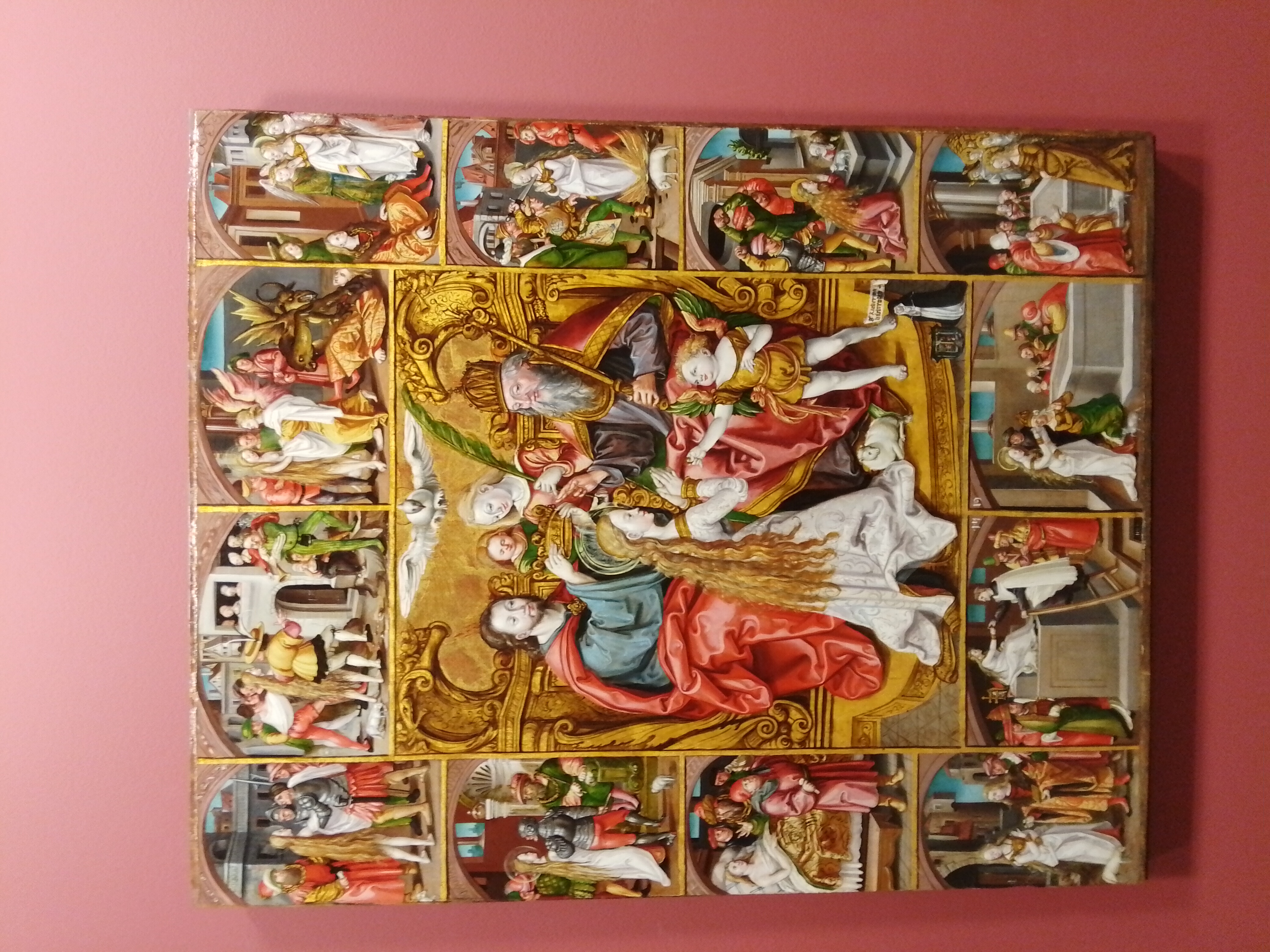
    By coincidence — but some say there are no coincidences — I’ve just found out that today is the feast of Saint Agnes. I wasn’t familiar with her story, but when I was in France, last December, I saw a medieval painting in a museum in Montpellier that called my attention. It was an anonymous painting telling the story of her martyrdom, with different scenes of her life displayed almost in the form of a comic book.

    Agnes was a young woman from a rich Roman family who converted to Christianity. According to the legend, when she was 12 or 13, a spurned suitor denounced her for being a Christian, therefore, as a punishment, she was paraded nude on the streets in order to be taken to a brothel (but her hair miraculously grew to cover her, and anyone who tried to have sex with her was struck blind). Then they tried to burn her (but the fire would not catch). So they stabbed her in the throat, and she died. She has since become the patron saint of virgins. Her skull has been preserved and it can be seen displayed in the Sant’Agnese church, in Rome.

    There is also a famous poem by John Keats called “The Eve of Saint Agnes“, which is inspired by the old folk belief that young maidens could see their future husband in a dream if, on the eve of Saint Agnes — that is on the night before the feast — they performed certain rituals. These could include fasting and transferring pins from a cushion to their sleeves while reciting the Lord’s Prayer, although different accounts give different rituals. Ben Jonson, one of Shakespeare’s most famous colleagues, mentions the custom in a text from 1603. John Aubrey, who seems to have been Keats’ main source, describes it in more detail in his “Miscellanies” (1696).

    In Keats’ poem, the ritual is described as the young maiden going to bed without supper and then lying nude under the covers, with her head resting on a pillow and her face turned up to Heaven as she sleeps.

           They told her how, upon St. Agnes’ Eve,

           Young virgins might have visions of delight,

           And soft adorings from their loves receive

           Upon the honey’d middle of the night,

           If ceremonies due they did aright;

           As, supperless to bed they must retire,

           And couch supine their beauties, lily white;

           Nor look behind, nor sideways, but require

    Of Heaven with upward eyes for all that they desire.

    The idea of the maiden’s future husband appearing in a dream is interesting. Jorge Luis Borges said once (apparently referring to some quote by T. S. Eliot that I could not find), that “In the Middle Ages, when people believed in the divine origin of dreams, it made them dream better dreams”. It’s a witty saying, but I think it’s also true. Freud and psychoanalysis first demoted dreams to a mere result of sexual repression, and, for modern science, dreams are just sequences of random imagery from our brains with no ulterior meaning. Therefore, we do not have the same interest in dreams that ancient people had, and, as a result, not just our interpretation of dreams, but our dreams themselves, have become poorer.

    And of course, all those curious folk rituals, not to mention the celebration of the feasts of most saints, have almost disappeared in an increasingly secular Europe, which is, in many ways, sad too. We no longer believe in saints, witches, demons or dreams — but we do believe in “global warming”, “aliens”, “fact checkers” and “gender fluidity”, so there’s that…

  • Articles

    How to get rid of a dead body?

    And how to marry a witch — two classic American films by European directors

    I have trouble being consistent with my themes, but, in general, this blog is about the things I like — film, literature, travel and conspiracy theories. So this is a post about film, for a change.

    I have been trying to use a bit more my Criterion Channel, which is a bit expensive, so I have been watching a few noir movies and other classic Hollywood movies from the 1930s to the 1960s. More recent productions by Hollywood are mostly propaganda and do not interest me all that much.

    There are two films from the 1940s that I watched recently that might merit further comment. The particularity of many of these movies of the 1940s is that, although they were produced by American studios, they were directed by European directors who were either escaping the war, the Nazis, or who had just migrated to the U.S.

    The first film is “The Woman in the Window” (1944), by Fritz Lang. Lang is one of the masters of German expressionism, and the director of one of the best silent movies of all time, which is of course “Metropolis” (1927). He moved to the U.S. when the Nazis took power, and stayed for decades in the U.S.. While he never made any other film as impactful as “Metropolis”, he directed several good noir movies and even Westerns, and had a long career in Hollywood. He returned to Germany only in 1958, where he directed a sort of sequel or reboot to his Mabuse series, “The Thousand Eyes of Dr. Mabuse” (1960), which is an interesting film in its own right.

    “The Woman in the Window” is, ostensibly, a noir movie, but I would argue that is really more an anti-noir, or a reverse noir. Let me explain. In noir movies, you usually have a male protagonist with serious character flaws who meets an even more flawed woman (“femme fatale”) and together they end up committing bad deeds. The classic example would be Billy Wilder’s “Double Indemnity” (1944). Man falls for sinful married woman, together they decide to murder her husband and run with the insurance money. Disaster and several double-crossings ensue.

    Here, instead, the main character is a quiet university professor who doesn’t really do much of anything wrong, except perhaps accepting a strange invitation, and gets involved in a death that cannot be characterized as anything other than self-defence. The supposed “femme fatale” is also pretty angelic, almost naïve, at least for film noir standards. I’d argue that she’s closer to the archetype of the “whore with the golden heart” than to the “femme fatale” archetype.

    The main character is played by Edward G. Robinson. He also appears in “Double Indemnity” as the insurance investigator, and he’s great there. He’s a very interesting actor, with unusual characteristics for a leading man. After all, he is short, not muscular, not very attractive. Now, Humphrey Bogart was also short and did not have a particularly beautiful face, but he had this tough guy persona which more than made up for it. Robinson is more the nerdy, weak, intellectual type. Here he plays a professor that approaches everything, even murder, cooly and rationally. The woman is beautifully played by Joan Bennet, and, if anything, she seems even more lost and confused under the circumstances than him.

    If film noir is in general about bad people doing bad things, this is more about relatively innocent people who end up mixed in bad things, and totally out of their depth, due to people much worse than themselves.

    Most of the film, therefore, and the main source of suspense, is really this: what would you, an average person, do if you suddenly had to get rid of a dead body? How would you do if you had to escape from the police and avoid being blamed for a crime? I am sure everyone has thought about these important questions at least once in their life…

    There is a double or really triple twist at the end of the movie that further changes its meaning, but I won’t discuss it as I don’t want to give spoilers. Let’s just say that not everybody likes the ending. But I think it works for this particular film, exactly because it is not a “real noir”. I really liked the whole thing.

    The second movie I wanted to briefly comment on is “I married a witch” (1942), by French director René Clair. Contrary to Lang, René had a short career in Hollywood, directing only four movies there, then going back to France after the end of the war.

    There’s no way not to give spoilers for “I married a witch”, because the film is about exactly what the title says. Anyone familiar with the “Bewitched” series from the 1960s will immediately know the basic plot. I grew up watching “Bewitched”, and it’s incredible how much the producers of that series stole from that earlier film. In fact, it seems that the only reason they were not sued for plagiarism is that both the film and the series were produced by the same studio.

    Veronica Lake plays the charming witch of the title, and she’s wonderful in the role. Lake’s story is the tragic, classic Hollywood story. She had a relatively short career before succumbing to alcoholism, several divorces and personal problems. She made perhaps only a dozen films, and of those, I’d say that only three or four are still worth watching today. Two are the noir movies she made with Alan Ladd as her co-star — “The Blue Dahlia” is my favourite — and another one is Preston Sturges’ screwball classic “Sullivan’s Travels”. But, to my mind, “I married a witch” is her best.

    The story, if you take it literally, is pretty silly, and in the hands of another, less skillful director, would probably fail. But René Clair, perhaps because he’s French, brings a certain je ne sais quoi to the movie that elevates it beyond its own silliness. The gags work, the characters work, and the whole thing is as charming as a witch’s love spell.

    Friedrich March plays the male counterpart. He’s not particularly memorable, but the role calls for someone who’s a bit more of a passive character, if not even a bit of a bumbling idiot, for Lake to have fun with. The “devil” father of the witch is played with gusto by Cecil Kellaway. I wasn’t expecting much from this movie, to be honest, but I ended up really enjoying it.

    This is it for today. Next post is going to be about conspiracy stuff again, don’t worry.

  • Articles

    Who is Klaus Schwab?

    A genealogical investigation of the Bond villain’s mysterious origins

    Very few people have heard about the obscure French writer Marcel Schwob, but many have heard about the infamous WEF chairman, Mr. Klaus Schwab. And yet it was a commentary related to the similarity of both surnames which led me through this rabbit hole.

    Although Mr. Klaus Schwab has been around for a long time, he rose to prominence in conspiracy theory circles mainly during the Covid era, when he argued that the pandemic was a perfect opportunity for a “Great Reset”.

    Thanks for reading Contrarium! Subscribe for free to receive new posts and support my work.

    He dresses and talks like a Bond villain and organizes yearly meetings in Davos when world leaders convene to decide the future of the world. (This year’s meeting is starting today.) He is a big proponent of transhumanism, and among other things the WEF is one of the main sponsors of Israeli writer Yuval Harari, transhumanist extraordinaire and author of “Homo Deus”. (Now that’s an interesting title, supposedly a play on Homo Sapiens, but it could also be interpreted as “Homo(sexual) God”. Harari is of course homossexual, “married” to another man and a big proponent of “human hacking” through “under the skin technology” that may include chips, vaccines and genetic manipulation.)

    But back to Klaus. Half of the people in conspiracy theory boards suspect him of being a closet Nazi, and the other half suspect him of being a closet Jew. Neither appear to be exactly correct: the truth is more mysterious and more complicated.

    In any case, he has strange family origins. Wikipedia says he’s the son of Eugen Wilhelm Schwab and Erika Epprecht. He himself lists Erika as his mother in the preface of a book. However, according to genealogy sites Wiki Tree and Family Search, Erika is actually the second wife of Eugen, and they “married about 1938 [location unknown], [children unknown]”.

    Now, 1938 is also the official birth year of Mr. Schwab, so was Erika already pregnant with little Klaus before the marriage? Or was she just the stepmother, and he was actually the child of Eugen’s first wife?

    The first wife is Emma Gisela Kilian, which doesn’t tell us much. Kilian appears to be an Irish surname. The site mentions that “She emigrated to the USA on December 9th, 1938.” Escaping from the Nazis? Or some other reason? Was this just after the divorce or separation from Eugen? But Klaus is registered as having been born in March 1938, so she still could be the mother.

    Some say Emma was Jewish, but, it’s not clear it is so. If anything, the father’s surname, Schwab, is more linked to Jewish origins: “German and Jewish (Ashkenazic): habitational name for someone from Swabia (German Schwaben)”.

    As I mentioned at the beginning, French writer Marcel Schwhob was Jewish, from the region of Alsace — which is now in France, but was at one point part of the same Swabia region in Germany, which explains the surname.

    Eugen Schwab and Emma Gisela are listed in Wiki Tree as having “at least” two children, neither of them, however, is our “Santa” Klaus. We have the names of Ulrich Schwab and Hans Ernst Schwab.

    The second wife, Erika, has no children listed.

    Klaus Schwab has no record, neither in Wiki Tree nor in Family Search. Weird.

    The Schwab family is listed as living and having roots both in Switzerland and in Germany. Eugen worked for a Swiss company, Escher Wyss, which, according to Wikipedia, “during WWII, the company was a supplier for the German war effort, manufacturing turbines for Norsk Hydro, and supplying flamethrowers. Additionally, the company was an integral part of researching and developing turbines to produce heavy water for the creation of nuclear weapons for the Nazis.” That’s why the family moved to Ravensburg, Germany, at some point during the 1930s, but then went back to neutral Switzerland before the end of the war. Klaus started his primary school in Zurich, this would have been in 1944/1945, but then the family returned to Ravensburg after the war.

    Interestingly, the Scwhab family seems to have migrated to Brazil in the 1960s. Although old Eugen returned to Germany, at least Hans seems to have made Brazil his permanent home.

    Why Brazil? It is not clear. The family appears to be moving between Brazil and Germany constantly during this period, with several entries and exits recorded from the 1950s until the 1970s. Hans is listed as an engineer, like his father Eugen, who “specialized in the manufacture of turbines and equipment for the Wehrmacht” during World War II.

    The first entry of the family in Brazil appears to be in 1957, coming from Ravensburg, Germany. According to Wikipedia, Klaus, then 19, finished school and took his Abitur exam in Ravensburg that same year.

    However, while the rest of the family for some reason started moving between Germany and Brazil, Klaus went to study in Switzerland. He graduated in 1961. Continuing the family tradition, he also graduated in Engineering, but afterwards took a doctorate in Business.

    Did he stay in Switzerland with Eugen’s second wife, Erika, the woman who raised him? According to Wikipedia, she was Swiss. Or was he living alone from a young age? We are still not sure if Erika’s his actual mother or stepmother, nor where she lived at the time. Very little appears in the genealogy sites about Erika.

    Interestingly, there is a record of the marriage of Eugen Schwab and Emma Kilian Jekelius in 1926 (Jekelius was the surname of her first husband, from which she divorced, Kilian was her single name). But there’s no record of the second marriage with Erika Epprecht.

    So, we still don’t know for sure whether Klaus was the son of Eugen’s first or second wife. We also don’t know why they went to Brazil so many times. And where did all the family’s money came from? They seem to be very rich, but engineers are, in general, not that rich. Was the Swiss part of the family connected to bankers?

    So, we are still very much in the dark. Perhaps this work will need to be complemented with a second part. The investigation will continue… Stay tuned.

    Thanks for reading Contrarium! Subscribe for free to receive new posts and support my work.

  • Articles

    The Sickness unto Death

    Random notes on illness, death — and moving to Samoa

    Calm down, the title of this column is just a quote of the title of one of Danish philosopher Søren Kierkegaard’s most famous books (which I haven’t read). I am not a hypochondriac. In fact, quite the opposite: I may be slightly iatrophobic. I avoid doctors like the plague, and go only when I really need them. Luckily, I didn’t need very many times for the last two or three years. But I don’t tend to get worried by every little illness or health problem I have. 

    And yet, lately I have been annoyed by a persistent cold and cough for almost two weeks now, only today finally receding. It’s not Covid — Covid was milder, if anything. This is mild too, just more persistent. One morning I think I am finally fine, then at night the cough returns again. And so on and so forth.  

    Since I am getting older — alas, we all are, even newborn babies — this type of problem is probably going to become more common. Then there are other small issues that come and go like back ache, muscle pain, etc. I just ordered new eyeglasses too, since my sight also seems to have deteriorated slightly and I can’t read small print anymore. “I grow old … I grow old… I shall wear the bottoms of my trousers rolled.” (This one is from T. S, Eliot, and it’s about rolling up the bottom of the trousers to take a walk in the seashore and hear the mermaids sing — which may or may not be an allegory of death, too.)  

    A disease, even if mild, is always a reminder of death. Well, perhaps not. I had a great-aunt who was always sick with either real or imaginary diseases, and lived up to 95 years. But, in general, I think we tend to think more about death when we are sick than when we are healthy. And yet, death can come any time, to the ill or to the healthy alike.  

    In a nice but little seen short documentary called “For the Children of the Donbass” — this was shot before the current war over there, when the conflict was mostly a local issue, not yet the calamity it is now — one of the character muses that, with war, your perspective on live changes. The idea that you can die any time, maybe in the next minute, becomes a normal part of your daily routine, and this makes you appreciate life more. 

    War kills mostly the young, sickness kills the old. For the ancient Germanic and Scandinavian tribes, dying in battle was a glory, dying in your bed was a shame. Those who died in battle went to Valhalla, those who died of illness went to Hel (just one l), an underground location reminiscent of the Greek Hades and which evolved into our word Hell (two ls). Today, dying in battle doesn’t appear to be so great. We care too much about living and too little about the afterlife, so most people would rather die old than young. 

    Of course, most people today are also terribly afraid of sickness and death, and that was one of the reasons that the Covid operation was so successful, in comparison, say, to the “climate change” agenda. In practice, most folks are not very afraid of “climate change” or “global warming”, because it’s not clear what its real consequences are, and it remains a somewhat abstract fear, but everybody is afraid of strange, new, unfamiliar diseases. If Covid had just been branded as a slightly different type of flu, and not something completely new, there might not have been all that panic and social change. But then again, social change was part of the agenda. 

    Now most people are no longer afraid of Covid, and the media has replaced its hysteria with other topics. Unfortunately, no one paid any price for all the lies and exaggerations, so it might happen again. Wait, what am I saying? Lies, panic and exaggerations are the daily bread of the media, so it never really stopped happening, the tone was just reduced in intensity, at least for the time being.  

    In the meantime, however, economic crash and poverty are the new worries of the day — they are also have a more concrete feel than “climate change”, and are a distinct fear for millions of people. 

    Being ill while rich is bad enough, but being ill and poor is of course much worse. 

    Many writers in the 19th century (poor or rich, it affected both) suffered from tuberculosis — it was a disease that especially afflicted Romantic writers for a reason — and, in the lack of a more definitive cure, one of the medical advices of the time was to move to a milder climate zone. Go South, young man, they said. Keats moved from London to Rome, even if it was too late to really save him and he just died there. And Stevenson moved from London to California and then to the island of Samoa in the Pacific, where he died, although at least after having lived there for many years. 

    (Another writer, the French Marcel Schwob, also suffered from some kind of respiratory illness, and in 1901 he traveled to Samoa in order to improve his health and to find Stevenson’s grave — but he never got to it, because apparently his health got worse on the island and he decided to go back immediately to Paris. I guess warm weather is not good for everyone?) 

    Anyway, I wish I had something more profound or interesting to say about all this, but all I can think is that, whenever I have a  cough or a cold, living in a drab, icy Central European town, I, who grew up in a subtropical region, sometimes miss and would like to move South to a warmer climate zone — Southern Italy, Spain, or even Samoa. 

  • Articles

    Strasbourg

    The last stop before resuming normal life

    I stopped for a couple of days in Strasbourg in the last leg of my New Year journey. It is a beautiful town, even if my visit was a bit marred by a persistent cough and sore throat that I caught somewhere between Barcelona and here. (Should I have worn a mask on the train? I don’t think those things work, and they are annoying. But I do have a cold and a cough now). 

    I had been in Strasbourg before: 20 years ago more exactly. A friend of mine from film school lived there, and I went to visit him. Coincidentally, it was also around the end of the year  — I remember it because he informed me, and that was news to me then, that one of local traditions of the people in the banlieues was to burn cars during the night of New Year’s Eve. I think the tradition still goes on, but I’m not sure, as I arrived after the New Year. From that visit I also remember, perhaps by association, the delicious tartes flambées, and, other than that, just my friend’s very funny and sympathetic sister — I think she’s now married with two or three kids and no longer lives in Strasbourg.  

    This time I stayed in a local hostel, and I suppose it would have been interesting to meet and talk to some other travellers and hear their stories — I admire people like, say, Linh Dinh, who have an easiness to talk to strangers and extract from them their best life stories like a dentist extracting a tooth — but the cough made me crankier and even more anti-social than usual. I consoled myself thinking that you can learn a lot just by looking at people’s faces. 

    There is something unique about French faces. I cannot always recognize Spaniards, or Germans, or Italians, but the French… The French have something very French about them. Simply looking around I could identify them and separate them from the others… See, there is this middle-aged man with a hat and a coat that has something of Jacques Tati… That pretty blond girl at the reception with a hint of Catherine Deneuve… The brunette at the bar with a smile that is a cross between Juliette Binoche’s and Audrey Tatou’s… That other petite woman at the door who maybe looks more like Isabelle Huppert…

    Or was my of weakness for French movies making me see things?

    Other than people watching, I used my time to visit the Strasbourg Cathedral, Petite France, and the Alsatian Museum. I enjoyed especially that last one, a little museum that gives you a glimpse of the history of the region. The Alsace is, to me, the best part of Germany — A Germany where they speak French, eat French food and have the French charm about them! Sure, I know it’s part of France now, but it wasn’t always, and its traditional architecture of course still looks more German than French.

    As most regions of the world lose their peculiarities due to the changes brought on by globalism and modern technology, it is nice to know that some corners still retain a bit of their ancient history and characteristics.  

    Holidays are over. As I get back, I find a letter from my landlord informing me that there will be a 25% increase in my rent in 2023, due to the high energy costs now in Europe…. So it’s time to stop travelling, and work. But let us still enjoy life while we can, for who knows what will be coming this year?

  • Articles

    Everything must change

    A Happy New Year to my few readers

    I’m in Catalonia, in a small seaside poble less than an hour away from Barcelona. When I started writing this, it was December 31st, 2022, the last day of the year, and I was sitting in a small cafe outdoors, looking at the sea.

    Inflation has struck Spain too, but things seem still cheaper here than in France and Germany. A coffee with a good croissant costs 2.5 euros, while over there it would set you down 5 or 6. In France the croissant at least would probably be good too, but in Germany, well, I guess it depends where you get it.

    A Catalonian flag on top of a building is waving in the wind. A few mural paintings talk about independence. Catalonians tend to be very nationalistic, but usually in a humorous, good-natured way. They say that Columbus (Cristòfor Colom) was Catalonian, and that it was also a Catalonian (Narcis Monturiol) who invented the submarine. They also say that Catalonians invented the airplane, the television and, perhaps, even the Internet. Wether they say such things because they believe them or just to mock the Spaniards is anyone’s guess. 

    People tend to speak mostly Catalonian, but not in the somewhat passive-aggressive and overprotective way that the French in Quebec do. Perhaps it’s because Quebeckers compete with English and Catalonians just with Castilian, but Quebeckers seem more insecure about it: they keep making laws about how shopkeepers should greet people only in French, for fear that otherwise their frail language will disappear.  Catalonians have no problem switching from Castilian to Catalonian, sometimes in the middle of a sentence. Catalonian, of course, is an interesting language. I can understand pretty much everything, even if I can’t really speak it. But if you are fluent in either French, Portuguese or Spanish, chances are you will understand at least 50% of Catalan too. 

    I support Catalonian independence, as I support most peoples who wish to be independent, but Catalonians probably deserve it more than most. For a few centuries Catalonia was part of the historical Crown of Aragon, even the flag is the same, until they joined with Castile giving rise to the Kingdom of Spain, so they go a long way back. Or maybe it’s because I also have Catalonian ancestors, and I identify more with them than with Madrid. Who knows.

    As I said, I started writing this last year, but now it’s January 1st, 2023. Many people tend to make big new year resolutions during this period, but I’m old enough to know that the will to make big changes rarely lasts more than a few days, weeks at most. It’s not easy to change. And yet, change we must. Change is part of life, and we change wether we want it or not, even if it just by getting older. What of it? There is always time to improve. The Romanian philosopher Emil Cioran once wrote:

    While the hemlock was being prepared, Socrates was learning a melody on the flute.
    ‘What use will that be to you?’ he was asked.
    ‘At least I will learn this melody before I die.’

    Well, it is not much different for Cioran’s Socrates than it is for us. We all have our own hemlock to drink, sooner or later.

    There is a certain melancholy in the beginning of a new year, too. The passage of time and all that. Wasn’t it just yesterday that we were in 31 December 2020 and everyone was saying that 2020 had been the “worst year ever”? Well, that got old fast… Two years of pandemics, one year of war (still ongoing), and who knows what 2023 will bring? But let as not worry about any of that for now, for whatever will happen, will happen.

    “Therefore do not worry about tomorrow, for tomorrow will worry about itself. Each day has enough trouble of its own.” (Matthew 6:34)

    Happy New Year to all!!!

  • Articles

    We'll always have Paris

    A visit to the iconic city sparks some thoughts

    What can be said of Paris that hasn’t been said before? It is one of those few cities, like London, or Rome, or Chicago — well maybe not that last one — that live in the world’s imagination, so much that even those who have never been anywhere near them may have an idea of what they look and feel like — at least, we all have seen their streets and cafes in the movies, or read about them in a book, or heard tales of wonder told by a friend who visited.

    Paris is justly regarded as a the most romantic of cities, the home — natural or adopted — of poets such as Apollinaire and Verlaine, and of several famous painters from Modigliani to Renoir to Picasso. But did it change in recent years, another victim of the globalist juggernaut, and of the economic changes brought by the engineered “pandemic” response and the no less engineered current “energy crisis”? Is it, as some say, no longer what it once was?

    Well, I had been to Paris a few other times before, but the last time was ten years ago or more, and since I had a few days before going to Barcelona, I thought it was a good moment to check out how the City of Lights was doing.

    “I love Paris in the summer when it sizzles / I love Paris in the winter when it drizzles”, Cole Porter memorably wrote and Ella Fitzgerald memorably sang; but I was lucky enough to have a sunny and, if not sizzling, at least not too cold day at the very end of December.

    My visit was short, one day and a half. When I arrived the main news was about a retired railway employee (no ethnicity or identity was provided by the media) who had shot a Kurdish Cultural Centre and killed three Kurds. Then over the next few days the local Kurds in Paris protested and destroyed shops and burned cars. But except in the television and computer screens, none of that confusion was apparent in the city, at least in its more fashionable, touristy arrondissements.

    After a failed visit to the Musee d’ Orsay (the line was too long) and an obligatory picture taken next to the Eiffel tower, I spent most of my time walking around the Marais, now my favourite Parisian neighbourhood. I tend to like old neighbourhoods with narrow, cobbled streets, which is why I also like the Barrio Gótico in Barcelona, Stare Mesto in Prague and Gamla Stan in Stockholm.

    I saw no Kurds protesting, but plenty of immigrants or people of immigrant background. In some parts of town, such as in the 18th arrondissement, they were clearly the majority: there was hardly any face in the street that wasn’t African or Arab. But this is not too different from most European capitals today, from Sweden to Sicily, and not just in Europe, too. The whole West has become a new Babylon, and whether that’s good or bad, we shall soon see, but it’s a reality we cannot deny.

    The streets did not feel dangerous, however, even in those ethnic, slightly ran-down neighbourhoods, and even there, there were plenty of shops and cafes, but not too many tourists hovering around. Ironically, or perhaps not, that quarter has a church dedicated to Jeanne la Pucelle — Saint Joan of Arc, patron saint of France, who fought against the English invaders and was later burned by them at the stake. There is a statue of this Saint, religious symbol of France, right in front of the church, looking sternly at the people passing by, many of whom are probably neither French nor Christian. It is not an old church, as it started to be built in 1930 and concluded only in 1964, but right next to it there is another, smaller chapel, Saint-Denys, which was built originally in 1204 and where Saint Joan is said to have spent a night in prayer during her visit to Paris in 1429.

    Near the hotel where I was staying there was another church, Saint-Ambroise, built in the 19th century. Its most distinctive feature is the Chapelle du Souvenir, a section of the church with statues created in the late 19th century but now dedicated as a memorial for the victims of the atrocious Bataclan terrorist attack of 2015, supposedly committed by ISIS/Daesh members and which killed 130 people who were there watching a rock concert. The Bataclan club is located a mere 100 meters away from the church, and it is still in activity, but now with new owners. Supposedly the reason for the attack was because the club had Jewish, pro-Israeli owners, and because of France’s involvement in the Syrian civil war.

    I say supposedly because a lot of details about the attacks and the reasons behind them are still unclear. They were immediately used as an excuse for the French government to bomb new ISIS targets in Syria; and France is to this day still involved in the conflict there, supplying weapons or aid to rebels fighting against the Assad government, and therefore acting in support of other Islamic rebels which do not seem very different from ISIS/Daesh — even if a lot of those rebel groups are enemies against each other, supporting any of them seems to contribute to the general chaos in the country. It is not clear, at least to me, why France is in Syria, and much less why its people, who do not support or probably even know what their government is doing there, should pay the price.

    Further away by the Seine, the most famous French church, Notre-Dame de Paris, is of course all covered in scaffolding, still being reconstructed after the mysterious but probably accidental fire of 2019. Reconstruction is expected to last at least until 2024.

    The central parts of town along the margins of the Seine are mostly filled with natives and tourists in equal measure, and, as mentioned, there are long lines to enter the Musee d’ Orsay and the Louvre. The city changed, for sure, but more in parts than on the whole. Tourists are still coming in droves, and its romantic myth — or reality? — still lingers on.

    I said before that the French don’t like to keep detailed statistics about the ethnicity and religion of the country’s inhabitants, and the reason is that they see themselves as a secular society of total equality based on the ideals of the French Revolution — you know, that liberty-inspired bloodbath the consequences of which we are living to this day. So in some ways it is fitting and adequate that France, of all countries, would become the topmost multicultural and globalized nation in the world. Well, after America, but isn’t America and its Constitution also influenced by the same ideas? The French enlightenment influenced the American Independence, which in turn influenced the French Revolution. There is a statue of Thomas Jefferson — U.S. Ambassador from 1784 to 1789, and spectator of the storming of the Bastille — by the Seine, right next to the Musse d’ Orsay.

    The Parisi were a Celtic tribe that inhabited the region of Paris in 300 b.C. and eventually gave their name to the city. It was conquered by the Romans in 52 b.C. and called Lutetia, then Parisius, then Paris. It was raided by Vikings in 845, occupied by the English from 1420 to 1436, shaken to its core by the revolutionaries in 1798, besieged by the Prussians in 1870, and of course occupied by the Germans in 1940. It survived all that, and remained Paris. There is no reason to think it won’t survive many other calamities. As Humphrey Bogart said, “We’ll always have Paris”.

  • Articles

    Argentina, again

    Messi, Borges and the World Cup win

    Yes! Argentina won the World Cup after a nail-biting game that seemed it would never end, and Messi got his dreamed and well-deserved prize. Fantastic!

    I didn’t realize that Argentina had last won in 1986, because it got really close other times: it was two times vice-champion since then, first with Maradona in 1990, then with Messi in 2014. I have little memory of the 1986 victory (I was 13 years old) except for Maradona’s brilliant goal against England in the semifinals, but I remember very well the frustration after Messi’s team ‘s defeat in the finals in 2014 — although, to be fair, Germany deserved to win that time.

    Besides being a great player, Messi seems to be a great guy; he’s certainly a less polemic character than the divisive Maradona, and he really deserved this win after a very long wait, and nearing the end of his career.

    But I was thinking now about Jorge Luis Borges, Argentina’s most prominent writer, who didn’t care about football or sports at all. Borges once wrote that a country’s foremost writer tend to be very different from the stereotype of the population. He gave the example of Shakespeare, who with his emotional characters and baroque prose seems very distant from the more typically English understatement, irony and stiff-upper lip.

    Well, it’s hard to think of anyone that, in appearance, is less Argentine than Borges. He was very humble, which is not a very Argentine character. He didn’t like soccer. And, besides his lifelong interest in tango and gauchos, that appear in many of his stories and essays, most of his universe revolved around vikings, saxons and ancient labyrinths. And yet, I’d argue that it is not possible to understand Argentina without reading Borges.

    Argentina is a strange country; it went from being one of the richest countries in the world at the beginning of the 20th century to being a mostly poor, corrupt and disorganized one, for decades now. And yet, for years, many Argentines saw their land as a basically European country wrongly located in South America, although that was always more wishful thinking on their part. Sure, big central cities such as Buenos Aires and Rosario were heavily Italian and Spanish, but the rest of the country and in particular the Northern regions were always more indigenous.

    Now, the country is changing again — there’s still lots of immigration, only now they come from even poorer neighbours such as Bolivia and Peru, but also from Asia. There’s many Chinese and Koreans in the country, who seem to dominate the grocery stores. A porteño will say he’s going to the “chino de la esquina” (the Chinese grocery in the corner) to buy his mate or his dulce de leche. It’s hard to find numbers, but some sources say that there are 200,000 Chinese immigrants in Argentina and perhaps 100,000 from Korea and other Asian countries.

    Argentina had a large Jewish population since at least the beginning of the 20th century, but what’s new since the 2000s is the number of Israelis moving to the country, mostly to the Patagonian region. It is curious that many Argentines of Jewish origin moved and are still moving to Israel thanks to the Law of Return, but a few are traveling in the opposite direction. For many years, Argentina has been a popular touristic destination for Israelis after their military service, but some remain in the country and there’s even a few richer people who bought huge tracts of land in the South, giving raise again to the old conspiracy theory of the “Andinia plan”. It seems a baseless fear: due to the economic troubles, the number of Jews in the country is actually decreasing, with more choosing to emigrate rather than immigrate.

    Other than that, the country has been in ups and downs since basically forever, so Argentines are used to living in an economic roller coaster.

    Argentina’s and Messi’s victory in the Cup has put a temporary smile on everyone’s faces, but inflation, corruption, rising crime and poverty continue being a huge problem in the country, with no easy solution in sight.