• Articles

    Get woke, go broke? Not really

    It’s okay. Relax and enjoy the decay.

    And now back to political commentary. Some “conservatives” like to parrot the idea that went companies “go woke”, they lose money.

    But this is not really true. Even if they eventually lose money on a particular film or product, they make up for it with something else.

    Disney, for instance, keeps making live action remakes of their old animated movies recasting traditional characters as black, female, gay or transgender, or changing the stories to fit some feminist/globalist/whatever agenda, and even if many of the movies are not exactly hits, they do not seem to be losing money either. In fact, they are probably making more money than ever.

    Amazon, the same. Most people hated its version of Tolkien, but so what? They do not seem to be going anywhere. People still use Amazon, even as it destroys small bookstores and local grocery stores.

    Sometimes some naive conservatives try to organize boycotts against certain brands, but this rarely works. And even when a boycott works, results are mixed.

    The most recent example is Bud Light beer. This awful, disgusting, watery American beer (but I repeat myself) had an advertising campaign involving some sort of “transgender influencer”, which wouldn’t seem to be its main demographic target, but then again, it’s been a long time since advertising was about selling products to customers and not annoying or lecturing them.

    People were upset, they boycotted Bud Light, and sales went down 21%. Victory, right? Sort of. Beer sales just went to other, equally watery beers, such as Miller Lite and Coors, and some of them are even produced by the same giant multinational company that sells Bud Light. There are just a handful of multinational companies that produce most of the famous beer brands.

    Then there was the even more recent backlash against Target shops, because they were selling some kind of “gay” or “transgender” clothes for children (I have no idea what it was, exactly). Their stock went down a few points, but so what? It will likely not affect them in the long run.

    I think that those outrages are actually calculated, done in purpose to irritate people and create division. Stimulating constant infighting and even boycotts among people are part of the plan. If they worry about “transgender clothes” they won’t worry about who’s ruining the economy or stealing the taxpayers’ money.

    I think Prof. Charlton is right in saying that boycotts are in general ineffective because it’s not just one big corporation or another that is the problem — the whole system is corrupt. So boycotting just one thing among thousands is rather pointless. The whole system would have to be boycotted for this to work. Of course, you can always stop using certain products for your own personal good such as, say, avoiding processed foods, or brands that sell unappealing ideas, but do not expect the system to change because of that. And in any case, it’s not just the “system”. We are the “system” too, as we all belong to this society, one way or another. And if we ourselves are part of this corrupt system… Then what?

    Accept it. It’s just silly people like me who rant against the modern world, AI, globalism, mRNA vaccines, and think that we are in the verge of societal collapse, for the dubious benefit of my 30 readers (soon to be less, after this rant). Most people are perfectly happy with the woke world and its woke products. They tattoo themselves head to food, consume MacDonald’s and Coca-Cola, watch Disney and CNN, and believe that we are on the right road to an equalitarian utopia. That’s how it is.

    It’s going to continue like that, for who knows how long. Until the money-printing machine breaks, I suppose, or until a large number of people realize that the “utopia” they’ve been sold is actually more like chaos, mayhem, war, poverty and crime.

    Whichever comes first.

    Since I don’t think my opinion is going to change things one iota, I might as well use my time in a better way, and occupy myself with more rewarding or productive activities. As, in fact, I should.

    And, you know what? Perhaps they are right and I’m wrong. Perhaps we’re really heading towards utopia and unicorns, and not towards the four horsemen of the Apocalypse.

    In any case, it’s time to forget it and relax.

  • Articles

    Sauna, Karaoke and other Finnish inventions

    Sauna is a great Finnish invention. It is not the only one: there’s also Moomins, Angry Birds, the original Nokia cell phone, and my favourite, the dish-drying cupboard or Astiankuivauskaappi, which, perhaps because of the long name, didn’t catch on in the rest of the world, but I find very practical. (In Finland, all apartments have dish-drying cabinets like that on top of the sink.)

    But I want to talk about sauna. It is really their greatest invention and shows the resilience and resourcefulness of the Finns.

    Now, think about it. These people were born in a place where it’s winter for six months. They have hundred of lakes and even sea beaches, but the water is usually ice-cold most of the time, even in Summer. So what to do?

    The Finnish solution was to create small cabins where you can artificially warm up your body until it gets extremely hot — in some saunas, even close to incineration point — that afterwards even swimming in an ice-cold lake becomes a relief. Rinse, and repeat. Warm, cold, warm, cold, warm cold.

    There are usually two types of saunas in Finland. The traditional ones, where male and female saunas are separated, and you have to go in completely naked (except for swimming in the lake, where you have to put on your swimsuit again). And then there’s the mixed saunas, where you usually have to be in the sauna with a swimsuit as well. There are a few mixed saunas where nudity for men and women together is the norm, but they are an exception.

    Now, remember, saunas are not beaches. People don’t go here to look at each others’ bodies, they go to sweat. You may talk about having a “beach body”, but there is no such thing as a “sauna body”. And you have to be comfortable enough with yours to be there.

    Some say that sauna helps you to lose weight, but I saw no evidence of that. Most people I’ve seen in public saunas were overweight, including a guy who seemed to be Finland’s sumo champion and occupied a whole bench just by himself.

    I was recently in Tampere, which is considered Finland’s sauna capital. Before that, I had visited only a local sauna frequented by tourists and artsy types, where the temperature was usually kept mild, but in Tampere…

    Oh, you haven’t really been in a sauna until you’ve gone to a public sauna in Tampere, such as Rauhauniemi, where they crank up the temperature to the max and pour water on the rocks to form water vapor (löyli) every 30 seconds, in a room crowded with old people, young people, and even families with small children. And then, when you feel your skin burning, you go to swim in a very cold lake while it’s windy and cold outside and strong waves chill you to the bone. The coldest the water, the better. If you think the place is crowded in spring and summer, wait to see it in winter, when supposedly there are long lines to get into a hole in the frozen lake.

    Just to give you an idea of Finns’ obsession with sauna, there are more saunas in Finland than there are buildings and cars. Most people have at least one sauna in their home or apartment complex or holiday home, and some more than one. A retired factory worker that I met in the public sauna told me that, if he won the lottery, he would use the money to “build a big sauna, like this one, in my home.”

    There was a yearly sauna championship in Finland until 2010. The idea was to see who could withstand the highest temperature for the longest time. But in that year’s competition, one of the finalists, a Russian man, died (thus earning second place), and the winner, a Finn, got third degree burns and ended up in the hospital.

    The competition has been banned since then.


    At night, I went to Helsinki to a karaoke place with a local friend. Karaoke is another Finnish passion. I was almost going to say “Finnish invention”, but of course they didn’t invent it, the Japanese did. And yet… Just as there is a “Finnish tango”, we might have to talk about “Finnish karaoke”, too.

    Karaoke is popular all over the world, but it is particularly loved among Asians and Nordics. I don’t know why, but some say it may have to do with the general introversion of people. The more introverted a society, the more karaoke is successful. It is a rare social occasion where you are allowed to let yourself go.

    Now, if you go to a karaoke in Finland, you will notice that things start very slowly. At first, say, around 9 or 10 PM, no one or almost no one is singing. The stage is empty even if the tables are full — Finns have to drink at least three beers or “lonkeros” before they feel uninhibited enough to sing. By midnight, however, you have one song after another, and waiting for your turn can take over one hour in the most crowded bars.

    Finns are also very supportive of anyone who dares going up the stage. There is no such thing as bad singing in Finnish karaoke. Finnish pop songs are particularly loved, of course, but ABBA and Queen’s “Bohemian Rhapsody” are also clear winners. But you can sing almost any song in any language, including Spanish, Estonian, Russian and Mandarin, and you will be sure to get an applause and smiles.

  • Articles

    Midnight in Kolho

    Losing the way, or finding a new one?

    When asked what are their main characteristics, Finns themselves will tell you that they are usually quiet and do not tend to talk too much. Paradoxically, the ones who tell you that are usually exceptions to the rule.

    Yesterday I made a short visit to the nearby town of Orivesi, where there was an Argentine tango festival that I wanted to check out. It was really just a dance event for people who are learning to dance, but it wasn’t Finnish tango, but the classic Argentine tango that I know too well. Still, it was nice to see Finns dancing to the voice of Gardel. (I myself can’t dance, as I have two left feet).

    I took the last train back at 22:37, and, sitting next to a Finnish woman, I ended up interviewing her for my documentary about Finnish identity. In reply to my question, she also said that Finns do not talk too much. However, in her case, she ended up talking quite a bit, and even after the interview she told me all kinds of things about Finland and Finns, and the best saunas to visit in Tampere and so on. It was really very nice of her, but I ended up losing track of time, and when I said goodbye and got off the train, I realized too late that I had missed my stop and had descended one station after.

    Finnish trains are very nice, and they all have free wi-fi, but they don’t announce the stops in the loudspeaker. At least, not on the small regional trains. And for some reason — perhaps too entranced with conversation with a nice young Finnish woman, or out of mere tiredness — I didn’t notice it at all when the train stopped at my station. In fact, I was sure I had counted only the two usual stops, so I was sure I was at the right one. But when I got off, I was in a very dark, unfamiliar place with no one around, and the sign read: “KOLHO”.

    I suppose there was a time frame of perhaps one or two seconds when I could have gotten back into the train, but, still too confused by the situation, I could just watch as the doors closed and the train departed. The young woman through the window was looking again at her phone and didn’t even see me as I waved, lost and forlorn.

    Now it was dark.

    Kolho. There was nothing there, really. Just a small wooden building which I suppose was the train station, which was of course closed, and forest all around. The village supposedly has 1,300 inhabitants, but the station seems to be located away from the main city entre, if it even has one. On one side of the station, there was just an empty parking lot, on the other side, a huge lake.

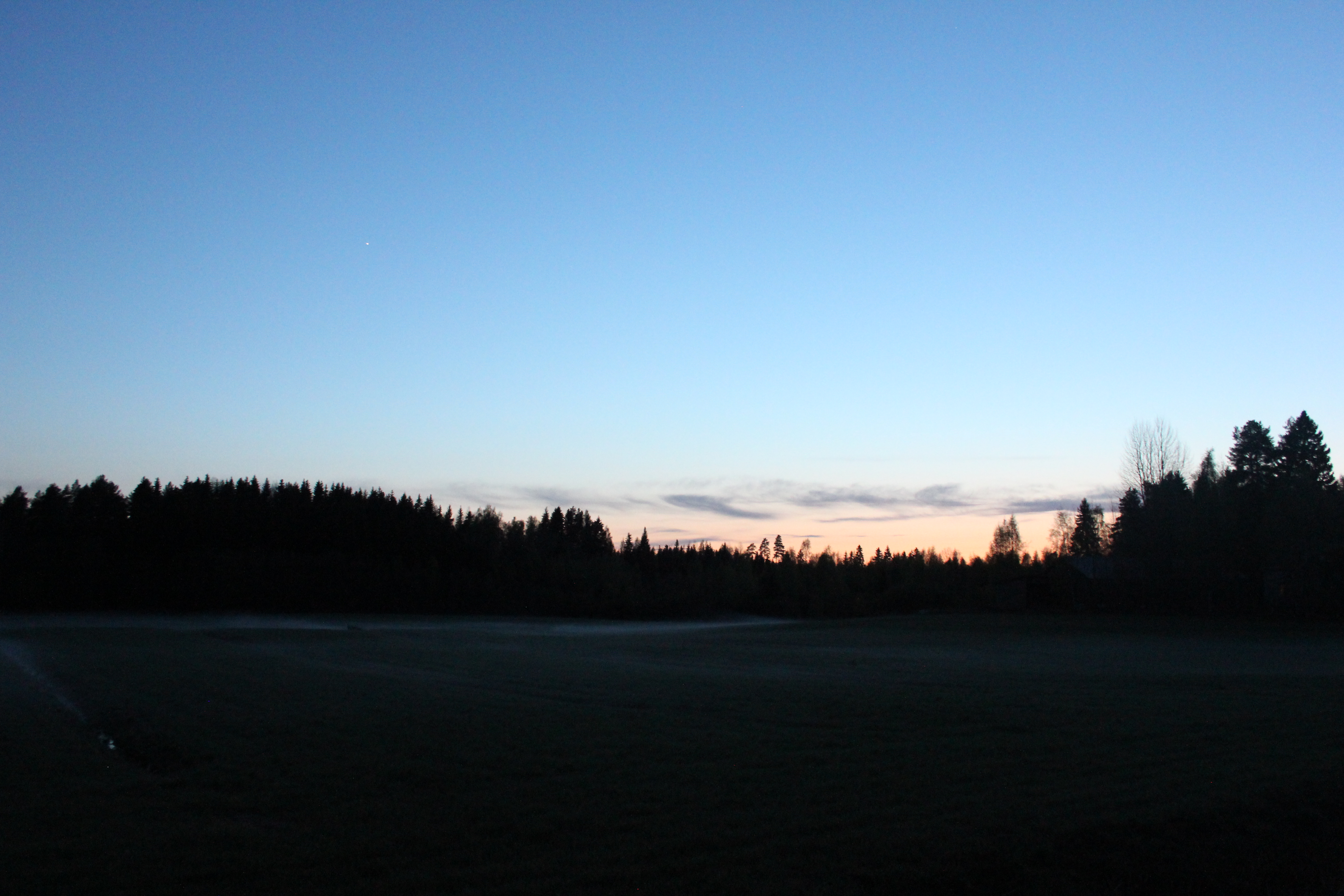
    I was lucky, though. For one, I had a bicycle with me, which I had taken on the train. And two, it was almost summer, and in Finland during this period it’s warm and it doesn’t really get dark until very late. In fact, it was about 23:20 then, but one could still see the light from the sunset on the horizon. The sky was still blue and only one star could be seen — perhaps Venus?

    A road sign further on indicated that the distance to my town was 15 km, which didn’t seem too bad, even if in the end it actually turned out to be 18 km, and I had a heavy bicycle with no shifts. Still, it was better than having to sleep in the forest.

    For many kilometres there were no houses, just trees all around. There was not even any road sign, except for the usual “Moose crossing” warning, so I wasn’t even sure if I was going in the right direction.

    By midnight, it was a bit darker, but still not completely. During the whole time that I was on the road, only one car passed by, just once. There were occasional farm houses here and there, but mostly it was just woods and lakes. No one to be seen for miles. Not even a moose, despite the several signs. A lonely place, indeed.

    The woods are lovely, dark and deep,   
    But I have promises to keep,   
    And miles to go before I sleep,   
    And miles to go before I sleep.

    I did arrive home — or at my temporary “home” — at around 00:30, after one long hour cycling. In the end, it wasn’t too bad. A little adventure to change routine.


    Sometimes I wonder. Did we, also, as a civilization, “miss our stop”? We seem to be advancing frightfully towards some kind of strange dystopia, although not many see it that way. In fact, most people seem to think that we are progressing, and that things are getting better and better, or at least tend to agree with the basic ideology of the status quo that says that we’re on a road to utopia.

    And yet, in most Western countries today, a large majority, close to 70% of people, think that the next generation will have it worse than we do, at least, in economic terms. Asked if they think their children will be better off financially than their parents, 82% of Japanese said “no, worse”; and the same think 78% of French, 76% of Italians, 75% of Canadians, and 72% of Americans, Brits and Australians. The only developed European country where the “better off” won, but just barely (47% against 46%), was Sweden. Finland was not part of the poll.

    When I was a child, back in the Pleistocene, we imagined that in the year 2023 (if we could even see that far) we would have colonies on the Moon and Mars, spaceships, robots, flying cars, incredible medical advances and a society with no crime, no poverty, no war. But now, all we have from that list are robots, and mostly they are of the annoying chatbot kind. When, a couple of years ago, I asked students to describe in a short essay their visions for the future, most painted a gloomy landscape of totalitarian governments and economic doom. The future ain’t what it used to be.

    Sometimes this darkness overwhelms me and I even ask myself if I should keep on writing. It all seems a bit pointless. Who am I even writing for, and why? I don’t really know. I wish I could write just about classic movies, but that doesn’t have a large public either.

    But, then again, why be so gloomy? A missed station and a detour can also be an adventure. It’s also possible that I have been reading too many negative news in too many questionable sites, and things are not that dark.

    It might be close to midnight, but the sunlight can still be seen on the horizon, the sky is still blue, and there’s a lone bright star in the sky, showing the way.

  • Articles

    Drifting Clouds

    How to survive harsh times in an increasingly difficult world

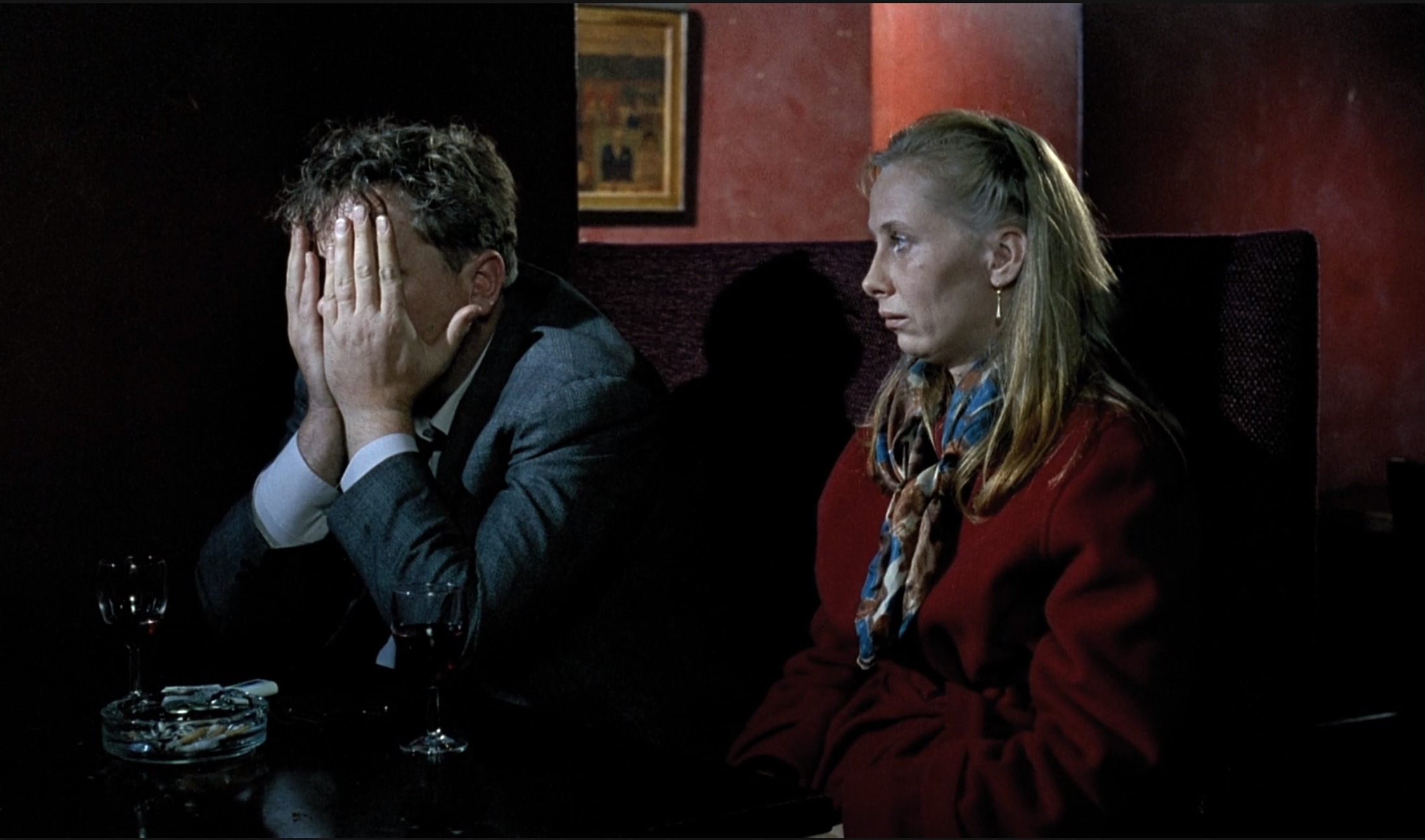
    If you should watch just one film by Aki Kaurismäki, I suggest “Drifting Clouds” (1996), which is probably his masterpiece. Well, to be honest, I haven’t watched a lot of his movies, but it’s the best from the four or five I’ve seen so far, both in technical terms — cinematography, camera, art direction — as in the balanced use of humour and pathos. Wonderful colours (no grey Helsinki here), and, as usual for Kaurismäki, excellent use of music, both classic and popular, including, of course, Finnish tangos.

    The story, such as it is, is about a working-class couple falling in hard times, due to mutual unemployment and a growing economic crisis. But there isn’t really a “plot” in Hollywood terms, as the film is mostly made up of little sequences which are almost independent of each other, showing the cumulative disasters that the couple, and a few other people, have to go through in order to… merely go on living.

    Is it a drama? Is it a comedy? Hard to say. It seems almost unbearably bleak at times, and yet, it does have many gags and even an optimistic feeling. Perhaps it is even the most optimistic film of this notoriously pessimistic Finn. The scene where they have their loan request rejected is both one of the saddest and funniest — “Banks don’t take risks!”

    Kaurismäki: “When I started working on Drifting Clouds, I looked for Frank Capra’s emotional story of salvation, It’s a Wonderful Life, on one side, Vittorio De Sica’s Bicycle Thieves on the other, and the Finnish reality somewhere in between.” (I would also add Robert Bresson as an influence, and in fact a poster of “L’Argent” by Bresson appears at one point.)

    Kati Outinen plays the wife, Ilona, and Kari Väänänen plays the husband. The role was supposed to be played by Matti Pellonpää, from Shadows in Paradise, to which this film was going to be a sequel, but he died just before shooting started, at only 44 years of age. Almost like the characters that he played in movies, Pellonpää (who also appears in Jim Jarmusch’s Finnish sequence in “Night on Earth”) lived constantly drunk and in debt. He managed to pay his last debts thanks to an advance payment he received to star in this film, but he died shortly afterwards. At least, he died debt-free. A very Kaurismäki-like ending, I suppose. The film is dedicated to him.

    Drifting Clouds is, at the same time, a very Finnish and a very universal film.

    At a time when recession seems to be rearing its ugly head again, and lots of people will probably go through what this couple goes through (or worse), there is much here to identify with.

    Many European countries are right now heading into a recession. Even mighty Germany is predicting economic doom. In the United States, inflation is worse than it has been in ages, and homelessness and drug addiction are at all time highs. Just go to any major city, from New York to Seattle, you will see it.

    And it’s not only the U.S. and Europe. Argentina is in an economic crisis that resembles the 2001 one and might even be worse, and most of South America appears to be heading into economic or political turmoil. War between Ukraine and Russia still rages, with thousands of Slavic young men killing each other for no fathomable reason, and other possible conflicts (Serbia vs. Albania? China vs. Taiwan?) also seem to be instigated here and there.

    A storm, maybe even a hurricane, is coming. Most people don’t seem to realize it, or, if they do, it is just with a general, abstract feeling, like someone who sees dark clouds in the horizon but thinks they are too far away, and even takes a photograph thinking they have some droll shape.

    HAMLET: Do you see yonder cloud that’s almost in shape of a camel?
    POLONIUS: By th’ mass and ’tis like a camel indeed.
    HAMLET: Methinks it is like a weasel.
    POLONIUS: It is back’d like a weasel.
    HAMLET: Or like a whale.
    POLONIUS: Very like a whale.

    How to get through hard times, then?

    The lesson from the movie seems to be: do your best to survive with what you have, but never stop dreaming. Things are bad now, they might become even worse in the future, but they may also unexpectedly get better. Clouds come and go. It’s grey now. It will rain later. But the sun will return one day.

    As a character at one point says, with unbridled Finnish optimism:

    “Life is short and miserable. Better enjoy it while you can”.

  • Articles

    Lost in Kaurismäki land

    Kaurismäki movies. The Finnish character. Russia and Sweden. Tango.

    Aki Kaurismäki is probably one of the most famous Finnish filmmakers abroad. He also has a brother, Mika, who makes documentaries. But Aki directs fiction movies and is more well-known, having won main prizes in Cannes and being nominated twice for the Oscars in the Best Foreign Language Film category.

    His characters are usually blue-collar workers down on their luck, in simple stories about simple conflicts, all told with a sort of dark humour delivered with deadpan seriousness. Far from Hollywood’s fake overproduced glamour, his actors are local, average-looking Finns, such as the wonderful Kati Outinen.

    In many of his films, people don’t talk much, and when they do, it’s in a straight-forward, almost abrupt manner. Consider “The Match Factory Girl” (1990), where there is very little dialog, and even the female protagonist barely speaks in the whole movie. You may think this is a style to make it closer to silent movies, but it isn’t. It’s just Finns being Finns.

    Or consider this dialog from another film, “Shadows in Paradise” (1986):

    “How much does a single room cost?”

    “With breakfast, it’s 100.”

    “And without breakfast?”

    “The same.”

    “Okay, I want to book a room.”

    “Sorry, we have no rooms left.”

    “You should have told me before.”

    “Why?”

    Before I came to Finland, this sounded like some type of absurdist comedy. But now that I am in Finland, I can see this dialog happening in real life. Not saying that it would necessarily happen, just that it could. Finns tend to dislike small talk and prefer to be straight-forward, even literal in their answers.

    There is one scene in that same film where a few characters sit round a table and, unable to say anything to each other, reach our for their pockets and… take out a pack of cigarettes, starting to smoke (today, they would reach for their phones). A foreigner might think that this means that they are feeling uncomfortable with all that silence. But not really. Finns can be comfortable in silence, too.

    In some ways it’s a relief. Compare it to the American custom of always having a forced smile, of always feeling that you need to say something to your co-workers or even to perfect strangers if you happen to share a corridor or an elevator with them, even if it’s just a comment about the weather.

    In American restaurants, the waiter or waitress will come every now and then with a smile to interrupt you and ask: “Is everything alright?” This invariably happens when you have just put another piece of hot potato in your mouth and can’t answer properly. (But when you actually need anything, the help is nowhere to be found.) Finnish restaurants follow the more appropriate European custom, which is ignoring you and letting you eat in peace until you call them to pay the bill (and no tips).

    Migration and Russian relations

    Kaurismäki’s two most recent movies seem to deal with the subject of migration, so I haven’t watched those, as I am afraid it might be just more immigration propaganda (even if, coming from Kaurismäki, I would expect a more nuanced approach, so I might watch them one day). But, in general, it seems to me that old-school leftists like Kaurismäki don’t seem to understand that immigration is actually bad for the working class, and a tool of big corporations to reduce salaries and the general quality of life. Just as they don’t seem to understand that phenomenons like “transgenderism” are not related to the protection of minorities, but again, tools used by big corporations and other powerful people to further destroy the family and reduce birth rates.

    (Whatever the case, it is certainly strange to see old-school leftists pushing exactly the same things that big corporations push.)

    Finland, or at least the small towns away from Helsinki, seems to be still relatively homogeneous, even when comparing it to Sweden, which already has 15% of immigrants, and several problems and political division associated with it. Finland does have foreigners, but most of them are neighbouring Russians, Swedes and Estonians (and now, a few Ukrainian refugees, but not as many as in other countries). However, Iraqis and Somalis have increased in the last years since the 2016 engineered “migrant crisis” and are now in fourth and fifth place respectively.

    Relations with Russia have become complicated by the current war and the joining of NATO. Well, to be fair, they have been complicated for a long time, as Finland used to be initially part of Sweden, then part of the Russian Empire for almost 200 years, until they managed to obtain their independence thanks in part to the Bolshevik Revolution of 1917 which ended the Russian Empire. The Baltic states were eventually gobbled up by Stalin and the Soviets, but, thanks in part to their victory in the Winter War, Finland wasn’t (although they failed in the subsequent Continuation War and lost a small part of their territory to Russia).

    So their concern with Russia is understandable, although perhaps it would have been more prudent to wait and see, as Finland wasn’t and isn’t in any immediate danger. But with the end of the decades-long neutrality and the coming of American military bases, things are probably going to get more complicated again.

    Besides Helsinki, most Russians in Finland live in the Karelian region, close to the Russian border. In fact the old historical region of Karelia was divided between Russia and Finland after the Winter War. Finland, today, has two provinces, called South Karelia and North Karelia, and Russia has the Republic of Karelia (even if ethnic Karelians are currently just a small minority there).

    In the event of a future conflict between NATO and Russia in Finland, watch out for this region.

    Sweden vs Finland

    Relations between Finland and Sweden seem to be in general more amicable, as both countries have more in common (and Finns and Swedes have been intermarrying for centuries). Swedish is even the second official language in Finland.

    However, it is true that Finland was politically dominated by Sweden for a large part of its history, and, even today, the Swedish-speaking minority in Finland comprise a more upper-class segment compared to Finns in general, a hidden aristocracy, you might say. So there is a certain historical resentment, which can be seen in the fact that Finns love to make jokes about Swedes, and have a great rivalry with them in ice hockey, among other competitions.

    The recent victory of Sweden against Finland in the Eurovision contest last Sunday certainly did not help to soothe things.

    Note: the Eurovision contest seems to be particularly loved in the Scandinavian countries. I suppose this is because of the victory of ABBA in 1974, which made that band internationally famous. But, for the life of me, besides ABBA (which was kitschy but at least had good and attractive singers), I never saw the appeal of Eurovision. It just seems very trashy to me, the epitome of kitsch and camp, and I never cared for it.

    But let’s go back and wrap it up with Kaurismäki again, since mentioning music gives me the opening to talk about him again. After all, Kaurismäki movies may sometimes have little dialog, but they do have a lot of music, and in particular Finnish tangos. And while most people of course associate tango with Argentina, Finnish tango — sung in Finnish with a slightly different rhythm — is a very interesting form of “cultural appropriation”, as it has become also a relevant part of Finnish culture. Just watch any Kaurismäki movie and you will see.

  • Articles

    Catholic Finns and alcoholic introverts

    In my constant quest for finding islands of peace and harmony in a corrupt and decaying world, the other Sunday I visited a Catholic Church in Helsinki, which organizes a monthly Latin Mass. (Finding Latin Masses all over the world is my latest hobby, as you may know.) I arrived late, however, missing the Tridentine mass, but I was kindly invited to join the church’s coffee break afterwards.

    If Finns, comprising about 5.6 million people, are a small minority among Europeans, Catholics in Finland are an even smaller minority. Only 14 thousand souls. Less than 0.25% of the population. And almost half of them are recent migrants from Catholic lands, and not native Finns.

    Most Finns are either Lutheran (66.6%) or have no religious affiliation (30%), and a few follow other religions, from Islam to Judaism to Buddhism. Arguably, there could be more practitioners of Buddhism or Wicca than Catholicism in Finland. Back in the woods up north, I was informed that a community of Theosophists following the teachings of Helena Blavatsky live around there, in a big house with their own sauna and even a theatre. I wasn’t aware Theosophy was still a thing. I don’t know how many of them exist in total in Finland, but they could be more numerous than the Catholics. Who knows.

    It was an interesting group, nevertheless. (I mean, the Helsinki Catholics, not the Theosophists, which I haven’t met yet, but will.)

    They told me that there is currently no Catholic Bishop in Finland. The last one, Teemu Sippu, the first native-born Bishop of Finland, retired due to poor health four years ago, and Rome hasn’t bothered to send a replacement yet.

    They also do not get the tax benefits that the Lutheran Church, which is the national church, gets, so they are strapped for cash and dependent on donations.

    On the other hand, they seem to be left mostly in peace. Since the community is so small, the government doesn’t really care about them, and they are not harassed by protesters as in other countries. For instance, in the U.S. and Canada, dozens of Catholic Churches were burned since 2021 by abortionist and leftist activists.

    There was a nice Finnish couple whose teenage daughter sung at the choir and whose son celebrated First Communion that day; also a group of recent Finn converts to Catholicism. I wanted to interview some of them for my short documentary about Finnish identity, but Finns tend to be camera-shy, so no one accepted. Still, asked off camera what he thought about Finnish people, a Catholic Finn defined them half-jokingly as “alcoholic introverts”. Again half-jokingly, or perhaps not, he blamed the “Protestant work ethic” for that. He said he became more extrovert since he converted to Catholicism, as the Catholic church promotes the creation of communities and the idea that life must also be enjoyed, and it’s not all just suffering and hard work.

    As for the alcoholism — well, like in other Nordic countries, alcoholic drinks are heavily taxed and regulated, and can only be bought in special shops. Fact is, winter is very cold, long and dark, and people tend to get depressed. Or, as a retired paper factory worker whom I met at the sauna said — Finns will get drunk and depressed in winter, then in Spring they start to smile again. (Perhaps a seasonal ban on alcohol could work?)

    Historically, whenever such rigid rules against alcohol are relaxed in such countries, alcoholism and public drunkenness become a big problem. Russia, for instance, was historically more liberal with the sale of alcoholic beverages, but that’s why they had more of a problem with alcoholism (it has decreased in recent years, in part due to more restrictive measures such as not selling alcohol in shops after 8 PM).

    For years, Finns used to go to Russia to buy their cheap booze, already during Soviet times, stupefying even the vodka-soaked Russians with their drunken antics. Now, with relations with Russia becoming more complicated due to the NATO-Ukraine war, I don’t know where Finns go to get stoned — maybe Estonia?

    The painting below, by Aleksi Gallen-Kallela, caused commotion in 1894 for showing the highest members of Finnish intelligentsia seemingly drunk. From left to right: Gallen-Kallela himself, composer Oskar Merikanto, conductor Robert Kajanus, and composer Jean Sibelius. (There is a second version of this painting which is more refined, but I like this one better).

  • Articles

    Death Games

    From school shootings to Squid Game

    What is it with all these school shootings? Recently there were two in Serbia, another one in Pakistan, and a month ago an attack in Brazil — already the second or third one there. Also Russia, Germany, Denmark have all had school shootings recently. Not content with just shootings, Germany and the UK have had several school stabbings too. Even peaceful Finland seems to have had at least three school shootings since 2008. And of course the United States has at least one every other day.

    While I do believe that some of those events are either false or not exactly what they seem — Sandy Hook and Nashville, for instance, were pretty strange — it is not very conceivable that they are all fake, all over the world, even in poor countries that would lack the money or organization for such type of “false flag”. So we must assume that mass shootings in schools are, unfortunately, a real phenomenon of modernity.

    But why?

    Bullying in schools is not new. It existed at my time too, but no one back then would have dreamt of taking a gun and shooting up his classmates. It just wasn’t part of the mental landscape. Most people have little imagination and take their cues from the media or movies. It was only as school shootings became a “thing” after Columbine, that many unimaginative youngsters started to copycat such events.

    Obviously, SSRIs seem to play a part, too. Most mass shooters were taking those drugs, which appear to affect our perception of reality, and, in some cases, conduce to suicidal or even murderous thoughts.

    Could violent “shoot-them-up” video games be a factor too? There was a discussion about this in the 1990s, but for some reason no one talks about it now. I guess video games make too much money today to be questioned. And I wonder if social media, which has increased the reach and the impact of bullying, plays a part in all that too.

    But one thing that seems interesting for me is the huge number of recent movies and series dealing with the idea of mass murder as a sort of competitive game. It seems to have even become a genre in itself, like the zombie movie or the super-hero movie.

    “Hunger Games” was not the first of those films — perhaps that was the Japanese “Battle Royale” — but it was one of the most popular, selling this idea of a “game” in which peasants kill each other for the entertainment of the upper classes. The earlier “Saw” had a similar concept, only it was a lone psychopath organizing the games.

    “The Squid Game”, the recent Korean series which became a phenomenon in Netflix, likewise tells the same tale: poor, indebted people killing each other, while rich people watch and bet on who will win.

    And a new Japanese series that just came out in Netflix, “Alice in Borderland”, is almost like an even more violent and surreal copy of “Squid Game”, showing a group of young people who are sent to a parallel universe to take part in competitive games where people have to kill or die in the most gruesome ways.

    I am not sure why such stories have become so common and so popular, but it seems to me that they reflect the current zeitgeist.

    One of the current themes in such movies is the idea that life is just a “game of survival”, and that you must kill in order not to be killed. Some characters even say that they prefer this new world of deadly games to the life they had before, and refer to the old world they left behind as boring, depressing or uneventful.

    Now, I guess that warriors or soldiers might have felt this way (at least before bullets and bombs start raining on their head), but what is different here is that these characters are not killing or dying for a country, a king, a religion a or even an ideology, not even for money — but just for a few points in a nihilist game. A meaningless victory, soon to be forgotten in the rivers of Time.

    In some ways, it seems very similar to the mentality of school shooters. What do they intend to achieve? Fifteen seconds of posthumous fame in a newspaper? Perhaps this would be still remotely possible in the 1990s, but in an age where shootings happens almost daily, who even remembers the name or face of the last school shooter? It seems a supremely stupid, random, and evil thing to do, so why even think of doing it? If you hate life so much, why not just kill yourself? Many governments now are offering euthanasia for people suffering from depression, and even children can apply.

    Yes, this really seems to be about finding the most evil thing imaginable — hurting innocent children. I am not sure if I believe in supernatural demonic influences, but there seems to be something evil in the air that is leading people to all kinds of bad stuff that didn’t happen normally before. Such kind of horror wasn’t common, at least, not outside of wars or revolutions.

    At a time when the schools themselves have become more about brainwashing than teaching, not to mention constant bullying and violence, I don’t really understand why more people don’t homeschool. Even when not having actual shootings, many schools these days in the U.S. have shooting drills every six months, which seems traumatizing enough. Actually, just normal public school is traumatizing enough for many people. I guess school shootings are in some ways also the result of forcing public schooling on everyone.

    There must be something terribly wrong in a society in which such violent events happen so frequently, just as there must be something terribly wrong in a society where movies selling random wholesale murder as a fun game have become so common.

    Are the movies just portraying reality, or influencing it? Has murder become a nihilist game because of its promotion by the media? Or are those movies just a reflection of a scary new way of life, where everything, even murder, is gamified?

    Now, I do agree that “Squid Game” was fun to watch, and there is a morbid interest in some of the other series or movies with such themes. Still, after watching one of those recent violent series, I had a nightmare. Like in those series, there were violent games in which people had to kill each other to survive. The only difference was that, in my dream, no matter what happened to them — falling from great heights, or being chopped into pieces — people just wouldn’t die, or would respawn immediately after death, like in a video game. So there was no escape. Everyone would keep torturing and killing each other, for all eternity.

    There is a known name for such a place: Hell.

  • Articles

    In Finland: between Art, Industry and Nature

    My experience in Finland is turning out to be very different from the one in Sweden last year, and not just because of the different seasons. While superficially both places seem to resemble each other (a small village somewhere lost in the woods, near lakes), the similarities end there. Björkö was, or seemed, lonelier and wilder. While I never really saw a lynx around there, the possibility wasn’t completely far-fetched.

    Here in this small Finnish town, nature is more curated. There are forests and lakes, sure, and hares and all kinds of birds, but also a paper mill that uses timber from the forest and the water from the lakes as its main raw materials. It was built here last century by Finnish magnate Gustaf Serlachius, even though today it belongs to another multinational company. It was the cellulose industry that put this small town in the map. In fact, I am not sure the city even existed before the paper mill.

    Its founder, Gustaf Serlachius, along with his nephew and heir Gösta Serlachius, was a great patron of the arts, and that is why there are not just one but two museums in this small town, which started from their private art collection. There is also a arts residency program and an art festival, which is unusual for such a small village. But the paper factory makes a lot of money — they had a boom thanks to the toilet paper sales during Covid — and they must spend it somehow.

    As part of the residency program, I am staying in a little house right next to the Gösta Serlachius Museum with its beautiful gardens, a forest and a lake nearby, and, not far away, on the other side of the forest, the paper mill.

    The Museum is surprisingly interesting, especially its classic collection. I suppose not many people are familiar with Finnish artists (I know I wasn’t until very recently), so here’s a basic primer about Finnish art.

    Albert Edelfelt is perhaps the first name worth mentioning. Born in Finland in 1854 from Swedish parents, he studied and lived in Paris, like many artists of the time. In a short time he became famous enough to be commissioned to paint a portrait of French scientist Louis Pasteur and, in 1896, of the Russian Czar Nicholas II — yes, the one who was later murdered, together with all his family, by the bloodthirsty Bolsheviks. It is worth remembering that the time, Finland was a self-governing Duchy that was part of the Russian Empire, who had wrestled it from the Swedish Empire. Finland has been independent since 1917, thanks in part to the Russian Revolution that put an end to the Russian Empire.

    But my favourite work by Edelfelt is a painting of a Finnish Mary Magdalene kneeling before a Finnish Jesus, in a very Finnish landscape (that ain’t Galilee). It is based on the poem “Mataleenan vesimatka” (“Magdalene’s journey across the waters”) from the classic Finnish collection of folk poetry Kanteletar. The model for Magdalene was Edelfelt’s servant, who had recently lost her husband (he had drowned in a lake). Apparently, the painter would ask her to think about her deceased husband during the posing sessions, to achieve the right suffering expression.

    The second artist worth mentioning is Akseli Gallen-Kallela, the closest that you may find to a Finnish national painter. He was a family friend of Gustaf Serlachius, and painted the most famous portrait of his patron, as well as of his wife and daughter. But he painted many other famous paintings (well, famous in Finland), several of them inspired by the Kanteletar and Kalevala, the Finnish national epics.

    Among my favourite paintings by Gallen-Kallela is “The Enchantress”. I saw this painting at the Gösta Museum, standing by itself at the end of a long corridor, and was immediately struck by it. A witchy naked woman holding an apple and a drink beckons you from the end of a corridor in an empty museum… I thought that I had made a photograph of the painting, but turns out I hadn’t. So a few days later I went to the Museum again to take a picture, only to find that it wasn’t there anymore! Something else was on its place. Had it been just a dream, a figment of my imagination, or some kind of witchery? (Which wouldn’t be wholly inadequate for the painting) But after some inquiries, I discovered that it has just been sent on loan to another exhibition.

    Helene Schjerfbeck is another important painter from this period. She started as a realist painter. “The Convalescent”, recently voted the second best-loved painting in Finland, is perhaps her most famous work from this period. Later on she changed to a more modernist, sketch-like style, which is perhaps more original, and not bad at all, but I still prefer her earlier work.

    Another interesting female painter from this period is Elin Danielson-Gambogi. While initially she — like every other artist of the time — moved to Paris, in 1895 she obtained a scholarship to study in Florence, and a year later she moved to Antignano, in Livorno. There, at 36, she married an Italian painter who was 13 years her junior, and lived most of her life in Italy, painting its people and its landscapes. “After breakfast” (1890) is one of my favourite paintings of hers.

    Hugo Simberg, from a slightly later period, is another relevant Finnish painter, associated, like Gallen-Kallela, with the Symbolist movement. His “The Wounded Angel” was voted as Finland’s favourite painting in the poll mentioned before. But I think I prefer “Sheep Girl” (1913).

    Finally, we should mention Eero Järnefelt, whose striking painting “The Wage Labourers (Brush wood burning)” (1893) caused a big discussion at the time for its unromantic depiction of the suffering poor. It is also at the Gösta Museum.

    I visited Helsinki briefly today — I will write about it later on — and as I was going back to the train station I saw that there is currently an exhibition of Albert Edelfelt at the Ateneum, so it might be a good excuse to visit the city again.

  • Articles

    Meeting the Finns

    Initial contacts with an alien race

    Finns are stereotyped as being extreme introverts who don’t like small talk — or even to talk at all. The series of cartoons “Finnish Nightmares” is a good general introduction to the Finnish psyche, and pretty funny too.

    But, so far, most people that I talked to have been kind, polite, and not afraid to start conversations. The most introvert person I met was a Lithuanian girl — or perhaps it was an Estonian, I forget. We didn’t talk more than 2 seconds.

    I suppose a difference with the Swedes is that, in Sweden, whenever I crossed paths with someone, being a small village, they would exchange a smile and a “Hey”. Here, people just cross each other in silence. It is true that, when I passed, perhaps a bit too closely, an old man in a narrow path with my bicycle, the man murmured something in Finnish, but I am not sure what it was. It could equally be “hello”, “have a nice day” or “damn, you bastard, watch where you’re going!”

    If you’re wondering how to meet Finns, the best answer is, in a sauna, of course. You’re all close together with strangers in a very hot and very limited space, so people tend to talk to each other. It does help that, in Finnish mixed sauna, people are not usually fully naked. In the one I go, they use swimsuits. (Finns tend to find strange the more common custom in saunas in Germany where everyone is nude — not that I would know, as I haven’t been to saunas in Germany. But it’s what they say).

    I haven’t been here long enough to fully understand the Finnish character, but I guess that the usual stereotypes about being reserved mostly hold out. While they are kind and polite, and surprisingly conversational in saunas, I suppose making long-lasting friendships takes a whole lot more time. They are more like Germans than Catalonians or Italians.

    Some go as far as describing them as grumpy, but it is not true. They just have a curious way of smiling, with the corners of the mouth going down instead of up.

    Another stereotype about Finns is their general honesty. In an experiment they did in different countries, leaving 12 wallets lying around to see if people would pick them up or just take them, Finns had the highest return rate — 11 of the 12 wallets. And I suspect the 12th one was either not found, or found by someone other than a Finn.

    I can attest to that — in the sauna, I forgot to close my locker. In fact, I left it completely open, with my phone and my wallet in full view. Everything was still there when I returned. In fact, I noticed that someone else had made the same mistake, and his phone and wallet were still there, too. You’ll say that this would happen in Germany too, but I’m not sure — I had too many things stolen there, including three bicycles and even a bag with library books (!), to be so casual about my personal items.

    Another thing Finns like is their personal space. They say that the Covid “social distancing” thing didn’t catch on in Finland simply because it would actually have moved people closer together.

    With 17 people per square km, Finland is one of the less densely populated European countries, so they have enough room to move around.

    Another thing about Finland is that they live mostly in small towns or villages, like the one I am in, and Finns like it this way. As someone said, Finns don’t do big cities, it’s not their thing. Even Helsinki, which concentrates about 1 million of the 5.6 million Finns, feels more like a village that grew too much than a big cosmopolitan European town.

    In general, Finns like to have a forest and a lake within walking distance. And with more than 200,00 lakes and 75% of forest covering the country, they usually do.

  • Articles

    Who really wants AI and why?

    The mystery in the rise of technologies that no one asked for

    Since no one is very much interested in my travel articles about Finland, I will go back to ranting about AI and automation — which interests even less people, but that’s fine. I get paid by the word…

    I’ve noticed that self-checkout is taking over more and more shops and supermarkets. They have existed for a while, of course, but more as an alternative to reduce lines.

    In Germany, they were not very common until recently, but suddenly they started appearing in most supermarkets. In Finland, they are a regular fixture of most stores and probably have been for a while.

    Yet, self-checkout appears not to be very effective or convenient, neither for shops nor for customers. Many customers tend to dislike self-checkout, as evidenced by the fact that there are always lines for human cashiers but none for self-checkouts. They give you the perception of more speed, but it is just illusory. Professional human cashiers scan and move your products faster (specially in Germany, where they go so quickly, basically throwing the stuff at your face, that you can hardly keep up).

    “Nobody likes self-checkout“, says an article at CNN, “Here’s why it’s everywhere”.

    Basically, as it is typical in the “digital economy”, it is just another way of passing the work to the customer and making think he’s gaining something with the exchange. Now, it may work for some — and I guess it is good if you want to avoid human interactions with a cranky cashier, which sometimes has its benefits.

    You’d think that this type of automation would reduce the work of human cashiers and therefore save money for the companies and therefore make products cheaper, but it is not so. First of all, the machines need constant maintenance. Even if companies reduce the number of cashiers, they need to hire more technicians, which are paid more. The machines cost a lot, too, and require programming. And are supermarket products becoming cheaper? I don’t think so, quite the opposite in fact…

    But not even the reduction in the number of human cashiers is a given. When people have to do their own checkout with machines, there is always something that goes wrong, or some product that won’t be scanned, so many people constantly require assistance even when using the self-checkout. In the end, cashiers and supervisors actually end up having more work, instead of less.

    Of course, self-checkout is more conducive to shoplifting — sometimes voluntary, sometimes accidental. There are items, such as bread, that have no barcodes, and it becomes more complicated to register them in. Even if most people are honest, some are not. Companies lose more money with that, too — according to that same CNN article, losses are about 77% higher than at stores without self-checkout.

    Since it doesn’t save money for companies, nor makes the products cheaper or the experience better for customers, one has to wonder why most companies are moving to self-checkout anyway? CNN‘s and The Guardian‘s answer is that “most companies are doing it, so they feel that they have to do it too”, which seems a stupid explanation.

    The same is true of customer service — most people dislike bots as costumer service agents and prefer talking to a person. Yet bots keep being used, more and more. I suppose they are cheaper than paying a person to answer the phone, but my suspicion is that it’s about something else entirely. And in fact an article gives it way when it says that bots can easily record, memorize and access all your information, in order to provide for a “better customer journey” (the new marketing buzzword is “journey” instead of “experience”).

    Obviously, there is something else behind the hype. Like with everything related to AI, there is a huge push by Big Tech for making everything automated and AI-dependant, from cars to journalistic essays to art works. And the reason is “big data”. Getting all the information they can about you.

    In “1984”, George Orwell predicted screens observing us 24/7. But now we have not just screens, but cameras, satellites, location tracking apps, facial identification apps, voice recording apps, AI. They will know what you eat, what you poop, how much money you make, how much you spend, what hereditary diseases you have, and what you did last summer.

    In the end, what “Artificial Intelligence” is really about, is not “intelligence” in the sense of “being clever”, but “intelligence” in the meaning understood by the CIA — gathering “intelligence”. Recording, remembering and accessing all kinds of information from everybody.

    Soon, all objects are going to be spying on you.

    And it will not be just governments and big corporations. A recent story about a mother who received a message about her daughter’s (fake) kidnapping using the daughter’s cloned voice, as well as the emergency of very believable “deep fake” videos, show the huge boost for scamming and crime provided by these new technologies. If you thought spam mails and spam calls were a nightmare, get ready for the new AI-powered identity thefts and scams.

    Unfazed by the relative failure of self-checkout, Big Tech is pushing for even more of it. Amazon, who owns Whole Foods and other physical stores, has introduced “smart carts”, where your products are scanned and weighed as soon as you put them in the cart, no checkout needed (your debit card or phone is charged automatically).

    Other new versions of self-checkout include shops where each movement is tracked by AI cameras and motion sensors, registering each item you take from the shelf and billing you later. All you need to do is swipe a credit card or smartphone, at least until the new methods that allow you to pay by facial recognition are installed.